


BOZEMAN, Montana — Montana State finished its first set of spring football practices under new head coach Brent Vigen on April 23.
A few days later, Vigen released his first depth chart as the leader of a Bobcat team that enters the fall of 2021 with sky-high expectations after 2019’s run to the FCS Final Four.
“You watch the film on Sunday and it brings some clarity to the performance,” Vigen said on Wednesday. “Very pleased walking off the field. Thought it was pretty consistent.
“The depth chart is a starting point like if we were playing this coming Saturday to at least give guys a baseline of where they are at.”
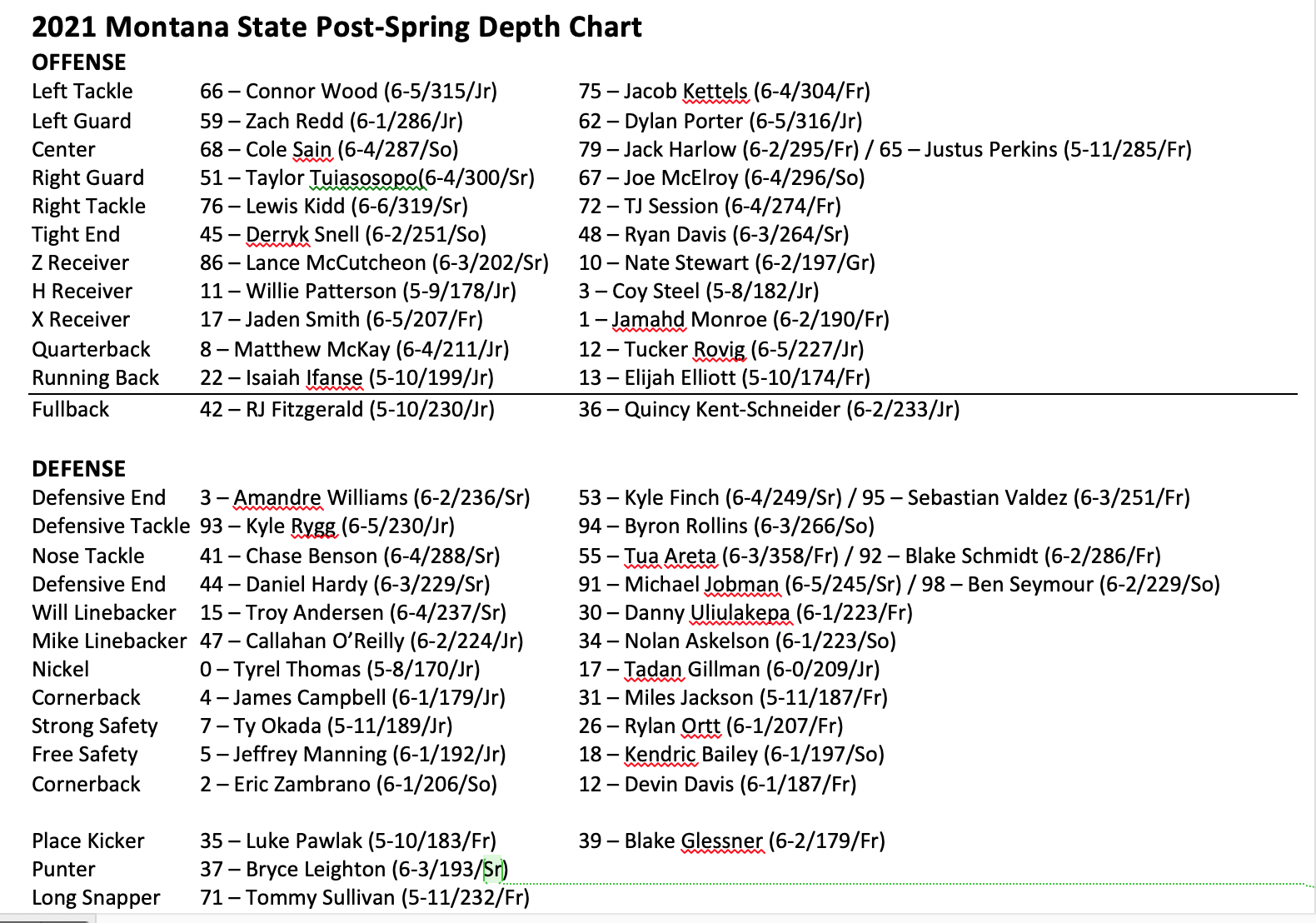
The two-deep includes a reshuffling of a talented offensive line, a defense featuring five defensive backs and a pecking order for the Bobcat quarterbacks, among other highlights and position shifts.
Returning starters like junior running back Isaiah Ifanse, senior defensive tackle Chase Benson, senior wide receiver Lance McCutcheon and junior middle linebacker Callahan O’Reilly occupy familiar spots.
Other returning All-Big Sky Conference talents like senior honors candidates Troy Andersen, Amandre Williams, Lewis Kidd, Taylor Tuisosopo, Ryan Davis and Daniel Hardy are starters once again but at new positions.
Returning all-league juniors like Connor Wood, Zach Redd and Ty Okada are also acclimating to newer roles.
And a variety of first-time starters won jobs while other returning contributors are no longer atop the depth chart.
Here’s a look at Montana State’s spring 2021 depth chart and analysis about the offensive portion.
[restrict paid=”true”]
Quarterbacks

When the pandemic first hit, basketball was in the midst of its postseason while many of the football teams around the Big Sky, including Montana State, had not yet started spring football.
With the cancellation/postponement of the fall of 2020 season, MSU also missed out on 29 fall camp practices in August, all the while its strength and conditioning periods dealing with interruptions too.
Matt McKay, a junior who transferred from North Carolina State in January of 2020, was the presumed first-string quarterback coming out of MSU’s abbreviated “spring ball in the fall,” as former MSU head coach Jeff Choate called it.
That 15-session stretch culminated with MSU’s “Fall Brawl”, an intra squad scrimmage in front of no fans on October 10. But what did it actually mean?
By January 22, Choate was on his way to reboot the Texas Longhorns. Many elements of the Bobcat football program, including the constantly volatile quarterback and offensive coordinator spots, are again influx.
Casey Bauman — a 6-foot-6, 235-pounder who fits the prototype Vigen has molded at his previous stops as OC at North Dakota State and Wyoming — made waves this spring, sometimes moving ahead of incumbent Tucker Rovig to take No. 2 reps behind McKay. But Bauman suffered a rib injury that kept him out of the Sonny Holland Spring Classic.
The initial depth chart lists the 6-foot-4, 211-pound McKay as the No. 1 quarterback. Rovig, a 6-foot-5, 227-pound junior from Boise, is listed as McKay’s backup. Rovig has started 14 games at MSU, including the last 12. He is 10-4 as the starter.
“Impressed; Matt made strides,” Vigen said. “Probably the thing that impressed me the most is his approach. He’s a guy that you transfer in from an FBS school, I think there’s a lot of times assumptions made. I don’t think Matt has made any assumptions.
“Last year, Year 1, a challenging year to go through. You get here Year 1, you are here for less than two months, you are gone for four months, then you are back, the fall was the fall, then a coaching change.
“I really appreciate his approach. I think he understands he’s made progress but he still needs to make a significant amount. His ability to make plays with both his arm and feet are in front of him. But there’s work ahead of him too.”
Offensive line

The Bobcat offensive line returns four starters — Tuiasosopo, Kidd, Redd and Wood — and all four are listed at different positions this spring than they were in the fall of 2019.
Tuiasosopo, a 6-foot-4, 300-pound fifth-year senior, is one of the best maulers of any interior offensive lineman in the Big Sky. Last season, his third as a starter, he earned third-team all-league honors while playing left guard. He started eight games in each 2017 and 2018 at right guard.
He’s back playing right guard in between sophomore center Cole Sain and new right tackle Kidd, an all-league (left) guard in 2019 who played on Redd’s right side.
The 6-foot-1, 295-pound Redd started 15 games in 2019, including the last 14 at center in between Kidd and Tuiasosopo.
Wood started nine games at right tackle as a redshirt freshman in 2018 and 11 more in 2019 before a late-season injury shut him down and thrust Jake Sessions into the starting lineup.
Now Redd is listed as the starter at left guard next to new left tackle Wood, a 6-foot-5, 302-pounder who like Redd prepped at Rocky Mountain High in Meridian outside of Boise.
“There was some shuffling around from what guys played before,” Vigen said. “(Redshirt freshman offensive tackle) T.J. Session is the one who hasn’t been on the game field (knee) but he showed early on he had a real ability.
“That hierarchy on the O-line is still an on-going deal. There’s still some work to be done on the O-line.”
Sain — a 6-foot-4, 287-pounder who spent time living in Hamilton as a child before prepping at national power St. John Bosco Prep in Southern California — played the 2018 season at Montana. He started two games for a depleted Griz offensive front that year.
Following the season, he transferred to Riverside Community College. Because he only played in two games at UM, he came to MSU last summer as a third-year sophomore with three seasons of eligibility.
During fall ball, Tuiasosopo took many of the reps at center while Kidd worked at both guard and tackle. Sain’s emergence influenced the re-shuffle as did Session getting banged up.
Session, a 6-foot-4, 282-pounder out of Vista Murrieta High in Menifee, California, is arguably MSU’s most talented young offensive lineman but he has struggled to find availability since arriving on campus in the summer of 2019.
The other offensive line No. 2s include: redshirt freshman Jacob Kettels at left tackle, junior Dylan Porter at left guard, redshirt freshman Jack Harlow and Justus Perkins at center, sophomore Joe McElroy at right guard and Session at right tackle.
Running backs

Ifanse, the 2017 Washington Gatorade Player of the Year at Bellevue High in suburban Seattle, burst onto the scene as a true freshman in 2018. In his third career game, he rushed for 146 yards, sparking the first 1,000-yard rushing season by a Bobcat rookie ever.
He battled injuries throughout 2019, yet still managed to rush for 813 yards and six touchdowns. He rushed for 114 yards in the first half of MSU’s 38-17 win over No. 19 Southeast Missouri State in the annual “Gold Rush” home opener. He missed the second half of that game plus the next three.
He returned for 10 carries against Cal Poly, then missed MSU’s 34-21 loss to Sacramento State on homecoming weekend. He only got five carries in a 16-12 loss at North Dakota that dropped the Bobcats to 2-2 in league play, 5-3 overall entering November.
Ifanse has been at his best late in the season, including 139 yards in MSU’s 35-14 win over Incarnate Word in the first round of the FCS playoffs in 2018, Choate’s first playoff victory. He exploded for 173 yards and three touchdowns in Montana State’s 48-14 beat down of the Grizzlies in Bozeman to cap the 2019 regular season.
Ifanse rushed for 196 yards and a 60-yard touchdown in MSU’s 24-10 win over Austin Peay in the quarterfinals to help the Bobcats to their playoff semifinal since the 1984 run to the Division I-AA national championship.
He enters his junior year with 1,838 career yards, already the 13th-most on MSU’s proud history.
Montana State must replace Logan Jones. Lane Sumner, a speedy sophomore from Huntley Project who’s already rushed for 100 yards in a single game back in 2019, looks primed to take that role.
DeMareus Hosey, a smooth 5-foot-11, 208-pound freshman from Houston, maintained his redshirt despite scoring a touchdown against SEMO and rushing for 76 yards against UND in 2019.
And Jaharie Martin looked like a significantly improved running back, from his agility to his vision to his explosiveness. The 5-foot-11, 232-pounder from Lakeland, Florida is one of MSU’s most impressive physical specimens.
He started his career as a linebacker before shifting to offense. Martin carried the ball 10 times for 38 yards in four games to preserve his redshirt following 2019.
Yet it’s true freshman Elijah Elliott who ends the spring as the No. 2 back on the depth chart. Elliott rushed for 77 yards and a touchdown in the Sonny Holland spring game. The 5-foot-10, 175-pounder out of Central Catholic in Oregon was also a standout during fall football, earning praises from Choate.
“There’s some positions where putting two players on is justified but running back is a spot where we would like to play four or five guys,” Vigen said. “Beyond the first two that were listed, Lane was right there. Lane will have a role for sure. He’s played effective football in the past and we expect him to in the future.
“We think DeMareus and Jaharie have flashed enough where you can say they are trending the right way where they are reaching a position where they deserve game reps. They need to keep coming. Flashing is one thing but ultimately locking themselves in.”
Wide receivers

Vigen did not go out of his way to mention wide receivers in this particular press conference but he was also not specifically asked about either the wide outs or the tight ends.
Still, this position remains one filled with mystery and intrigue. Choate and his staff had no problem recruiting talented pass catchers to Bozeman. But that iteration of the Bobcats had a hard time retaining young talent or finding opportunities for any pass catchers outside of Travis Jonsen and Kevin Kassis.
During MSU’s consecutive playoff seasons in 2018 and 2019, the Bobcats completed 163 and 225 passes in each season, respectively. Jonsen, who’s now with the Tampa Bay Buccaneers, caught 83 passes for 899 yards and six touchdowns. Kassis caught 122 balls for 1,534 yards and nine TDs during his final two seasons.
Those 205 catches accounted for 53 percent of MSU’s completed passes during the two most recent seasons. While the Bobcats were (literally) running their way to the playoffs, several previously praised 3-star prospects like Koby Duru and Mekhi Metcalf left the program.
The Bobcats enter 2021 with a solid contingent of in-state products who have been waiting their turn, led by Bozeman High product Lance McCutcheon. The 6-foot-3, 202-pound senior has been part of the receiver rotation since his rookie year in 2017, a campaign that saw him catch a pair of 60-yard bombs, including a 64-yarder for his first career touchdown among his three catches that season.
He’s caught 28 passes for 394 yards and three touchdowns since then, respectable numbers for a player caught in one of the most-run heavy offenses in the FCS that also had two of the best pure athletes at wide receiver of any team in the Big Sky. He is listed as the starter at Z wide receiver, ahead of graduate transfer Nate Stewart.
The hiring of Vigen will almost certainly put a jolt into the passing Bobcat passing game, simply because of his offensive background. And MSU has a variety of receivers waiting to break out.
Junior Peyton Hanser (Billings Central) along with sophomores Logan Kleinhans (Bozeman) and Mark Estes (Phillipsburg) make up the Montana contingent competing for playing time but none of the three are listed on the two deep.
Returning slot starter Coy Steel, a 5-foot-8, 173-pound junior from Wyoming, is listed as the backup at H receiver behind junior Willie Patterson, an explosive yet oft-injured 5-foot-9, 179-pound athlete from Tacoma.
Before he left to take a job with the Houston Texans, former MSU assistant DeNarius McGhee – himself a native of Euless, Texas who helped quarterback the Bobcats to three consecutive Big Sky Conference championships between 2010 and 2012 — McGhee helped lure Lone Star State stud wide receivers Jaden Smith and Charles Brown to Bozeman.
The cousins from the Dallas-Fort Worth area are the up-and-comers that might benefit most from the change in offensive philosophy. The 6-foot-6, athletic and smooth Smith caught a touchdown during a freshman season in which he still maintained his redshirt because he played in four or less games. He is listed as the starter at X ahead of Jamahd Monroe, a 6-foot-2, 190-pound redshirt freshman.
Brown, a 5-foot-11, 170-pounder that Choate said several times might be Montana State’s fastest player, graduated high school early and joined the Bobcats in January of 2020 yet has not played a game because of the Covid-19 delays. He also missed a big chunk of spring drills with a injury.
Choate also added Stewart, a 6-foot-2, 200-pound who showed good body control, strong hands and a knack for going to get the football during a standout spring showing. He is a graduate transfer from Akron.
Montana State’s wideout group also has a new coach in Justin Udy, a man who was hired as the offensive coordinator following former OC Matt Miller’s return to his alma mater, Boise State. Udy was the Bobcat OC for a year when no games were played. Then Vigen hired Taylor Housewright as OC and kept Uday as wide receiver coach and passing game coordinator.
Montana State has a collection of pieces — from talented players to young coaches, hungry coaches — to have a production jump at wide receiver. Who will rise to the occasion to seize the opportunity?
Tight ends

Choate joked upon his departure that one thing he wouldn’t miss was all the inquiries from the quarterback club and the Bobcat faithful about the lack of use of the tight ends on the passing game.
On one hand, Choate’s style catered toward a collection of tight ends getting playing time, and often at the same time. In 2017 and 2018, Curtis Amos, Connor Sullivan and Wilson Brott became a three-headed tight end mechanism that played with each other or rotated in for one another, giving an added element of diversity to the Bobcat run game.
Amos caught five passes for 49 yards in his career, Sullivan notched 22 grabs for 199 yards. Neither scored a touchdown. Brott, a converted tackle, did score – he caught a 12-yard toss in 2017, one of his two career catches.
In 2019, Derryk Snell had a solid redshirt freshman year. The former Alaska Gatorade Player of the Year caught nine balls for 84 yards and two touchdowns. Other than a pair of touchdown catches by defensive tackle Jason Scrempos, no other tight end caught passes in 2019 for MSU.
If spring practices were any indication, the tight ends will be more involved this season. Ryan Davis, a 6-foot-4, 265-pound senior from Billings, has been a contributor for four years but has not caught a pass despite starting 11 of 15 games in 2019. He caught a pass during the Sonny Holland Spring Classic.
Snell also caught a touchdown in the spring game, adding to a string that saw him catch TDs in each of the three live scrimmages. The 6-foot-2, 251-pound Snell is listed as the starter while Davis is listed as the No. 2. Treyton Pickering, an impressive physical specimen at 6-foot-4 and 245 pounds, is a former Class C stud out of Sunburst who’s early Bobcat career has been impacted by a serious knee injury suffered in high school.
The Bobcat offense will still have a fullback role, a position junior R.J. Fitzgerald fits perfectly. The 5-foot-10, 235-pounder is built for blasting holes on the interior and on the perimeter for the Bobcat offense. Quincy Kent-Schneider, a 6-foot-2, 233-pound junior, is listed as Fitzgerald’s backup.
The tight ends have Nate Potter, a former NFL offensive lineman, back as their position coach for a second season. Can the group get more involved in the offense in 2021?
[/restrict]

