


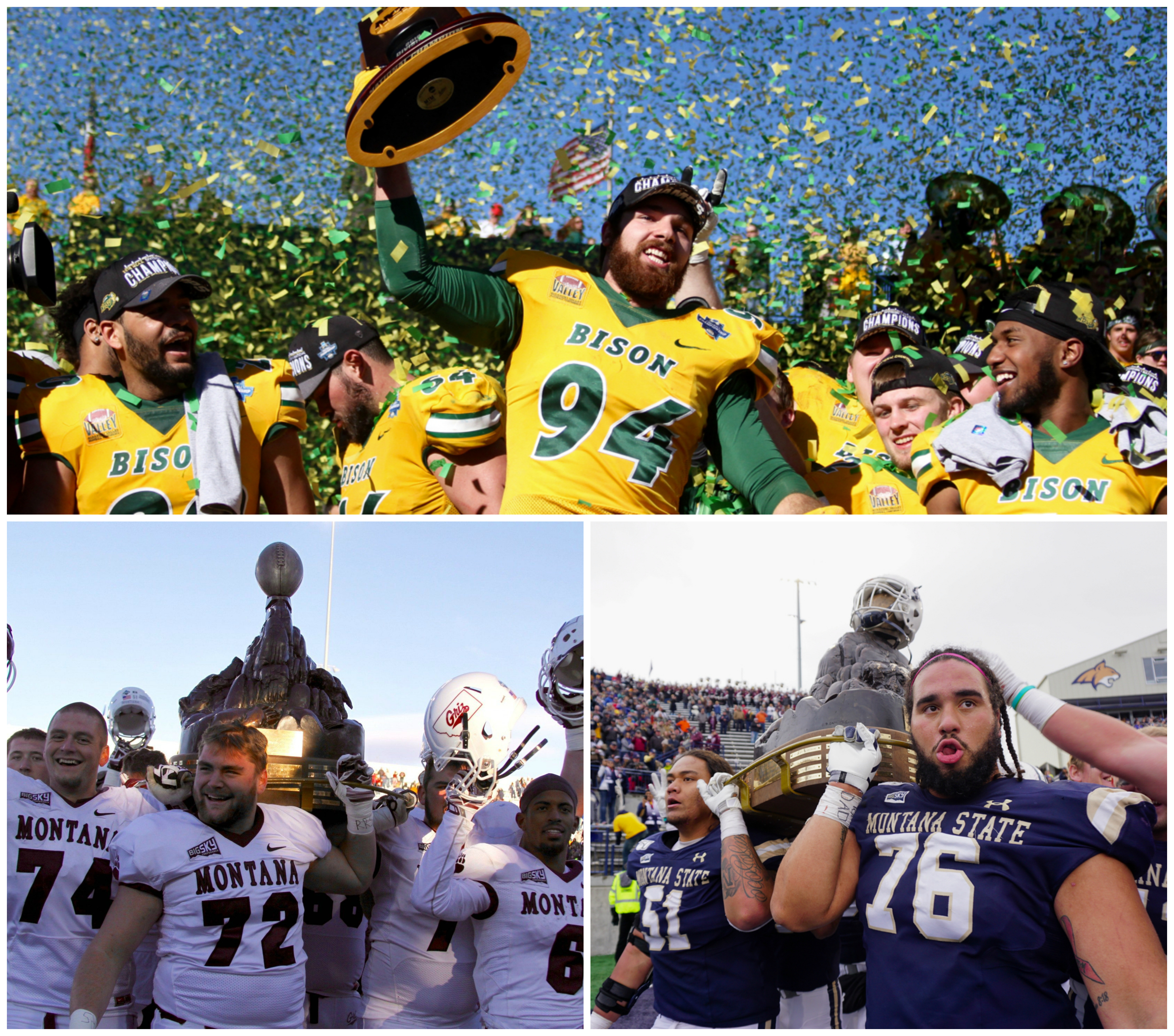
Even before his team’s much anticipated 2020 season was postponed, Bobby Hauck knew his Montana Grizzlies would already be making up for lost time.
And with North Dakota State electing to play a game in October, the Griz, their rival Montana State Bobcats and the rest of the challengers to the Bison’s throne will enter next year another proverbial step behind the greatest dynasty the FCS has ever seen.
[restrict paid=”true”]
Entering their third season under Hauck, the Grizzlies are primed to continue their return to the ranks of the nation’s best football programs. Between 2000 and 2009, Montana won 119 games. That total — UM won 80 games under Hauck and advanced to three national title games between 2003 and 2009 alone — was more than any football program in college football history.

That is, until North Dakota State’s current unprecedented run. In 2010, Craig Bohl led NDSU to nine wins and a final national ranking of No. 9. Little did the rest of the FCS know what was coming next.
During Bohl’s last three seasons as the head coach in Fargo, the Bison wen 43-2, earning three straight national titles. When Bohl left for Wyoming, North Dakota State did not miss a beat. The Bison won national titles in 2014 and 2015 to push the streak to five straight FCS championships.
NDSU lost in the semifinals of the 2016 playoffs. The Bison have lost one game since, ripping off an unmatched 37 wins in a row. North Dakota State went 15-0 in head coach Chris Klieman’s last season before he took the head coaching job at Kansas State.
In Matt Entz’s first season at the helm last fall, NDSU went 16-0, including a 28-20 win over James Madison to help sew up the program’s eighth national title in nine seasons.
Between 2010 and 2019, North Dakota State won an incomprehensible 137 games in 150 contests, including posting a 128-8 mark over the last nine seasons. NDSU went undefeated in 2013, 2018 and 2019.
All of that is to say that the Bison are in a league of their own. So the fact that NDSU scheduled a single non-conference game to be played on October 3 at the FargoDome against No. 11 Central Arkansas gives North Dakota State another sneaky advantage.
In mid-August, the NCAA approved that teams who had to postpone their seasons during the fall of 2020 in favor of playing next spring would be approved for 12 hours of countable team activities per week. This stipulation will allow teams from conferences like the Big Sky Conference, including Montana and Montana State, to have some football activities in September and October.
Because the Bison are hosting Central Arkansas — UCA is embarking on a nine-game schedule, more than any of the other 14 FCS schools planning to play at least one game this fall — NDSU will conduct what amounts to a month-long fall camp leading up to the October 3 showcase.
“When we start practice up next week we’re going back to the mode of fall camp and back to heavy installation,” Entz told the affiliated Fargo and FCS national media in a press conference on August 25. “We know we have a game October 3rd, but we have games hopefully happening in March and April too that we have to start preparing for.

“The great thing now that I told the team in a meeting yesterday, because of the NCAA’s decision on eligibility every single one of us in this room, meaning the players, are all going to be available for this game.”
While Hauck will not get to engage his team in a vigorous fall camp session like he has become famous (and infamous) for, UM will still try to maximize its time.
A season ago, Montana had a major breakthrough, winning 10 games and advancing to the quarterfinals of the FCS playoffs. An Elite Eight appearance is still a far cry from the stretch between 1995 and 2009 that saw Montana play for the national title seven times in 14 seasons. But nine regular-season wins, including the decimation of No. 3 Weber State two games before the playoffs, helped earn the Griz a first-round bye in the 24-team bracket for the first time since 2013. The 10 wins also marked the best total since Mick Delaney’s second season seven years ago.
By the second week of March, Montana had participated in half of its allotted 15 practices of spring football in before the NCAA effectively called off all spring sports and activities across all sports with the sudden concern that has consumed the nation stemming from the COVID-19 global pandemic.
Finally on August 7th, the Big Sky announced the 2020 season had officially been postponed, and Montana athletic director Kent Haslam also confirmed that UM would not play any of its non-conference games. Because of the cancellation of all fall sports in the Great Northwest Athletic Conference, Montana’s home opener against Division II Central Washington had already been cancelled.
Haslam confirmed UM would not travel to Missouri State on September 12 (the Bears are going to play a home-and-home against Central Arkansas) nor would the Griz host Morehead State on September 19.

The day the Big Sky made its announcement, the NCAA had not approved its 12-hour allotment. But Hauck anticipated his team would get some form of fall football. And he said sternly the Grizzlies would certainly take advantage of it.
“We will have some football in some form or fashion because we lost it in the spring,” Hauck said. “Football is not over. We need to be ready. We are going to continue our preparation for whatever our next game is.
“We are like the military. We believe that the reason we are better than the people we go against is because we train harder. We will train as a football team.”
On the other side of the Continental Divide, Montana State fifth-year head coach Jeff Choate said his Bobcats started “in-season training mode” on July 24, trying to maximize the 20 hours a week of in-person meetings, walk throughs and also including the eight hours a week of strength and conditioning allowed under NCAA rules.
But Choate said in the weeks leading up to the opening of fall camp the first Friday of August, the model “started to get stale.”
“There is only so many times you can run through the same drill, so many times you can walk through the same concept when you can’t go all the way full contact,” Choate said.
On August 7, the day the Big Sky made its announcement, the Bobcats started practicing at 8:30 a.m. The announcement came at 10 a.m.
“That’s the stuff that created frustration,” Choate said less than a week after the league’s postponement. “Here we are, literally, on a day that has been circled on the calendar for nine months and they are going, “Ok, we are finally going to cancel and push to the spring.

“Our deal was that hey, we didn’t get spring ball, but let’s get something done. And that’s what we will continue to do.”
Montana State had its non-conference home opener against Long Island University and its money game at Utah (MSU was slated to earn $650,000 for playing one of the top teams in the Pac 12) cancelled before the announcement. MSU explored keeping its September 19 date against Dixie State on the schedule before the newest FCS independent elected to postpone all fall sports.
Even then, Montana State still explored playing a few games this fall. One source close to the MSU athletic department confirmed that the Bobcats and fellow FS South Dakota State explored playing a non-conference contest this fall. Choate also said the idea of playing regional Mountain West schools like Utah State, Colorado State, Boise State and Wyoming was floated.
The Mountain West eventually postponed its season, those options went away as well. Like Hauck and the Grizzlies, Choate and his Bobcats will have to make due with what is certainly an anomalous situation there is no blue print for.
“Our players are very used to hanging out in the locker room together, study table, position meetings, weight room, the rhythm of their lives is to be around each other,” Choate said. “That’s one of the things we are paying attention to – keeping them mentally engaged.
“That tells you the mind set and hopefully, that’s the biggest problem we continue to have, although unfortunately I expect it won’t be. That connection, that connectivity is what’s important to them right now.”
The Bobcats came in at No. 6 in the preseason STATS Perform FCS Top 25 poll of the season. Montana came in at No. 7. The Griz were picked to finish second in the preseason Big Sky Conference polls by the league’s coaches and media; Weber State second, and the Bobcats were picked third.
Last season, UM and MSU each received playoff seeds in the same playoff field for the first time since 2011. Despite Montana State’s 48-14 destruction of Montana in Bozeman last season — the Bobcats have now won four straight rivalry games for the first time since a six-game rivalry win streak from 1972 until 1977 — the upcoming season, whenever it might commence, is filled with more simultaneous national expectations for the old, fierce rivals than at any time in the modern era of the FCS.

Choate and Hauck have certainly developed a heated yet professional and respectful rivalry. Not since Mike Kramer headed up the Bobcats from 2000 until 2005 and Hauck was in his first stint as the head coach for the Griz have their been two fiery, aggressive personalities leading UM and MSU.
Although Hauck and Choate have distinctly different styles in many ways, Hauck’s comments about the well being of his players echoed Choate’s.
“We have to support our guys and the challenge to this is mentally,” Hauck said. “I know not being here for some number of months in the spring was not good for them. For their physical well being, it wasn’t good to not be able to train. Isolation is not good for these guys mentally, either.
“It doesn’t help us in any way to not be able to play. This doesn’t help our university or the state of Montana or the community of Missoula for us to not be playing.”
Although a return to the normalcy we once enjoyed seems like a distant aspiration, that’s one thing even the Bobcats and the Grizzlies can agree on.
[/restrict]
Photos by Brooks Nuanez. All Rights Reserved.


