



Editor’s Note: This biography was originally written for the Montana Pro Football Hall of Fame Class of 2026. For more information on the HOF, visit https://www.mtfootballhof.com/

Despite all his accolades and successes, Brock Coyle spent much of his football career feeling like he still had something to prove.
Coming from a Bozeman High School program where winning was difficult to a juggernaut on one of its most historic runs when he jumped the Great Divide to attend the University of Montana, Coyle wanted to prove that he coveted and valued winning above anything else.
Despite having an epic run to end his stellar senior season for the Griz, Coyle felt like he still had something to prove when he did not earn first-team All-Big Sky Conference honors.
When he entered the NFL as an undrafted free agent, Coyle’s desire to prove himself continued to drive his football journey.
So when Coyle broke out during his first season in San Francisco after three years as a backup in Seattle, then signed a long-term contract with the 49ers to take over as a starting inside linebacker for one of the NFL’s most storied franchises, he finally felt like he had set out what he had intended to do when he first started playing football years earlier.
“Up until when I signed the long-term deal with the 49ers, I had always been fighting to prove myself,” Coyle said. “From high school in Bozeman, not winning very many games, to college, starting and then standing out as a senior and not getting those post-season awards to then not getting drafted and still working, making the teams and playing well, that was the final stamp,” Coyle said. “That was the stamp that I was a legitimate, great football player. And the NFL recognized that.”
“That was the stamp that I was a legitimate, great football player. And the NFL recognized that.”
Brock Coyle
When his pro football career was abruptly cut short by a devastating back injury, Coyle was able to walk away from the game he loves without any regrets.
Having your football life cut short is not easy for anyone no matter when the hourglass runs out of sand. But Coyle has settled into retirement nicely, living back in his hometown of Bozeman and enjoying being a father, a husband and an outdoorsman.
And although he might’ve felt like he had plenty to prove for most of his football saga, he certainly finds contentment knowing he maximized his abilities and had an opportunity to prove he belonged as a front-line player in one of the most competitive pro sports leagues in the world.
From a two-way talent at Bozeman High to the heart and soul of one of the most decorated Griz linebacker corps in UM program history, from playing in the Super Bowl as a rookie for the Seattle Seahawks to starting for one of the premier franchises in the NFL, Brock Coyle has continued to prove himself. And it’s what makes him one of this year’s headlining inductees into the Montana Pro Football Hall of Fame.
“Brock’s personality and his character plus his football knowledge, his smarts within the game are so good and that’s what made him so good,” said Johnny Holland, the linebackers coach for the 49ers since 2017. “I knew from watching him in Seattle that he could come to San Francisco and make plays.
“His knowledge of the game plus the fact that he’s very instinctive as a player is why we wanted him to be one of our starters.”
Coyle always felt fearless on the football field. He’s almost sure that fearless nature was actually honed on the ski hills in and around Bozeman.
He, his older brother, Chris and his younger sister, Alexa, were all on the Big Sky ski team from a young age. That helped Brock learn the importance of balance, speed, power, and the initiative to not take your foot off the gas.
“It helped me in the game of football because it’s such a high-pressure sport where you only have one chance to put everything together one time,” Coyle said. “From a mental standpoint, that really helps me in the game of football for sure … I think it built my mental strength up.”
When Coyle was a rookie for the Seattle Seahawks trying to make the active roster as an undrafted free agent ahead of the 2015 season, the Everett Herald wrote a story about how, 10 years prior to that, one of the best young ski racers in Montana told his ski coach that his future wasn’t on the slopes.
“He was a real talented skier, one of the top kids in Montana, but Brock has always had that passion for football,” said Jeremy Henrichon, who coached Coyle for several years at Big Sky, told the Herald in August of 2014.
“Even from the time he was 10 years old when I first met him, we were sitting there talking on the chairlift and he looked up and said, ‘I know I’m going to quit ski racing and be a football player, and I’m going to play in the NFL.’ He always had that mentality, he always had the drive and knew that he was going to do something special.”
Coyle was born in Bethesda, Maryland, but his family moved to Bozeman when he was a 1-year-old, so he’s always considered himself a Bozeman native. He went to Longfellow Elementary School, Sacajawea Middle School and Bozeman High, a common path for many kids from his age group growing up in the early 2000s.
Ski racing was Coyle’s first sport. He started when he was 5 and didn’t strap on a pair of shoulder pads until he was in fifth grade. His first Lions Club youth football team was the Patriots and the head coach was none other than Shane Collins, a 2021 inductee of the Montana Pro Football Hall of Fame. Collins is widely considered one of the great athletes to ever come out of Bozeman High or the state of Montana.
“I loved it right away,” Coyle said. “I could feel I had those instincts of playing football right away. One of my first-ever plays and memories was a sack-strip-fumble recovery touchdown and I thought, ‘I could get used to this.’”

Early success gave way to team struggles when Coyle was in high school. It’s easy to forget that Bozeman High used to suffer from a lack of success given that the Hawks have been a powerhouse since 2010.
Bozeman has played in seven state championship games and won five titles in the last 15 seasons. But before Tanner Roderick led the Hawks to that 2010 state title, Bozeman hadn’t won a championship since 1917 and had only played in four state title games (1961, 1976, 1995, 1997) in nearly 100 years.
Coyle’s high school years were defined by individual successes — Coyle was a team captain as a junior and a senior, an all-conference pick as a junior and a first-team all-state selection as a senior — and team struggles. The stud linebacker and fullback experienced just three wins as a senior.
“We had some good players, too, we just couldn’t put it together,” Coyle said. “I didn’t get used to winning until my first year of college.”
Coyle remembers rushing for more than 200 yards as a junior against Billings Skyview. He remembers his recruiting picking up heading into his senior year and being thrilled about the prospects of his football career continuing.
Cody Davies was the quarterback for Bozeman High and one of Coyle’s best high school friends. Davies is the son of Dan Davies, a former Bobcat football player and coach who went on to a Hall of Fame career as an administrator and associate athletic director at Montana State.
Despite those direct ties into the program, Coyle was not heavily recruited by the hometown Bobcats.
“I’ll never forget when Rob Ash brought me into his office and offered me a half scholarship,” Coyle said. “They had some great Montana recruits like Brad Daly (Helena), Chris Wilson (Great Falls), Jase Muri (Billings West) that had already committed. But I left that meeting not knowing what to think.
“I texted Mick Delaney, who had been recruiting me, that the Cats had offered me. And Bobby Hauck called me, offered me a full ride. They had just lost to Richmond in the (2008) national championship. And the Cats were in the middle of the league.
“It was a slam dunk.”
One of the other lures was that Hauck told Coyle he would be in the mix for playing time as a true freshman. That proved to be true as Coyle was a key special teams contributor and a rotating linebacker as a college rookie.
Coyle racked up 30 tackles and two interceptions on a team that won 14 straight games and advanced all the way to the 2009 FCS national title game. Coyle was a part of a Griz squad that had one of the most unforgettable playoff runs in school history, rallying for a 61-48 win over South Dakota State in the first round (Marc Mariani anyone?) and emerging with an iconic 24-17 win over Appalachian State in the semifinals to earn a repeat trip to Chattanooga, Tennessee.
“That was really my first taste of winning and I couldn’t get enough,” Coyle said. “The way Hauck ran the program, it was good for my mentality. Just go to work. Doesn’t matter if you’re nervous or intimidated, we have to get it done.
“The thing that separated me throughout my football career was my work ethic and that first really started accelerating when I got to Montana. Experience is your greatest teacher and that year gave me experience right away.”
Coyle’s freshman season was a breakout but his second season provided the first of a collection of speed bumps that would define the next several years. He ended up using his redshirt year in 2010 after needing surgery for a shoulder ailment as the Griz navigated life without Hauck, who left for UNLV during the off-season after UM’s 21-19 loss to Villanova in the 2009 FCS title game.
Coyle struggled mentally with his first major injury —“You’re just not a part of the team when you’re injured and you’re that age,” he said. He was on the sideline when Montana lost to Montana State in Missoula to give the Bobcats the Big Sky Conference championship and keep the Griz out of the playoffs for the first time since 1992.
During the 2011 season, Coyle was part of Montana’s second tier of linebackers behind a talented, veteran front line that included 2011 Big Sky Defensive Player of the Year Caleb McSurdy along with all-conference talents like John Paul Kanongata’a and Alex Shaw. Coyle still managed to notch 31 tackles, 4.5 tackles for loss, 1.5 sacks and his third career interception.
In 2012, Coyle felt like he was in a blast from the past. Individually, he had his breakout season, rolling up 107 tackles, 6.5 tackles for loss, two sacks and a forced fumble on the way to All-Big Sky honors. But Montana suffered its first losing season in 30 years, finishing 5-6 while starting quarterback Jordan Johnson stood trial for a crime he was eventually acquitted of.
That controversy had also resulted in a coaching change the off-season prior. Despite leading Montana to 11 wins and a semifinal appearance in 2011, head coach Robin Pflugrad was dismissed amid a cloud of controversy that also included the abrupt firing of beloved athletic director Jim O’Day.
“It was crazy, crazy times,” Coyle said. “I remember sitting in class next to Jordan Tripp and I remember getting texts that O’Day and Pflugrad had just gotten fired. We were like, ‘What?!’ When you’re that young, it’s your whole life.
“With that all gone, we were like ‘what’s going to happen?’ I remember the leaders getting together and putting together a statement that we were still committed to winning and to the future of Griz football.
“Then before that 2012 year, I would skip class — and I don’t skip class (laughs) — to go watch the Jordan Johnson trial because it was so captivating, so intense and so surreal. You have your friend and teammate fighting for his life. I mean, we had Dateline NBC at our practice. It was crazy.
“We had been in the national championship game as freshmen and in the semis two years later and we won five games that junior year. I remember losing to the Cats at home and after that game and I gave a fiery speech pretty much apologizing to the seniors but also reminding people that we had to remember this. It was on us to bring Griz football back.”
Coyle’s senior year ended in heartbreak, however. But the leadup to a second-round home playoff defeat to upstart Coastal Carolina certainly helped Griz football right the ship.
The 2013 Griz had a roster littered with talent. Coyle, Tripp, defensive linemen Zach Wagenmann, Tyrone Holmes and Caleb Kidder along with wide receiver Jamaal Jones all earned opportunities in the NFL. Tripp and Holmes were drafted.
Alex Bienemann was also a standout defensive tackle, as was Tonga Takai.
“I would put that up with one of the best front sevens in school history,” Coyle said.
Coyle’s signature moment as a Griz came when he returned to his hometown for a rivalry game with plenty hanging in the balance. For the Griz, a win in Bozeman would propel Montana to a Top 8 playoff seed. For the Cats, a win would mean a fourth straight playoff appearance. A loss would mean one of the most decorated senior classes in school history would finish outside of the post-season picture.
On a crystal clear yet freezing Bozeman afternoon, Coyle played out of his mind. He set the tone early and often, looking very much like McSurdy had during the 2011 rivalry game when the Griz came to Bobcat Stadium and spanked the No. 1-ranked team in the country.
During that 2013 rivalry game, Coyle had no fewer than eight bone-crushing hits among his 12 solo tackles. He made three tackles behind the line of scrimmage. And he forced two fumbles, including making sure-handed MSU senior running back Cody Kirk fumble during a pivotal moment in UM’s 28-14 victory.
“If I was to go back through all the games in my career, especially in college, that’s probably the best game I’ve played in my life,” Coyle said. “Everything from driving over from Livingston that day, I was in the very front of the bus, focused. I knew I would have a chip on my shoulder, eyes would be on me and I was ready to dominate.
“That was one of those games where I was completely in flow state, reading and reacting with an intensity that we would not lose.”
The Griz were headed back to the playoffs while Kirk, Daly and star quarterback DeNarius McGhee would see their careers end without a playoff berth.
“Just huge for us and for the program,” Coyle said. “Those Bobcat guys were great players. That was one of the best moments of my football career.”
It might seem like Coyle was peaking, but the motivations kept coming. First, despite finishing with 125 tackles, 13.5 tackles for loss and five forced fumbles (all team-bests), Coyle was voted second-team All-Big Sky while Tripp and Kanongata’a landed on the first team.
“That was one of the most deflating moments in my career, because it was a goal of mine as a freshman to be a first team all-conference player, to be the Big Sky defensive MVP, because in the Hall of Griz Hall of Fame, if you are a first team all-conference player, your picture goes up there, and that was my goal,” Coyle said. “I remember writing it down, maybe my junior year and to not get that, and almost feel like you were robbed, that hurt.
“Knowing that goal was not accomplished, I would never be a first-team all-conference player, that was tough.”
Then, despite receiving a bye and hosting a team from Myrtle Beach, South Carolina in the coldest game in Washington-Grizzly Stadium history, Coyle’s Griz career ended in abrupt heartbreak.
With Montana trailing 42-28 midway through the fourth quarter to Coastal Carolina, Coyle sacked CCU quarterback Alex Ross, forcing a fumble that Coyle recovered. Three plays later, Johnson threw an interception.
The Griz would cut the lead to a touchdown when Johnson hit Jones for an 88-yard score with five minutes to play. But the Chanticleers salted away the rest of the clock, the Griz couldn’t get off the field and a season filled with renewed optimism came to a crashing halt.
“The finality of all that was tough, but it also fueled me when I turned the page to go to the NFL,” Coyle said.
As he entered the NFL Draft preparation process, Coyle knew he would have a shot based on size (6-foot-1, 235 pounds), production and the lineage of pros that had come out of Montana during the modern era. But he knew he needed to get faster.
Coyle temporarily moved to Florida to train with Tom Shaw, one of the gurus in the country when it comes to speed and NFL combine training. The first day he reported to Shaw’s facility, he remembers seeing future NFL Defensive Player of the Year Khalil Mack walking out of the facility with his shirt off.
“That was the day I knew what an NFL guy looked like,” Coyle said with a laugh.
Mack ended up being Coyle’s lifting partner before becoming a Top 5 pick in the following year’s draft.
The lack of opportunity continued for Coyle, however. He hoped to get invited to the NFL Combine. Tripp did, he didn’t.
Still, Coyle set the stage for himself to perhaps get drafted when he showed out on Montana’s pro day. At 6-foot-1 1/2 , 235 pounds, he ran 4.60 seconds in the 40-yard dash, soared 37 inches in the vertical leap, jumped 9-foot-7 in the broad jump and pumped out 25 reps at 225 pounds on the bench.
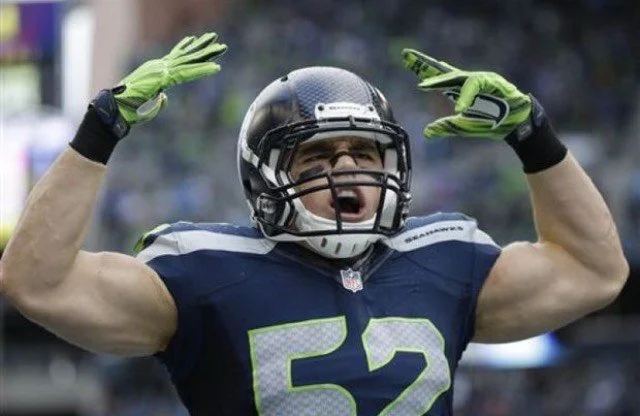
Yet the NFL Draft came and went without Coyle getting a call. Granted, his phone blew up after the draft ended and he fielded more than a dozen opportunities to sign with NFL teams as an undrafted free agent. But being slighted reset his motivation once again.
“My numbers were there with the rest of the country, and I thought I was going to get drafted, and that was a huge goal for me ever since I was a kid,” Coyle said. “I had always dreamed of seeing my name go across the bottom of the TV. But I ended up not getting drafted. And that was really tough for me to take because it felt like another goal I couldn’t check off.
“So here we are again, just like when I was coming out of high school, just like when I was coming back from injury, just like when we were coming off a losing season with the Griz, just like when I didn’t get first-team all-conference, just like when we lost in our first playoff game, I felt like I still had to prove myself.”
The Seahawks were the reigning Super Bowl champions, which might seem like an easy hook for a rookie. But Seattle also had one of the deepest rosters and one of the most stacked linebacker corps in football. Still, Coyle chose the Seahawks over opportunities with nearly half of the NFL.
Going into Coyle’s rookie year, his first training camp saw All-Pro Bobby Wagner pull his hamstring the second week back. All of a sudden, Coyle was running with the first-team Seahawks “Legion of Boom” Super Bowl championship-winning defense.
“I’m sitting there looking at all those future Hall of Fame players as a rookie, undrafted guy,” Coyle remembered with a laugh. “I remember Michael Bennett not being able to get the call and yelling at me in his high pitched voice.”
In Coyle’s first preseason game, Seattle took on Denver in a Super Bowl rematch. The Seahawks had drubbed Peyton Manning and the Broncos 43-8 the previous January to win the franchise’s first world title.
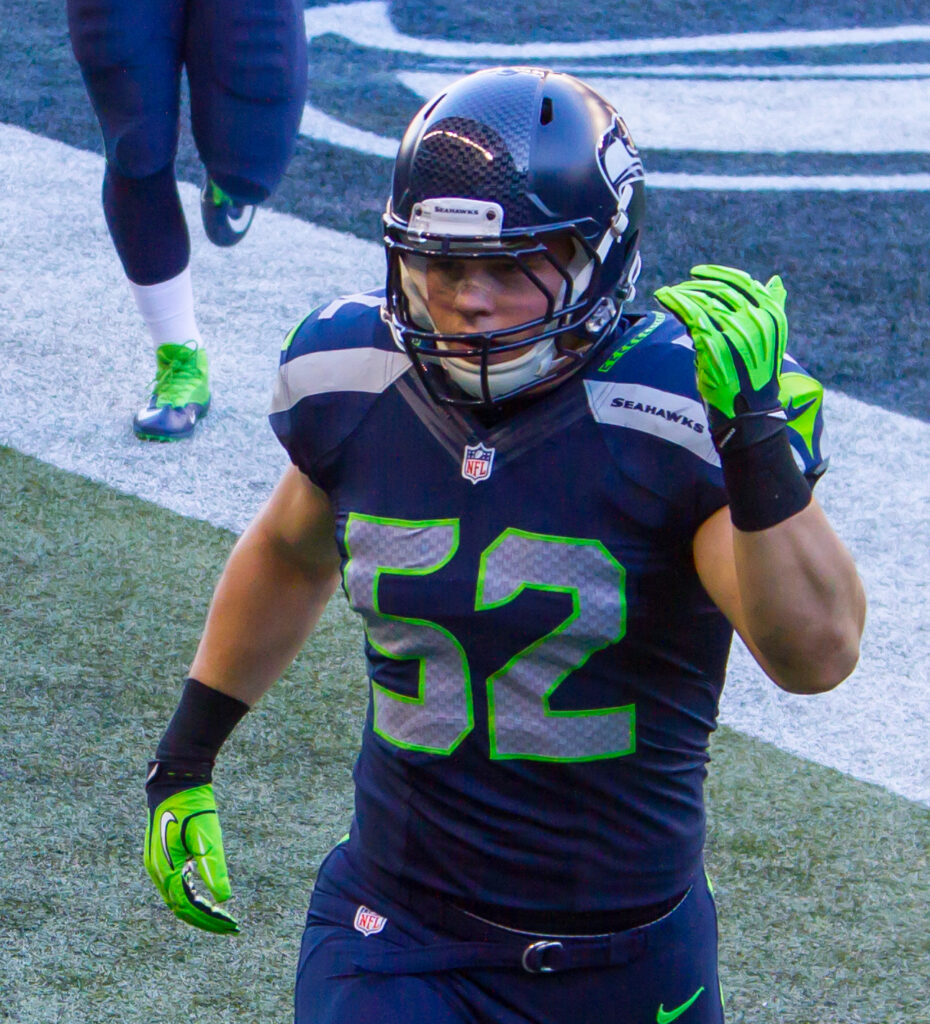
“My first ever game in the NFL, Peyton Manning walks up to the line and he points right at me, and in his Southern twang, yells “45 is the Mike, 45 is the Mike,” said Coyle, who wore No. 56 for the Griz and switched to No. 52 in the NFL before the regular season but wore 45 during the preseason. “I remember being like, ‘Holy Cow. I’m here. That’s Peyton Manning.’ But also, it was like, ‘lock in. Here we go!”
Coyle started for the first three preseason games and played well enough throughout that training camp to earn a spot on the 53-man roster entering the 2014 season.
“He’s done a fantastic job,” Seahawks head coach Pete Carroll said during that training camp. “Here he is, first camp as a rookie and he’s running the first defense out here. Everybody really likes him. He’s doing a good job on special teams, he’s very bright, it’s not too big for him to handle the calls and all of that. We won’t really know until we get to playing and see how he’s running and hitting and making his plays and all, but he’s done a great job. Really to command this defense like he has, he’s done a very, very good job.”
Coyle also fit in with his teammates instantly. He didn’t expect to find a strong culture in Seattle like he’d experienced at UM, but that’s what Carroll was known for during his time leading the ‘Hawks.
“First day of camp, he walked right up to me and said, ‘Hey, I’ve been watching you and admiring your play for awhile, I’m honored to be your teammate, it’s nice to meet you,” said former Seahawks Pro Bowl linebacker K.J. Wright, one of Coyle’s best friends. “He had a big smile like he always does.
“I knew about him because I followed the undrafted rookies and he stood out right away. Dude is smart as a freakin’ whip, tough as hell and the effort is all out.
“The value of Brock is that this dude can play Mike, he can play Sam, he can play special teams. He fit really good in the room right away.”
“Dude is smart as a freakin’ whip, tough as hell and the effort is all out.”
Former Seahawks Pro Bowl linebacker K.J. Wright
Wagner returned before the regular-season, but Coyle found a key role on special teams. He also started twice that year and five times overall in his three years in Seattle.
“He showed his value right away,” said Wright, who played 11 NFL seasons including 10 in Seattle and now is the assistant linebackers coach for the 49ers. “He was someone we could depend on, someone you could trust. He played our style of football with the way he tackled and the way he ran to the ball. From Day 1, you could tell he wasn’t going anywhere.”
The Seahawks stumbled to a 3-3 start in 2015 before catching fire. Seattle won nine out of 10 down the stretch to win the NFC West and take the top seed into the playoffs.
In the NFC Championship game, Coyle was on the field for one of the wildest and most unforgettable endings in NFL history. Green Bay jolted out to a 16-0 halftime lead. Seattle got on the board when punter Jon Ryan ran in a fake field goal attempt. But the Packers held a 19-7 lead with five minutes left in the game.
The Seahawks stormed back, turning a defensive stop into a quick touchdown. Then with Coyle on the field, the Seahawks attempted and recovered an onside kick.
“He was disappointed when he wasn’t drafted, and now look at him,“ former Montana defensive coordinator and linebackers’ coach Ty Gregorak said in 2015. “You see undrafted rookie free agent in there on the onside kick; you can’t write this kind of stuff. It couldn’t have happened to a better guy.”
Seattle took that possession, scored a touchdown and pounded in a two-point conversion to take a 22-19 lead. Aaron Rodgers helped the Packers drive the length of the field to set up a game-tying Mason Crosby field goal that forced overtime.
Seattle won the OT. Facing a third down, Russell Wilson hit Doug Baldwin for a 35-yard gain. On the next play, Wilson hit Jermaine Kearse for another 35-yarder, this one for a walk-off touchdown that sent the Seahawks faithful into pandemonium.
“I was the Special Teams Player of the Game that game, had a couple of tackles, was on the field for the onside kick and then us winning, it literally felt like we won the Super Bowl,” Coyle said. “We had this incredible comeback, this incredible win, celebrating with our fans. Then we lost the Super Bowl the way we did (28-24 sealed another Patriots title) was tough, but we all will never forget that NFC championship game.”
In the Super Bowl, Coyle suffered “a bad high ankle sprain” but still managed to notch two tackles.
Coyle continued to be a valuable contributor for the Seahawks, making 33 total tackles and notching his first career sack on Monday Night Football against the Buffalo Bills in 2016. Seattle made the playoffs both seasons but lost in the divisional round.
Coyle loved the culture of Carroll’s locker room and life in Seattle. Entering his fourth season, he knew he had one last thing to prove. He wanted to sign a veteran contract and get a real chance to start for an NFL franchise.
“I’d gotten a chance to start and play in big games,” Coyle said. “I’d played in the Super Bowl. I’d made plays in big games and in the playoffs. I had started when called up. That really prepared me for the rest of my career.
“In Seattle, I was behind just studs. K.J. Wright and Bobby Wagner and Bruce Irvin, those guys were some of the best guys in the league. Seahawks had played me all over, middle, strongside, weakside, but I knew I had a chance to go to another team to start some games. I knew what I wanted to do.”
Entering the 2017 season, San Francisco hired former Atlanta Falcons offensive coordinator Kyle Shanahan as their head coach. Shanahan tasked Robert Saleh as his defensive coordinator. Saleh had been in Seattle as a quality control assistant on Carroll’s staff and was familiar with Coyle.
The 49ers signed 31 free agents that off-season, including Coyle, who was brought in to compete for a starting gig at inside linebacker.
“Brock was at my house when he was going back and forth with John Lynch and the 49ers and I’ll tell you, I shed a few tears. But also, I knew he had to go and embrace the opportunity,” Wright said. “That was really my first time having a close friend leave but I was so happy for him. It was fun to see a team value him.”
The 49ers struggled early, losing their first nine games. But then Shanahan inserted Jimmy Garoppolo as the starter and San Francisco won six of their last seven down the stretch.
Coyle started the final 10 games of the season. He accumulated 68 tackles, 38 solo tackles, three tackles for loss and a forced fumble.
“That’s when I felt like I was playing my best football ever,” Coyle said. “I was starting at middle linebacker, in the NFL, I’m calling the plays on defense. I remember having a huge game against Tennessee and having a big day against Derrick Henry, Hall of Famer. I remember beating the Jacksonville Jaguars and they ended up going to the AFC championship game.”
Holland remembers Coyle for his sharp ability to pick things up quickly.
“You give him something once in practice, what a team would do, he would remember it and he would make the play,” Holland said. “He’s a very good student of the game and you could tell him one time, he would get it.”
Following his first year in San Fran, Coyle signed a three-year contract worth up to $8.4 million, including a $2.1 million signing bonus.
“I felt like finally, I had not only proven myself but that the football world also recognized it, too.”
Unfortunately for Coyle, that affirmation quickly turned into tough circumstances. The very first game of the 2018 season, Coyle rolled up eight tackles against the Minnesota Vikings. But in the second half, he suffered a compression fracture in his back and a severe concussion.
“It was a scary injury and that is also when a lot of the initial research about CTE was coming out,” Coyle said. “I knew I would be on injured reserve all of that season. But it was like, ‘damn. We aren’t invincible here. And this all has long term effects.”
The physicians in Minnesota told Coyle that he was ok. But when he got back to San Francisco, the doctors at the Stanford Medical Hospital diagnosed him with the compression fracture.
“They said it was an injury they only ever saw in car accidents. I started thinking, ‘Wow, I got in a car accident on a football field.”
Coyle decided to walk away from the game he loved.
“I knew I had a serious injury. It took me months and months to fully recover from the concussion. And that scared me,” he said. “Let alone the back injury. Thank God I was with the Niners and they had Stanford Medical, so I could recover. But when multiple of the best doctors in the world tell me they recommend I stop playing football, that was the writing on the wall.”
An abrupt ending like that can be enough to haunt any fierce competitor, especially when it all comes to a screeching halt at the age of 28.
“He’s a high-character guy and you can identify the guys in your room that are going to have success after football,” Holland said. “Brock was that type. You knew he was going to be OK. Football was a great game for him and he made the most of it but I don’t feel like football was his entire life. I knew Brock would be successful after football.”
Coyle, who will turn 36 in October, is at peace with the finality to his football life.
“I think for me, to be able to have the conclusion of my career in the way that it happened, where I got to finally start games, play linebacker in the NFL, and then to have an organization in the NFL give me a contract that represent, my ability of playing football as a top 10 linebacker, it made me feel settled,” Coyle said. “I don’t miss the game of football. I miss my teammates, I miss the locker room, because there’s just nothing like it in the world. Going to work every day with your best friends and team, and two great organizations. I mean that’s what I miss.”
Coyle lives in Bozeman with his wife, Kelly and their three children: Krue, age 6, Grace age 2, and Cora, who celebrates a first birthday this month.
“You see him now with his wife and his beautiful family, he has his dream house in Montana, he has his nice weight room and he’s still hunting… my biggest thing with my guys is ‘how is your mental?’ And you see Brock, and how happy he is, that’s all you can ask for for a friend,” Wright said.
Coyle has a few entrepreneurial pursuits, but is mostly concentrated on being a “professional dad”. That, and enjoying not having to prove himself any longer.
“I think I really am at peace, because one, health. I got hurt but I walked away healthy enough,” Coyle said. “I only played five years, but really, in that five years, I accomplished a lot personally, and I was on great teams. I set a goal to sign a long-term contract and be paid as one of the best players in your position. I did that. So I have no regrets, and I feel blessed for that.”
LISTEN & WATCH
WATCH: Brock Coyle at the Montana Pro Football Hall of Fame’s 10th anniversary induction ceremony.
LISTEN: Coyle reflects on his journey from Missoula to the Super Bowl on the ESPN Roundtable in February 2026.
MORE: Colter Nuanez reflects on the 2026 induction ceremony and Coyle’s speech (listen), and Coyle joins Nuanez Now live from Bozeman on Cat-Griz eve in 2022 (listen).
