


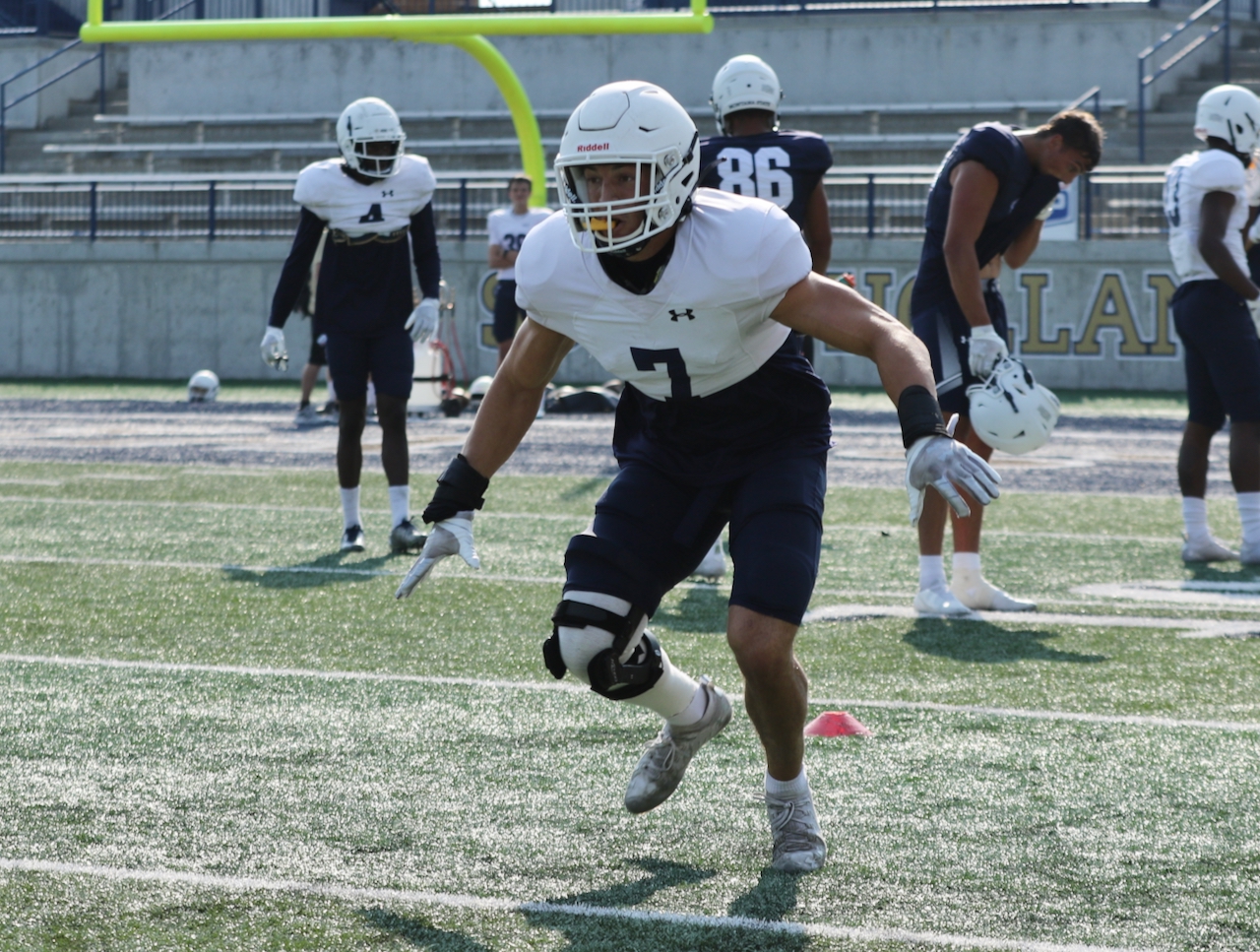
BOZEMAN, Montana — The number of times Ty Okada has had his number change has been about equal to the number of times he’s spent each off-season learning the nuances of a new position in Montana State’s secondary.
As a redshirt freshman in 2018, Okada first started building a reputation within the program, earning MSU’s “Young Gun” award during his redshirt year in 2017 while wearing No. 11. Then he started getting time on the field the following season while covering kicks and wearing No. 19.
Then the Woodbury, Minnesota product burst into the collective conscience of Bobcat followers while sporting No. 3. Okada’s stellar performance in MSU’s 35-14 victory over No. 24 Incarnate Word in the first round of the FCS playoffs proved pivotal as former head coach Jeff Choate earned his first post-season victory and the Bobcats won in the post-season for the first time since 2012.
That afternoon, Okada proved he could play nickelback against a Southland Conference team with a penchant for throwing the ball.
In 2019, Okada fought off an injury that cost him the first half of his sophomore season to play a big role in Montana State’s secondary as the Bobcats favored a three-safety look during a stretch run that saw them race to the semifinals for the first time in 35 years.

Although Montana State’s roster featured three talented seniors — Brayden Konkol, Jahque Alleyne, JoJo Henderson — Okada found his way on to the field for the final seven weeks of the season, wearing his No. 14 jersey. Okada rotated in as MSU’s third safety, started the final month of the season next to Konkol and Alleyne and established himself as a legitimate cog in the Montana State program.
As he enters his junior season, the former walk-on who’s in his fifth fall on campus is back in single digits — the 5-foot-11, 185-pounder will wear No. 7 this year — and he’s expected to have Elevated Expectations for the No. 9 Bobcats.
[restrict paid=”true”]

“This is about my eighth number change and I’m not exaggerating that,” Okada said with a laugh while participating in a live interview on Nuanez Now. “This is the first one by choice. Playing on all the special teams, it made it different to keep a number because injuries happen, people are switching out of different special teams units so I was always the younger guy who was like, ‘Hey, I will switch my number, it doesn’t bother me.
“Finally, coming into a year where I’m an older guy, I want to keep this number. I’m thankful for it. Hopefully, I’ll get to keep No. 7 and this will be what I graduate in (laughs).”
Jersey numbers aside, Okada will be relied on heavily, regardless of if he plays either safety spot or nickel or as a rover-like third safety next to FBS transfers Tre Webb (San Jose State) and Jeffrey Manning Jr. (Oregon State). He is now one of just 25 players on the MSU roster who played multiple seasons under Choate. Because of that, he’s expected to have an elevated leadership role as well.
“First off, he’s very intelligent and he leads by example,” first-year Montana State head coach Brent Vigen said. “He’s a hard worker who does well in the classroom. He understands how to communicate and he comes across as a consistent guy who understands and is purposeful. He’s intelligent, he means well and he is not afraid to speak his mind while still instilling a little fear in the offense.”

Okada’s versatility is not often defined by gaudy statistics. And to be frank, there wasn’t a lot of statistics to gather for MSU’s safeties back in 2019. The Montana State front seven so thoroughly dominated the line of scrimmage and opposing backfields, even Konkol only notched 65 tackles during a first-team All-Big Sky senior season.
Troy Andersen, Bryce Sterk, Derek Marks and Amandre Williams combined for 62 tackles for loss and 26.5 sacks as MSU gave up 60 or less rushing yards in each of its six consecutive wins in November and December of 2019. The Bobcats ended 2019 with an astounding 108 tackles for loss.
Okada finished that season with 16 tackles and two tackles for loss. He also recovered a fumble.
In July, MSU added Webb, a 6-foot-1, 195-pound thumper who was an all-league pick in the Mountain West in 2020 for a resurgent San Jose State team. That addition plus the addition of Manning in 2020 and the continued development of redshirt freshman Rylan Ortt gives Montana State position flexibility with Okada once again.
“I don’t know if Tre’s skill set diversifies the defense but I think that Ty’s skill set does diversify our skill set so when you add a veteran talent with a lot of experience, Tre has been a really productive box safety at San Jose and Ty has the ability to play strong, free and nickel,” Vigen said. “So bringing Tre in is the key to diversifying Ty and allowing us to lock a couple other guys into a couple other positions.”
Montana State opens its season in a week. Okada is listed as the starter at both strong safety and nickel with senior corner/nickel Tyrel Thomas along with Manning expected to miss Montana State’s opener at Wyoming with injuries.
Webb (safety) along with Ortt or sophomore Level Price Jr. are expected to start in the secondary with Okada plus cornerbacks junior James Campbell and sophomore Eric Zambrano.
“It’s the group where it’s the least experienced but it’s the most talented,” Vigen said. “I think we have some guys who can play.”

Since Vigen took over in February, Montana State has been tasked with revamping its defensive scheme under young, upstart coordinator Freddie Banks. That means a move from a base 3-4 defense to a 4-2-5 look that has been in favor at North Dakota State and Wyoming, Vigen’s last two stops, over the last decade. Banks played defensive back at NDSU and is now also Montana State’s secondary coach.
Okada said the defense “requires a lot more discipline with your eyes”, adding that you have to “play off the guys around you”. But he was quick to add that “defense is defense and you’ve gotta run to the ball fast, tackle and make plays.”
He thinks the new practice style implemented by Vigen’s staff has Okada and the secondary ready to roll come September 4 at War Memorial Stadium.

“One thing I’ve really loved is the change in practice,” Okada said. “We are running plays, two-spotting balls, just running plays like 80 times per practice,” Okada said. “The best way to learn something is to do it over and over again. I think that’s the best way to master your skill as a position player, a unit, as a defense and as a team. Getting those reps in have not only helped me see things but visualizing the playing field.”
Back in 2016, Okada was a high school quarterback looking for an opportunity to play college football, although he knew it wouldn’t be as a signal caller. Eastridge High School’s primary rival is Woodbury in the same Minneapolis-St. Paul suburb in Minnesota. Okada went to church with Woodbury High’s head football coach, Andy Hill.
Hill had connections to Montana State, particularly to former MSU defensive coordinator Ty Gregorak, who was the primary MN recruiter for the ‘Cats and Kyle Risinger, the only defensive coach who spent all four seasons on Choate’s staff before being retained to continue working with the secondary alongside Banks.
So that’s how Okada went from an out of state walk-on from the Midwest to an expected and expectant leader for the Bobcat secondary. Okada says he’s ready to take on the challenge.
“I would never take that for granted,” Okada said. “I remember how I felt coming in as a younger guy and I had great older guys ahead of me, Konkol, JoJo, Que. I had Bryson McCabe when I initially came in who was a phenomenal leader and I just try to model my leadership from those guys and take bits and pieces from what they did well and hopefully be a guide to one of these younger guys in football and in life.”


