


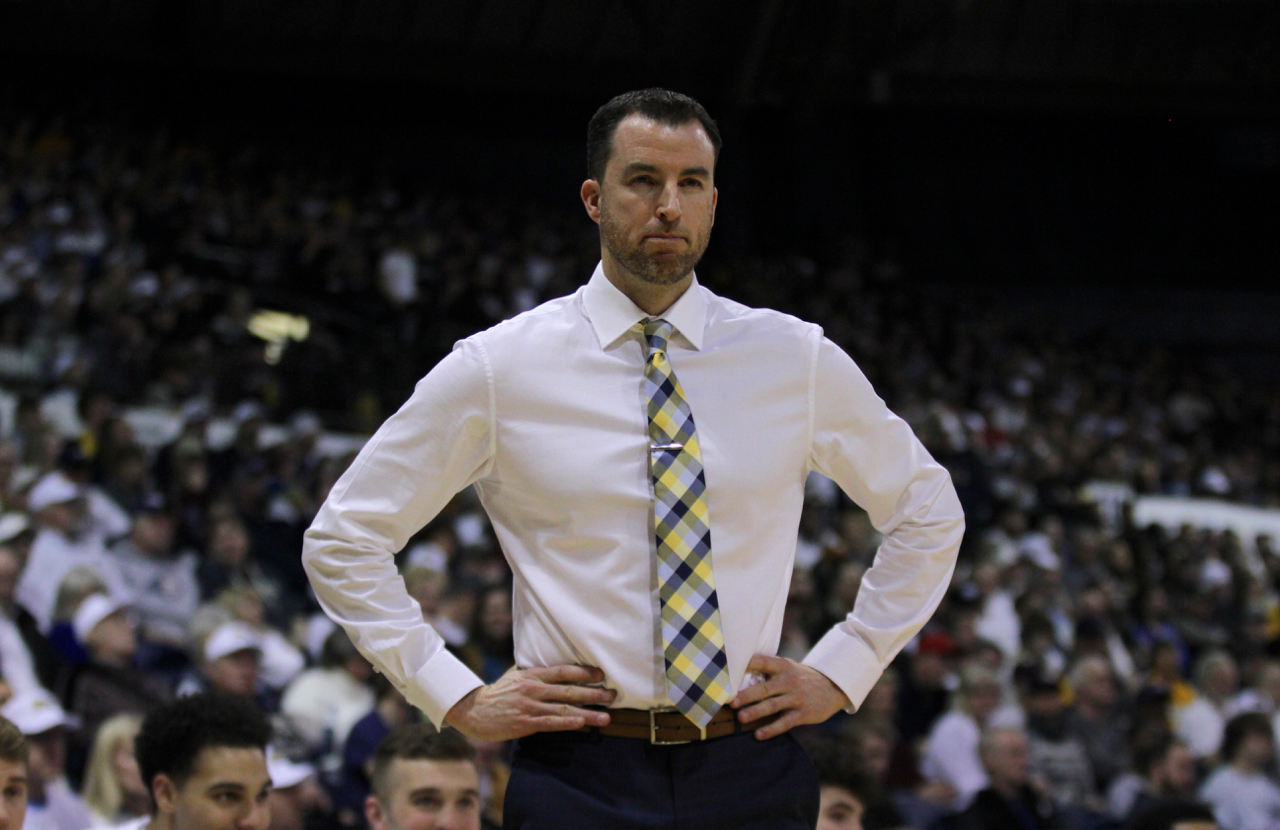
Since his days as a player at Montana State, Danny Sprinkle has been well aware and in fact a part of MSU’s reputation for always having slick guards who can score no matter the overall performance of the Bobcat men’s basketball teams.
As a true freshman in 1996, Sprinkle shot the Bobcats into the NCAA Tournament. The Helena High native earned Big Sky Tournament MVP and propelled Montana State in to the Big Dance for the third time in school history. MSU has not returned in nearly 25 years later.
In his first season as the head coach at his alma mater, Sprinkle went to work revamping the identity of the current Bobcats. He did not however take the approach of Mick Durham, MSU’s head coach for 16 seasons, Sprinkle’s head coach for the duration of his career and the Big Sky’s all-time leader in conference wins at the time of his resignation in 2006.
Durham’s teams played a fair amount of defense but when they were at their best, Sprinkle, Scott Hatler, Nico Harrison, Quadre Lollis and Nate Holmstad were running, gunning and lighting up scoreboards across the Big Sky.
Sprinkle did not want his team to identify with the same philosophies as Brad Huse’s squads. Huse, a former Montana Tech standout who first earned a reputation at the Division I level as an assistant at Montana, was an ace at recruiting athletic junior college players but few of them ever meshed together enough to make MSU a serious conference contender.
[restrict paid=”true”]

For all five years of Brian Fish’s tenure at Montana State, the Bobcats produced one of the most productive backcourts in the league, whether it was the combination of Mike Dison and Marcus Colbert, Colbert and Tyler Hall or Hall and Harald Frey. All five guards finished with All-Big Sky accolades and rankings among the top 10 to 15 scorers in the league. Hall finished his career as the Big Sky’s all-time leading scorer thanks to making a league-record 431 3-pointers.
Yet MSU never finished higher than tied for fourth in the league standings. Fish was dismissed with a career mark of 65-92, including 41-51 in league play following last season’s fourth-place finish.
Sprinkle, a sweet-shooting guard who earned a reputation as one of the fan favorites of the modern era of Bobcat basketball, spent most of the last 20 years as an assistant. After wrapping up his playing career as the 7th-leading scorer in MSU history, he took an assistant coaching job on Bobby Braswell’s staff at Cal State-Northridge, where he stayed from 2000 until 2006. He returned to be a part of Huse staff at MSU from 2006 until 2008 before reuniting with Braswell at Northridge in 2008.
Sprinkle spent 2013 until last season on Dedrique Taylor’s staff at Cal State-Fullerton before taking over at MSU. Over the last 20 years, he learned different coaching philosophies, schematic ideas and how to take challenges head on.
Once Sprinkle hired the staff of retained assistant Chris Haslam along with Dan Russell and Shawn Dirden, the group went to work analyzing the strikingly consistent yet underwhelming last 18 years of Bobcat basketball.
Durham led the Bobcats to their last regular-season Big Sky title and their last 20-win season in 2002. He went 54-58 the following four seasons combined, never finishing with a win percentage above .500, before resigning.
Huse went 107-133 overall and 64-72 in league play. He never went better than 10-6 in league play and never worse than 7-9. MSU finished a game above .500 one time, a 15-14 mark in 2009-2010 that included that 10-6 Big Sky mark.

Under Fish, MSU finished with a .500 record just once: a 16-16 mark in 2016-17. The Bobcats won 11 league games (out of 18 in 2017, out of 20 in 2019).
Sprinkle analyzed that consistent yet average compilation of records and compared it against the teams winning the Big Sky. Since 2002, Weber State has won the regular-season title six times and advanced to the NCAA Tournament four times.
Montana has won five regular-season championships since 2002, advancing to seven NCAA Tournaments since then. Eastern Washington has two regular-season and two tournament titles over the last 18 years, as does Portland State. Northern Colorado won the league and the league tournament in 2011 and North Dakota did int in 2017. NAU has one regular-season league title but lost to Montana in the 2006 Big Sky Tournament.
Sprinkle’s staff recognized that you either needed a transcendent player like Portland State guard Jeremiah Dominguez or Northern Colorado guard Devon Beitzel or Eastern Washington’s Tyler Harvey or North Dakota’s Quinton Hooker. Or you need one of the top defenses in the league, which is the formula Weber State and Montana have used to own the Big Sky during the 21st century.
“Montana State has had a lot of talent the last six, seven years,” Sprinkle said in an interview. “You have two high-major guards who could play at the highest level. We just knew the defensive side was missing.
“And I knew it was a toughness factor. It was a want-to. Anyone can go jack up shots. You have to commit and want it to actually compete for championships.”
Sprinkle took over a Montana State team that spent the last five seasons making as many jump shots, nailing as many 3-pointers as anybody in the league. Led by Hall’s silky shooting, MSU entertained fans, particularly those that love offensive basketball, with scoring prowess and an up-tempo style.
But Montana State could never truly break into the upper tier of the league because of an inconsistent defensive identity and the lack of ability to get stops never allowed the Bobcats to peak.
In Fish’s first season in 2014-15, Dison averaged 14.3 points per game and Colbert averaged 13.1, both Top 20 marks in the league. But Fish’s rebuild attempt had not gotten traction yet. The Bobcats finished last in the league in scoring margin thanks to allowing teams to shoot 47.2 percent from the floor, including 41.5 percent from 3-point range. The ‘Cats finished 7-23.
In Year 2, Fish added Tyler Hall, who first earned Big Sky Freshman of the Year honors by averaging 20 points per game in league play before going on to become the all-time leading scorer and 3-point shot maker in Big Sky Conference history. A team led by Hall and Colbert, who averaged a shade shy of 17 points per game during his senior year, helped MSU double its league and overall win totals.

That season, MSU made 9.6 3-pointers per game but gave up nearly 78 points per game in league play. Opponents shot 47 percent from the floor.
In Fish’s third season, MSU added Harald Frey, who followed Hall’s footsteps in earning league Freshman of the Year honors. Hall had his best year, averaging nearly 24 points per game and breaking the league record for 3-pointers made in a single season. But the ‘Cats gave up 79 points per game, allowing teams to shoot 47.6 percent.
During Hall’s junior year, the Bobcats took a serious dip for a variety of reasons, including the injury and extra attention Hall received and the acclimation of the league to Frey. MSU finished 13-19 and ranked second-to-last in the conference in scoring defense, allowing just seven less points than Portland State by allowing 81.6 points per league contest. MSU ranked 11th in the league by allowing opponents to shoot 48.5 percent.
And last season, the Bobcats made 9.6 3-pointers per game, giving up 9.9 triples per outing. Opponents shot 48.3 percent from the floor and 37.5 percent from beyond the arc, scoring nearly 80 points per game.
That overlay between Montana winning five of the last 10 Big Sky Tournaments on the foundation of the most suffocating defense in the league and MSU’s coinciding defensive struggles convinced Sprinkle and his staff they had one primary objective to turn MSU around.
“I looked up the last 10 or 12 years, the top four teams in the league, it’s the best field goal percent defense teams and the best rebounding teams,” Sprinkle said. “I knew for us to take the next step, we had to improve defensively. The guys bought in. They want to win. And when you have factual data to back it up, they are like, ‘Ok’.”
During Sprinkle’s first year at the helm, despite a roster featuring 10 players in their first season playing Division I basketball, the Bobcats finished with their first winning record in a decade.

MSU tied for its most wins since 2002 with 16 and found a way to scrap out 10 league victories despite only one All-Big Sky player: Frey. The Bobcats gave up 70 points or less in all 16 wins. MSU went 0-11 in games giving up 71 or more and also dropped four games in which neither team broke 68 points.
“As soon as the coaching staff came in, their priority was defense,” MSU senior guard Ladan Ricketts said. “As players, after we finished last season, we came together last season and we knew we really had to change it on the defensive end. That was the No. 1 priority for us.
“We had to lock in our defensive principles and all around be tougher on the defensive end than last year.”
During Big Sky play, Montana State ranked third in the league by allowing 66.9 points per game. MSU allowed Big Sky opponents to shoot 41.9 percent from the floor, trailing only Southern Utah in field goal percentage defense. The Bobcats ranked fourth in field goal percentage offense, a stat that took a hit the second half of Big Sky play.
Entering MSU’s first of two February matchups against rival Montana, the Bobcats ranked in the top 10 nationally in 3-point field goal percentage allowed. That was before Montana drilled 12 3-pointers in a 78-64 win, causing Sprinkle to mutter “we were ranked there nationally but not after tonight,” following the first Cat-Griz loss of his career.
Despite that lapse in Missoula, MSU’s defensive improvements left impressions with opposing Big Sky coaches, including Montana sixth-year head coach Travis DeCuire.
“I think the biggest thing is defensively, they are toward the top of the standings in defensive statistics and they haven’t been there in a long time,” DeCuire said leading up to the Cat-Griz game in Bozeman three weeks after the first showdown. “Defense wins.”

MSU won four of its first five games, including a 67-66 win over UNC Greensboro thanks to a half court heave at the final buzzer by Frey that found the bottom of the basket. Montana State endured just one three-game losing streak this season, the stretch to end February where MSU lost at Portland State two nights before losing to Montana at home, then laid the egg at Sac.
The Bobcats also never won three straight again either. But Montana State always bounced back, protecting its home court respectively, earning a winning record and accelerating the progress of the program despite so many new faces, including the head coach.
“All year, he’s done an incredible job in all respects,” Frey said the final week of the regular season. “He has challenged us. We talk about how the great teams have accountability. The players take ownership of the program and how the team is performing. The Xs and Os is one thing but we want to win games.
“We had to bring it from the non-skilled standpoint. In my mind, I don’t necessarily think…we are not Gonzaga. We can’t come in and play teams at 50 percent of our capability. We cannot relax. We have to bring the effort ever time. We have to be the toughest team and the hardest working team if we want to have a chance against the top teams in the league.”
The other area Sprinkle helped Montana State turn the corner in is the ability to rebound from disappointing losses. Montana State lost its first home game against a Division I opponent, coming out on the wrong side of a 98-72 beat down at the hands of Green Bay.
Montana State rallied with a 77-70 win over South Dakota State, one of if not the best victory the Bobcats posted this season.
MSU bounced back from a frustrating 74-72 loss to Cal State Bakersfield to wrap up non-conference play by sweeping Sacramento State (66-51) and Northern Arizona (63-61) the opening weekend of conference play.

MSU lost at the buzzer to Portland State and the next time out against Eastern Washington, two of MSU’s five home losses in 14 contests at Brick Breeden Fieldhouse. MSU bounced back by winning at Weber State for the first time in 10 seasons and following it up with a win at Idaho State.
Following the loss at Montana, the Griz destroyed Idaho 72-50. Following an 87-77 loss at Portland State and a 59-54 home loss to Montana and an 81-52 loss at Sac State — the third representing MSU’s worst league loss of the season — MSU rallied again to beat Northern Arizona and Southern Utah, two victories that helped the Bobcats earn a first-round bye in the Big Sky Tournament for the first time since the league moved to a neutral site in March of 2016.
“After the Sac State game, I didn’t say much. I sat down and said, ‘Guys, you tell me what happened,” Sprinkle said. “I made them tell me what we needed to do better so this never happens again. What did you do or didn’t do that attributed to us getting our butts whooped? It was good because some guys spoke up and got them out of their comfort zone.
“In Flagstaff, I didn’t write anything on the board. There was no scout details or anything. It was just about being tougher than them and throwing the ball to the person in the same color jersey you have on. Just everyone wearing a blue jersey, ok, that’s who you throw the ball to. Not the team in the white jersey and we will be fine. We will be in the game if we do that. And we did.”
MSU posted a 63-57 win over NAU in Flag against a team that had defeated the first-place Griz less than 48 hours prior.
Player empowerment: it’s a strategy Sprinkle has employed all season. Because of the elite leadership skills of Frey and a roster that collectively bought into Sprinkle’s fun-loving, loose style, Montana State overachieved as much as any team in the league.
“One thing I always tell my players is I am going to tell them the truth,” Sprinkle said. “They are not going to like it sometimes but you are never going to be able to tell me that I didn’t tell you the truth. As long as you tell them the truth and then show them why or how they can get better, kids will respond. They are different than they were when we grew up but they aren’t. They still want discipline and they want to be told what’s right, what’s wrong.”
MSU graduates Frey and Ricketts. Since the abrupt cancellation of the Big Sky Tournament before Montana State could even play a game, the roster has four open spots and three scholarships available. Scholarship players sophomores Zeke Quinlan and Quentin Guliford along with freshman Zach Hobbs all mutually parted ways with the program. Walk-on Brett Finn also left the team.

Sprinkle signed Jacksonville (Texas) College freshman Nick Gazelas, a 6-foot-4 junior college guard who averaged 17 points per game last season. Sprinkle is currently looking to fill his other two available scholarships despite the uncertainty in the world stemming from the COVID-19 pandemic.
Next year’s Bobcats will build around junior-to-be Jubrile Belo. The 6-foot-9 post from the United Kingdom was MSU’s second-leading scorer behind Frey. MSU also returns explosive swingman Amin Adamu, himself a native of the United Kingdom. And Devin Kirby, the 6-foot-11 stretch center who is the lone player to play for Fish, will be a senior.
MSU will also welcome Xavier Bishop, a speedy point guard who transferred from Missouri-Kansas City before last season, to the rotation.
Frey will be tough to replace. But Sprinkle proved this season he has the acumen and the positive leadership ability to help his team continue building a new identity.
“Overall, I think it was a successful first year,” Sprinkle said. “As it got going, I think our guys got a little more confidence. You could see it. They believed in Harald and Ladan. We kind of got rolling.
“And the one thing I was really proud of was having 10 guys who had never played Division I, having those guys play consistently and never really hit a wall, especially guys like Borja Fernandez (a freshman) to never hit a wall, that’s impressive. Jubrile, same thing, Amin, same thing. They just kept getting better and better.
“Overall, it was successful. It’s obviously not where we want to get to but we have to take those steps in order to get to where you want to get to. You have to take some butt kickings like we did at Eastern Washington and at Sacramento State. You have to go through those times to get to where you want to get to as a program. Now we have.”
[/restrict]
Photos by Brooks Nuanez. All Rights Reserved.

