


AnalysisBig Sky ConferenceFeaturedFootball

Unbalanced scheduling continues to be controversial among Big Sky coaches

PARK CITY, Utah — Earnest Collins Jr. is entering his sixth season as the head coach of the Northern Colorado Bears. His team’s trip to San Luis Obispo, California for their season finale on November 19 this fall will be the first of his coaching tenure at his alma mater.

Cal Poly joined the Big Sky Conference in Collins’ second year at the helm at UNC in 2012. The next season, Northern Colorado played the Mustangs in the first Big Sky meeting between the two teams. Cal Poly and UNC have not played since.

[restrict paid=”true”] “That sucks,” Collins said. “I haven’t played Montana State since 2013 and we don’t play them again this year. I hope that at some time, we get it to where its only two years between playing teams. You do want to face all the teams in your conference just to measure yourself, to see who you are.”

Former SUU linebacker Matt Holley celebrates an interception in 2015/by Brooks Nuanez

In a conference flush with most of the Football Championship Subdivision participants west of the Mississippi, scheduling has become an issue of primary importance for the Big Sky and its head football coaches. And it only stands to get more complicated with Idaho joining the league in 2018 as a football member. The Vandals rejoined the Big Sky in all other sports in 2014.

The 13-team league plays an eight-game schedule, meaning every season’s draw is like a lottery. It’s certain four teams will not appear on any given schedule. When Idaho joins, the league could split into two seven-team divisions or add another league game but nothing is set in stone. Avoiding tough trips to places like Missoula, Bozeman or Flagstaff may seem like an advantage on paper each summer but it’s impossible to predict who will be the top teams in the league each season.

“You really don’t know how good your schedule is until the season is going,” said Southern Utah first-year head coach DeMario Warren, an assistant at SUU the last eight seasons and the Thunderbirds’ defensive coordinator during last season’s Big Sky title run. “You play Idaho State coming off of 2013 and you feel like you have a pretty good chance (ISU was 3-9 in 2013), then they whip you (beat SUU 56-28 in 2014) and finish 8-4. You play Southern Utah after 2014 and think you have a 3-9 team on your schedule and boom, we win the conference.”

“I think some years, it’s fair and some years, it isn’t but that’s the nature of the beast,” added Northern Arizona 19th-year head coach Jerome Souers. “But you have no way of knowing how each team is going to be. If you had a crystal ball, you could make sure who needs to play whom to determine a true champion. But it’s the nature of having this size of a conference.”

The opinions of the unbalanced scheduling are all over the map when it comes to the league’s head coaches. Eastern Washington head coach Beau Baldwin said he “didn’t mind” not playing Southern Utah last season. But the Thunderbirds’ first Big Sky title in school history will always be remembered as one that didn’t include wins over EWU or Montana, the league’s two most successful teams over the last two decades.

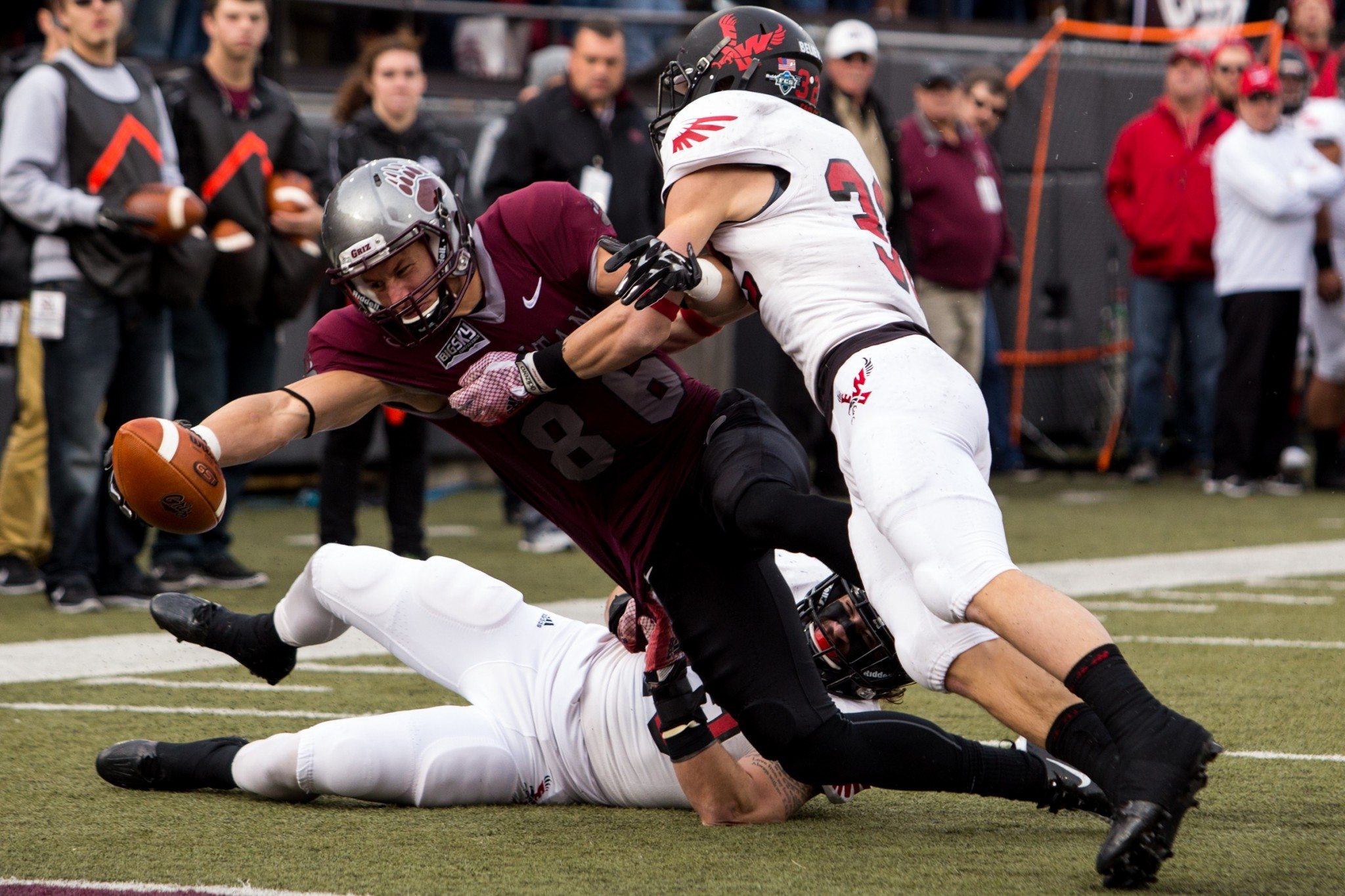
EWU quarterback Jordan West beats MSU linebacker Grant Collins in the open field in 2015/by Brooks Nuanez

“It’s disappointing when you are not able to play a team but I will take that disappointment with being a strong 13-team league over having nine teams like we had before,” said Baldwin, EWU’s ninth-year head coach. “The strength of this conference top to bottom and being able to get to a few more places in recruiting that you didn’t get to before, those are benefits. But the downside is you might not play a team like Southern Utah but sometimes that’s a positive too.”

Coaches like Montana’s Bob Stitt, Weber State’s Jay Hill and Idaho State’s Mike Kramer are all opposed to the unbalanced scheduling.

“I’m not a huge fan of not playing everybody,” said Stitt, who’s team is always guaranteed games with the rival Bobcats and Eastern Washington but didn’t get a shot at the champion Thunderbirds last season. “You’d like to have a true champion. You don’t want to win a championship and not have played everybody and have somebody say, ‘Well, if we would’ve played you, we would have beat you.’”

In 2014, Kramer’s Bengals put together one of the better seasons in the modern era at ISU. Idaho State went 8-4, just missing the FCS playoffs. The only teams ISU beat in Big Sky Conference play that finished with winning records were Sacramento State and Cal Poly, each who went 7-5. ISU did not play Montana, a playoff team, or Northern Arizona, a team that finished just outside the playoff picture.

Even though the unbalanced scheduling likely aided Kramer and the Bengals two seasons ago, one of the Godfathers of the Big Sky is vehemently opposed to the current situation.

“I hate it. It means I can’t talk about the league,” said ISU’s sixth-year head coach, a head coach in the Big Sky for most of the last 24 seasons. “I haven’t seen U.C. Davis since Ronald Reagan was governor. I’m not in favor of it. I hate it.”

WSU running back Eric Wilkes in 2015/by Weber State Athletics
Weber State running back Eric Wilkes in 2015 vs Northern Colorado/by Weber State Athletics

Before the Big Sky expanded from nine teams to 13 teams in 2012, Weber State’s primary rivals were Idaho State and Montana. The addition of Southern Utah gives the Wildcats an in-state opponent worth getting up for. But the tradition of the bitter rivalry with the Grizzlies, one that dates back to the inaugural Big Sky season in 1963, runs deep.

Last fall, Hill took his team into Washington-Grizzly Stadium and walked out with their first win since before any of his players were born. Weber State’s 21-14 overtime victory was Weber State’s first in Missoula since 1987. But Stitt won’t get a chance for revenge and Hill won’t get a chance to welcome the Griz to Ogden this season.

“There should be ways around that,” Hill said. “I get that we want to create rivalries but quite frankly, throughout a conference, the whole conference should be a rivalry. Six years without playing a team once? You might as well not be in the same conference. Us not playing Montana every year? How are we cultivating rivalries if we don’t play Montana?

“I just want regularity in what we are doing. It doesn’t matter if we play every team twice in a three-year span, I just want some consistency in it. I want to know that every three years, they are going to come to us once and we are going to go there once.”

North Dakota is the team with the perceived “easy” schedule coming into the 2016 football season. The Fighting Hawks return a slew of key players from last year’s 7-4 squad. UND plays at Montana State, but the Bobcats are coming off a 5-6 campaign and have a new head coach for the first time in a decade. UND’s schedule includes seven straight games against teams picked to finish no higher than sixth in the preseason Big Sky polls. North Dakota wraps up its season by hosting NAU, the preseason favorite in each poll.

Portland State quarterback Alex Kuresa in 2015 vs Montana State/by Troy Wayrynen

“All that stuff is not for me to make a decision on,” UND third-year head coach Bubba Schweigert said. “I know this league is really good so it’s just my job to take it week by week and get my guys ready to play.”

Dodging trips to Washington-Grizzly or Bobcat Stadium seem like a competitive advantage each season. In Cal Poly’s first year in the league, the Mustangs shared the league title with a 7-1 record that did not include competition against UM, MSU or EWU.

Playing the consistently powerful programs in the conference in one given schedule can also have advantages. Last fall, Portland State’s schedule included two FBS games along with matchups against Idaho State, North Dakota, Montana State, Montana, Southern Utah and Eastern Washington when each was ranked in the FCS Top 25.

The Vikings won all but one of the contests (UND beat PSU 19-17 in Portland) en rout to a 9-2 record and the No. 6 seed in the FCS playoffs. Portland State’s quality wins gave the Vikings the Big Sky’s only playoff seed despite the fact SUU won the outright league championship with a 7-1 record.

“I miss some things,” PSU head coach Bruce Barnum said. “The Montana schools, they are on TV and I like being on the TV (laughs). But really, what two great venues to play, stadiums, crowds, atmosphere. That’s what I want for my kids. I want to play those schools and I want to play in Montana.”

Tim Walsh’s Cal Poly team might have the biggest advantage in the league by not popping up on schedules for years at a time because of an element of surprise. The Mustangs run the triple option, the most unorthodox attack in a league filled with explosive aerial offenses.

Brown option #2
Cal Poly fullback Joe Protheroe and former CP quarterback Chris Brown run the option vs Montana State in 2015/by Brooks Nuanez

“If you were playing us every year, you would devote X amount of time in the spring of stopping the option,” Walsh said. “Then in the off-season, you could critique what you did against us, what you liked, what you didn’t like. But if you don’t play us, there’s a lot of relief and then all of a sudden playing us again, it’s back to the grease boards and the film room to figure out how to stop it.”

Even if it provides his team an advantage, Walsh still doesn’t like the unbalanced schedule.

“From a selfish standpoint, every coach in here wants to play Montana and Montana State every year,” said Walsh, Portland State’s head coach from 1994-2007 before taking over at Cal Poly in 2009. “They are great places to go play and they travel strong to your place too. Sometimes playing teams, you don’t have a good feel for each other. That’s difficult. It has an effect on who wins the championship.”

Between 1978 when the Big Sky began playing Division I football and 2006 when the league expanded from eight teams to nine teams (adding Northern Colorado), two teams from the conference consistently made the playoffs. On four occasions before the most recent expansion (1990, 1994, 2003, 2009), the nine-team league qualified three teams for the FCS playoffs.

By absorbing the Great West in 2012, the thought was to strengthen the Big Sky’s national reputation. But the 13-team league has qualified four teams once (2014) since the expansion.

Idaho State head coach Mike Kramer/by Brooks Nuanez

“The league is so big, it precludes all conference balloting, it precludes all playoff selection,” Kramer said. “We have so many teams, we get lost in the long list of scores on the East Coast by the East Coast media. The East Coast media is not the selection committee but they influence them.

“Last season, our best teams can’t get enough East Coast recognition to get enough exposure on the East Coast and rise in the polls. Southern Utah wins the league and has to play a first-round road playoff game.

“We are so big, we get fewer teams in the playoffs than before percentage wise. More has produced less by getting this big. I thought I knew what the vision was under Commissioner Fullerton. I’m not sure anyone knew what the end game was supposed to be.”

[/restrict]

Photo attribution noted. All Rights Reserved.

Colter Nuanez

Colter Nuanez is the co-founder and senior writer for Skyline Sports. After spending six years in the newspaper industry with stops at the Missoulian, the Ellensburg Daily Record and the Bozeman Daily Chronicle, the former Washington Newspaper Association Sportswriter of the Year and University of Montana Journalism School graduate ('09) has cultivated a deep passion for sports journalism during his 13-year career covering the Big Sky Conference. In August of 2014, Colter and brother Brooks merged their passions of writing and art to found Skyline Sports.
Back to top button