


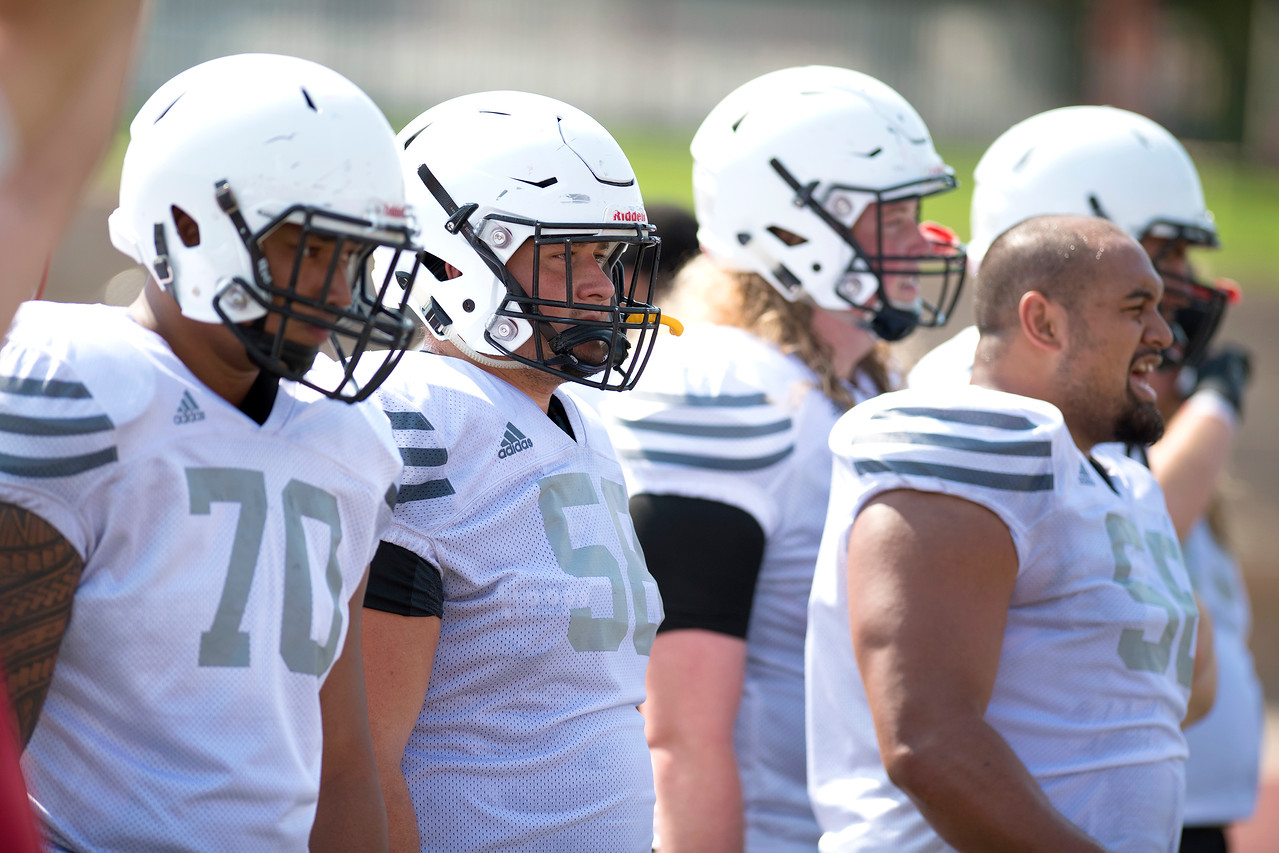
Editor’s note: All quotes aside from those by Montana head coach Bobby Hauck come from interviews conducted at the Big Sky Kickoff media conference in Spokane on July 16.
SPOKANE, Washington — If the Big Sky Conference’s preseason all-conference team is any indication, Southern Utah should have the most fearsome offensive line in the league.
Junior center Cody Larsen is not only a preseason All-Big Sky selection; he also earned preseason first-team All-American honors from STATS FCS and second-team honors from Hero Sports. He earned first-team all-league honors as a sophomore last season.
Senior tackle Marquez Tucker earned second-team All-Big Sky recognition while junior guard P.J. Nu’usa was a third-team all-conference selection for the co-Big Sky champions.
All three SUU offensive lineman earned spots on the league’s preseason all-conference squad along with junior Noah Johnson of Idaho, a second-team All-Sun Belt nod last season and Iosua Opeta, an All-American tackle for co-champion Weber State as a junior last fall.
Tucker is one of the rare junior college tackles that turns into an all-conference player at the FCS level. The 6-foot-4, 270-pounder from Mesa (Arizona) Community College started his only 12 Division I games last season as SUU advanced to the FCS playoffs for the third time since joining the league in 2012.

Johnson, a 6-foot-4, 300-pound prototypical power guard, has started 22 consecutive games for Idaho after graduating early from Fayetteville (Arkansas) High in January of 2016.
The rest of the best offensive linemen in the Big Sky were recruited as defensive linemen. Wyatt Ming made 52 tackles and four tackles for before earning all-league honors as a senior at Sac State last season.
Southern Utah head coach Demario Warren and offensive line coach Aaron Fernandez, himself an All-Great West defensive lineman at SUU in 2008, made the decision to move the 6-foot-1, 300-pound Larsen and the 5-foot-11, 265-pound Nu’usa from the defensive to offensive line before the 2016 season
“I came to SUU to be a defensive lineman and when those guys left to BYU, that put me on the o-line and I’m super grateful for that opportunity,” Larsen said. “Ever since then, I feel like the mentality of the room changed. That’s when our coach implemented the points of being physically dominant and relentless out on the field. That’s where we as an o-line morphed into the o-line we are today.”
During the spring of 2016, All-Big Sky Thunderbird linemen Keyan Norman and Andrew Eide graduated and decided to use their fifth years of eligibility at BYU. SUU still performed respectfully even with Nu’usa still playing defense and Tucker still in junior college. SUU produced a 1,00-yard rusher in Malik Brown and a first-team all-league wide receiver in Mike Sharp.
Last season with Larsen and Nu’usa anchoring the offensive interior and Tucker protecting senior quarterback Patrick Tyler’s blindside, the Thunderbirds scored 33 points per game on the way to sharing the league title for the second time in three seasons. The physical, mean offensive line played a big role.

“Our offensive line coach is a great, great, great coach and we have built it through moving a couple of d-linemen, a couple of tight ends there and we got lucky getting a great tackle in Marquez Tucker,” Warren said of the construction of his offensive front. “We did it by moving guys there.
“We wanted to be more tough, we wanted to be more athletic, we wanted to be more physical.”
Southern Utah has the luxury of three all-conference lineman along with returning starters senior tackle Austin Mikkelson and junior guard Josh Anderson entering the 2018 season. That solid base has the most underrated team in the league chasing a championship once again.
“We are mean,” Larsen said. “That’s one of the biggest things about playing offensive line is being mean. You have to impose your will on the other team and make sure everybody knows. If you are playing the SUU offensive line, you are going to get put on your back. That’s what we pride ourselves on: being physically dominant.”
Weber State has one of the most talented and naturally recruited offensive lines in the Big Sky. Guard Baron Bruce earned third-team all-league as a junior while Tyler Downs pulled down an honorable mention all-conference nod as a true freshman.
Opeta is the star of the group, perhaps the best offensive lineman in the league and perhaps the best NFL prospect in the Big Sky. Like his Southern Utah counterparts, he began his career as a defensive lineman. He had four tackles against Oregon State and North Dakota State and he had a sack against Montana during his redshirt freshman season in 2015. By his sophomore year, his freshman weight of 240 pounds had swelled significantly.

Now the 6-foot-4, 305-pounder is a physical specimen possessing more natural gifts than any other linemen in the league.
“Recruiting that position is part of the fun and it’s awesome for me to watch guys develop,” Hill said. “Opeta was 240 pounds when he came out of high school and now you look at him, he’s a grown man who looks as good as anyone in the country. He’s strong, he can run and he’s a big-time NFL prospect.
“He’s a good example of some of the other schools maybe passed on him because he wasn’t big enough at the time and now you look at him, you are like, ‘what were they thinking? This guy is a monster.’ He’s a phenomenal player.”
The SUU trio and Opeta are one side of a two-sided coin when it comes to the philosophy of recruiting offensive linemen. The in-state rivals tapped into the rich recruiting resources of the Beehive State to get a collection of players with athleticism, competitive drive and a violent style. Recruiting undersized players and predicting their potential while trusting the evaluation of their mentality is one way to recruit offensive linemen effectively in the Big Sky.
“(Offensive line) and defensive line, those are the gold nuggets of recruiting,” Portland State head coach Bruce Barnum, a long-time offensive coordinator in the Big Sky before earning his first head coaching job at PSU in 2015. “Everybody wants them but they are hard to get.
“And then when you get them, you have to decide how are you going to grow them? Do you want to take them big out of high school and coach them up? Or do you want to find the frame and build it yourself? But they are bigger, faster, stronger. You look at them on game day (laughs).
“What we’ve done is find that kid who can run with a frame. If they have the speed along with that size, years three through five, you are going to have what you want. But that’s the game at this level.”

One of the most efficient, crisp and successful units in the league this decade was Montana State’s 2011 offensive line. The group included firs-team All-Big Sky center Shaun Sampson, a former walk-on who joined the team at 6-foot, 180 pounds. The MSU offensive line also included a converted fullback in Casey Dennehy and a converted defensive end in Leo Davis paired with the All-American duo of Alex Terrien and Conrad Burbank. The determination of the group combined with the peerless coaching of Jason McEndoo, the 2011 AFCA Assistant Coach of the Year, helped the line pave the way to a Big Sky title for the Bobcats.
Under third-year head coach Jeff Choate, Montana State has gone back to recruiting more traditional offensive line prospects, although slated starter Lewis Kidd, a 6-foot-6, 295-pound mountain, is entering his second year playing offense after spending his redshirt season as a defensive tackle.
Dylan Mahoney became the leader of the unit is Choate’s second season last fall. The Great Falls C.M. Russell High product came to Montana State as a 6-foot-6, 225-pounder who left as a 285-pounder who earned second-team All-Big Sky honors at offensive tackle last season.
This year’s Bobcat offensive line returns three-year starter Mitch Brott, a former partial scholarship recruit out of Billings West for MSU’s previous coaching staff. The 6-foot-6, 290-pounder will make his fourth start at left tackle against Western Illinois on August 30 in Bozeman after starting most of the last two straight seasons at right tackle.
The rest of the line will be made up of Choate recruits, starting with senior center Alex Neale, a 6-foot-3, 290-pound former UNLV transfer. Sophomore Taylor Tuiasosopo (6-4, 314) will likely start at one of the two guard sports while Kidd will start at either right guard or right tackle. The fifth spot will go to whoever wins the battle between redshirt freshmen Connor Wood, a 6-foot-5, 310-pounder who would likely start at right tackle or Zach Redd, a 6-foot-1, 275-pounder who is in the mix at all three interior positions.

“I think it’s such a developmental position,” Choate said. “…You have to project these kids. Sometimes if you go for the guy who have the size, they don’t have the athleticism. His feet aren’t quite what you want it to be or maybe they are injury-prone because they put that weight on at the high school level.
“There’s that balance and it is: (offensive line) and corner are the two hardest positions to recruit and develop, especially at the FCS level because you almost have to take more guys at those two positions knowing you are going to have a higher miss percentage. You are loading up on guys on the offensive line and in the secondary knowing you aren’t going to have that big of a hit percentage as you might at linebacker and running back.”
During his first tenure at Montana, Bobby Hauck’s offensive lines dominated opponents. Groups that featured first-team all-conference talents like Colin Dow, Levi Horn and J.D. Quinn along with consistent producers like Brent Russum, Terran Hillesland and Chris Dyk plowed massive holes for record-setting ball carriers like Chase Reynolds and Lex Hilliard.
The Griz consistently recruited and developed the best linemen in the league, the likes of Dylan McFarland, Corey Proctor, Cody Balough, Horn and Dow earning shots in the NFL. Hauck left in 2009 to take the head coaching job at UNLV. The Griz have had a string of elite talents — Jon Opperud, Danny Kistler, William Poehls and last year’s leader, Davis Reese — since then but the units have not compared.
This year’s offensive line, a group that loses four starters, is a glaring concern for the Griz even with a collection of players with prototype size like 6-foot-5, 315-pound junior Dallas Hart and 6-foot-5, 330-pound junior Angel Villanueva
“We are not going to get people here that are the top end of their development,” Hauck said. “Now, we can get guys who have great potential. That’s what we have to recruit.
“You’ve got to have a little bit of a crystal ball, which none of us have. Historically speaking, we have had a lot of success doing that.”

Cal Poly’s offensive line assembly strategy is much different than any other team in the league. Because of academic standards and a few other factors, the Mustangs run the triple option. In order to run the old-school run-heavy intricate offense, Cal Poly needs spry, quick, fearless linemen willing to violently cut block opposing defensive lines to allow lanes for the deceptive attack to operate.
“For us, it’s easier to recruit because we are going to teach what we teach,” Cal Poly ninth-year head coach Tim Walsh said. “It’s a completely different thing than most kids have ever been taught. But these guys, the size…from year to year that I’ve been in the league, the size of every team is pretty different. They are gigantic. You look at Sac State, Weber State.
“In the old days, you used to look for athleticism,” continued Walsh, who coached at Portland State from 1993 until 2005. “Now size seems to be the deal because most teams aren’t looking for the vertical push. They are looking for the horizontal push, let the guy see his own crease and hit it. It’s a different game, there’s no question. The development to be honest is easier than it was the way it was taught 10, 15 years ago.”
Former Idaho State offensive guard Skyler Phillips is still on the Seattle Seahawks roster. Despite earning just honorable mention All-Big Sky honors, Portland State tackle Randin Crecilius signed as an undrafted free agent with the Baltimore Ravens. Former UC Davis guard Julian Bertero signed with the Bears.

Former Northern Arizona offensive guard Tyler Shank earned all-conference recognition as did center Blake Porter and tackle Cole Habib. Those three graduate and NAU’s other two slated starters are out indefinitely.
NAU 21st-year head coach Jerome Souers added seven mid-year transfers to help fortify the unit. It’s the latest experiment as Souers tries to solidify an offensive line that seems to always be a part of a Lumberjack offense featuring a slew of elite skill.
“We’ve never been able to recruit the plug-and-play offensive linemen out of high school,” Souers said. “If they are 6-4, 300 pounds, and they can play, they are already going big. That’s easy recruiting at that level.
“The hard part is recruiting a guy that in two years is going to look like that, throw him in the weight room, throw away the key and what comes out will be that guy, you hope. You have to think ahead a little bit on offensive line recruiting”
Photos by Brooks Nuanez and contributed. All Rights Reserved.

