


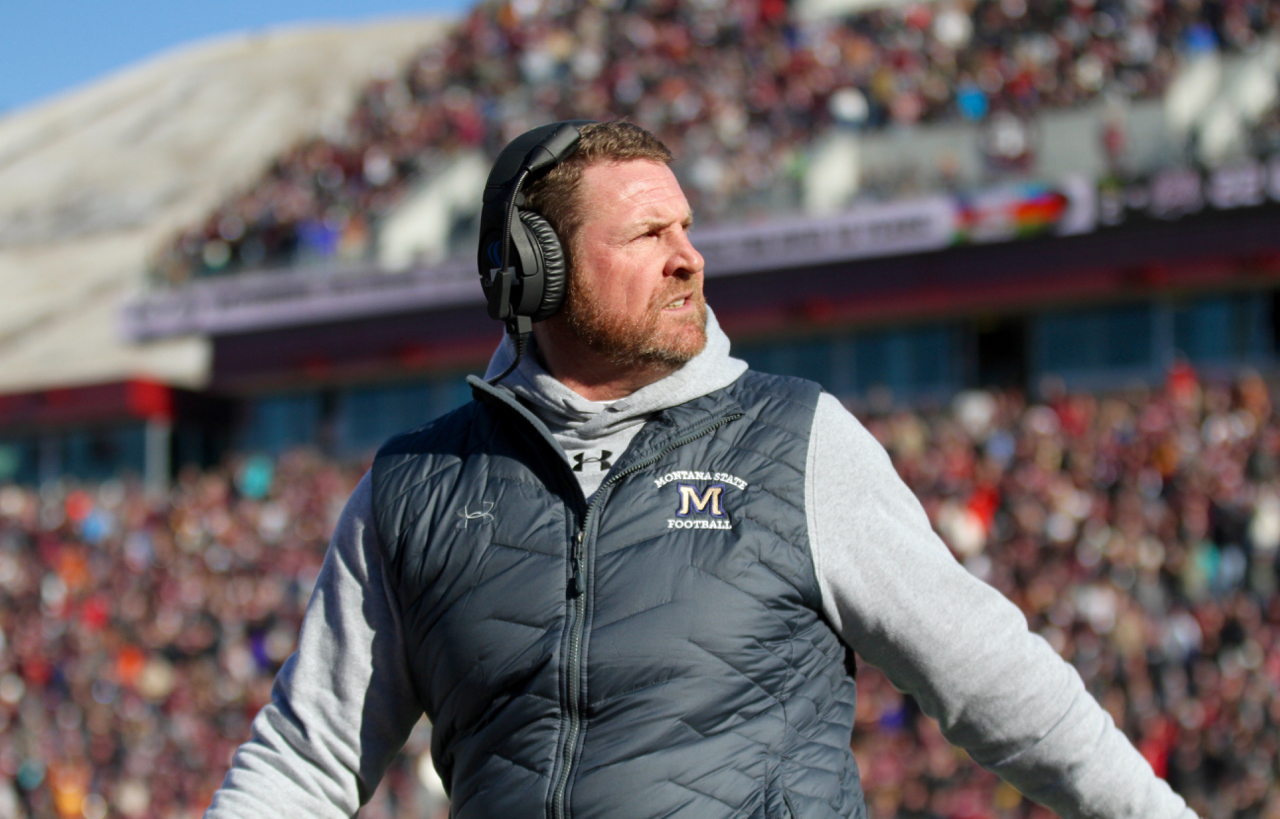
Jeff Choate spent more than a decade as a high school history teacher before he ever started coaching college football.
During strange times that sometimes seem like they couldn’t possibly get any stranger, most of the dialogue provided by Montana State’s head football coach has centered upon any silver lining he can find as his team, the MSU campus, the state of Montana and the world at large endures a global pandemic. And he’s encouraged his players to embrace the historical aspect of this once in a lifetime experience.
“One thing I told them is, ‘You guys are all primary sources of history,” Choate said in an interview in April. “You should journal. Your grandkids are going to ask you about this. This is an event like September 11, Corona Virus, these are historical markers. You don’t know exactly what to do.
“But like I told them, take care of your 20 square feet, guys. If the CDC says this, if your local government says this, if I am telling you this, just do it. Have the personal discipline to do it. If you really want to play football any time soon, make some sacrifices now and encourage other people to do the same thing.”
[restrict paid=”true”]
Months later, the Big Sky Conference announced the league would delay its 2020 season to the spring of 2021, the Bobcats were in the midst of an early fall camp practice. Later on the first Friday in August, Choate and his staff addressed the team.
Choate, who is set to enter his fifth season at the helm for the Bobcats whenever the next season commences, said he commiserated with his players over the collective loss of a fall filled with great expectations. MSU came in at No. 6 in the one and only STATS Perform FCS Top 25 poll released earlier this week.
But Choate also expressed to his team the unique nature of the situation.
“I told them, ‘I never knew what it’s like to be a normal college student and you don’t either so why don’t you go find out?” said the 50-year-old, who played football and earned his undergraduate degree from Montana Western in the early 1990s.
“Go get a side gig. Go to a poetry reading. I’ve never been to one of those. Go do something new on a Saturday in the fall. That’s where I’m at on all this.”

COVID-19 hit the world of college athletics like a freight train the first week of March. An explosion in the spread of the virus and the information about the pandemic caused for a domino effect that ultimately resulted in the cancellation of the NCAA Tournament.
By mid-March, schools across the NCAA cancelled all spring sports. Football teams across the Big Sky Conference had spring football called off, except in the cases of UC Davis and Portland State, who completed their sessions.
With the postponement of the fall season to at least the spring and maybe longer, patience will be key for everyone involved in college football.
“The hardest part is we really aren’t a team in this even if we want to be. There are a lot of individual agendas that come into play,” Choate said earlier this summer. “Trying to explain to the players that what we are doing is based on the greater good than for what is good for the individual was the hardest part. Fifth-year seniors, they don’t want to play in front of nobody. Our kids that have redshirted, they don’t want to say their opinion because they are just going to keep redshirting. The guys who are impacted the most are the guys who have already redshirted who now are basically going to lose a full year if we don’t play in the spring.”
The opening of fall camp slates across college campus came with mixed results in terms of players reporting. At Utah State, only 34 players reported. At Montana State, all 94 invited players showed up for the first few practices of the fall.

Choate, who actually began his college coaching career as a graduate assistant on Mick Dennehy’s staff at Utah State almost 20 years ago, said reporting players is a direct reflection of the internal culture of a program.
“Our kids have ownership at this place and our kids know that we have their best interest at heart,” Choate said. “It’s from the top down from President Cruzado at the top all the way down to (head trainer) Rob Higgs and his staff taking care of these kids. These places that are run well are going to come out better than this. That’s the reality.”
And because of that, Choate and defensive coordinator Kane Ioane echoed the same observations of their players: disappointment is certainly a shared emotion but each Bobcat is trying to make the best of a delay of the football season that could last anywhere from six months to a year.
Montana State senior Michael Jobman and MSU senior center Denver Krone each told their head coach they planned on renewing their rodeo careers with the Bobcat rodeo team. Jobman, a 6-foot-5, 250-pounder from Huntley Project who has played Buck end and is currently an inside linebacker, has a background as a team roper.
Krone, a 6-foot-2, 275-pounder from Augusta who played high school ball in Choteau, told Choate he was going to bulldog. Choate joked he was worried that someone might report “animal abuse” if someone with the size and aggressiveness got back into steer wrestling.
Other occupying activities aside, the upcoming extended off-season could serve as a benefit in terms of training and health.

The unrelenting year-round calendar that never seems to let up across Division I football makes true recovery from serious injuries challenging. And while college football players certainly train with vigor, the change for an extended period of time to build speed and strength could be a benefit to players who take advantage of it.
Choate said his goal for his roster is to “build mass and power and work on speed development, which is actually a total rarity for us.”
Earlier this month, the NCAA approved extended practice and meeting time for any college football team that had its season postponed until at least next spring. Teams are provided with 12 hours a week to interact. The model, which was approved on August 19 by the NCAA Division I council, includes time for strength and conditioning, meetings and five hours a week of on-field activities.
The 12-hour model is in place from August 24 until October 4. Just 15 of the 122 teams in the FCS will attempt to play any sort of game this fall, led by No. 11 Central Arkansas embarking on a nine-game schedule that includes three games against FBS opponents, a showdown against No. 1 North Dakota State on October 3 and home-and-homes with Missouri State and Eastern Kentucky.
“We had planned a six to eight-week training block in the weight room along with a sort of spring ball in the fall,” Choate said before the decision was approved. “We will take advantage of whatever time they give us.”

Regardless of if the fall is taken up by practices and training sessions or an attempt at a season that seems uncertain at best, it’s uncertainty that rules the day in 2020. During an impassioned 38-minute address of the media earlier this month, Choate gave insight into the pulse of his program, the disappointment of the postponement and the state of college football.
When asked what he might do when he wakes up on a Saturday with no football game to prepare to coach for the first time in close to 30 years, Choate gave pause before contemplating the inquiry out loud. And he continued to look at the bright side of these dark days.
“The fact that I would wake up is something because if it was normal fall, I wouldn’t sleep,” Choate said. “I don’t know what I’ll do. Maybe I’ll go elk hunting for the first time in 38 years. I’ll do whatever I want. How about that? I might go take a fall boat ride on Lake Coeur d’Alene. I’m going to smell the roses. I’m not going to cry in my beer.”
[/restrict]

