


AnalysisBig Sky ConferenceFootballMontana StateMontana State Spring Football

DEFENSE: Bobcats release first two-deep depth chart of Vigen era

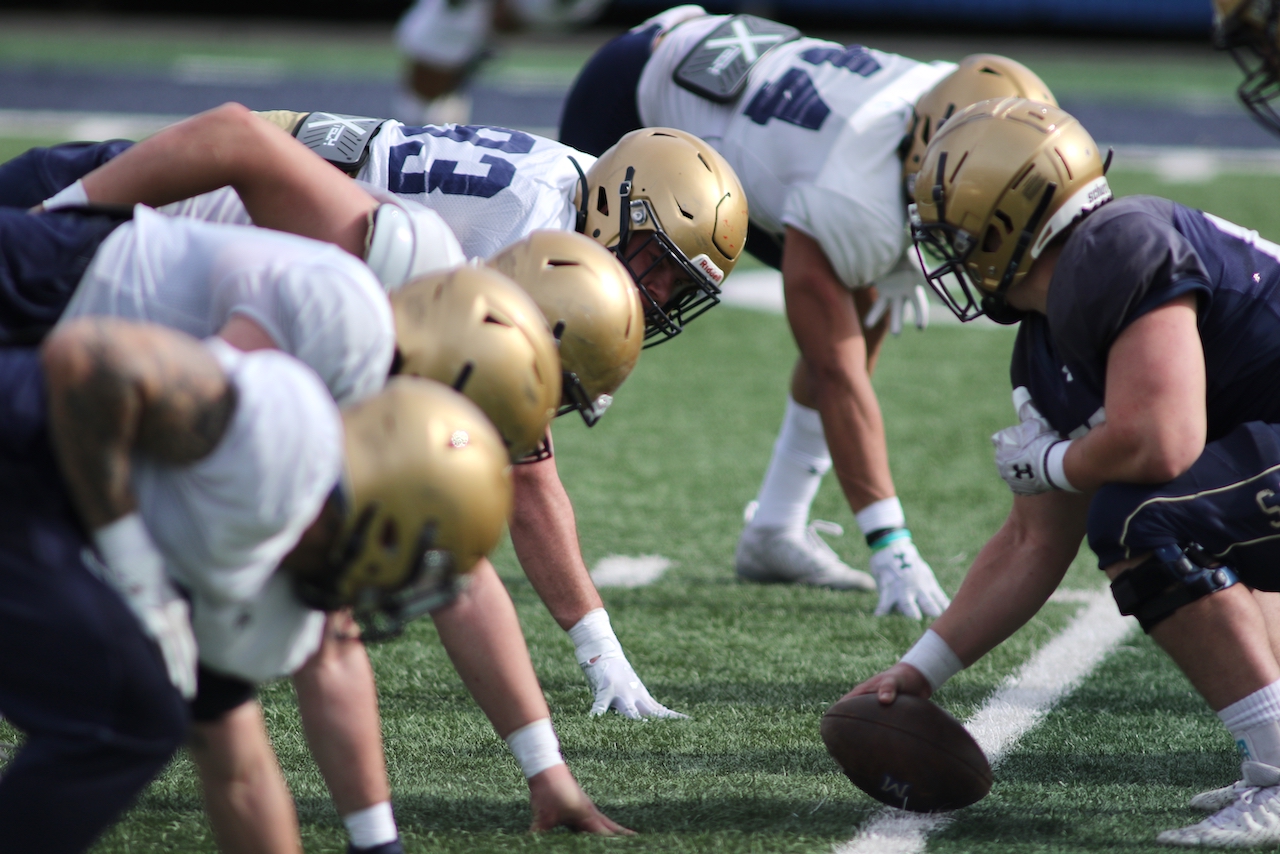
BOZEMAN, Montana — Montana State finished its first set of spring football practices under new head coach Brent Vigen on April 23.

A few days later, Vigen released his first depth chart as the leader of a Bobcat team that enters the fall of 2021 with sky-high expectations after 2019’s run to the FCS Final Four.

“You watch the film on Sunday and it brings some clarity to the performance,” Vigen said on Wednesday. “Very pleased walking off the field. Thought it was pretty consistent.

“The depth chart is a starting point like if we were playing this coming Saturday to at least give guys a baseline of where they are at.”

The two-deep includes a reshuffling of a talented offensive line, a defense featuring five defensive backs and a pecking order for the Bobcat quarterbacks, among other highlights and position shifts.

Returning starters like junior running back Isaiah Ifanse, senior defensive tackle Chase Benson, senior wide receiver Lance McCutcheon and junior middle linebacker Callahan O’Reilly occupy familiar spots.
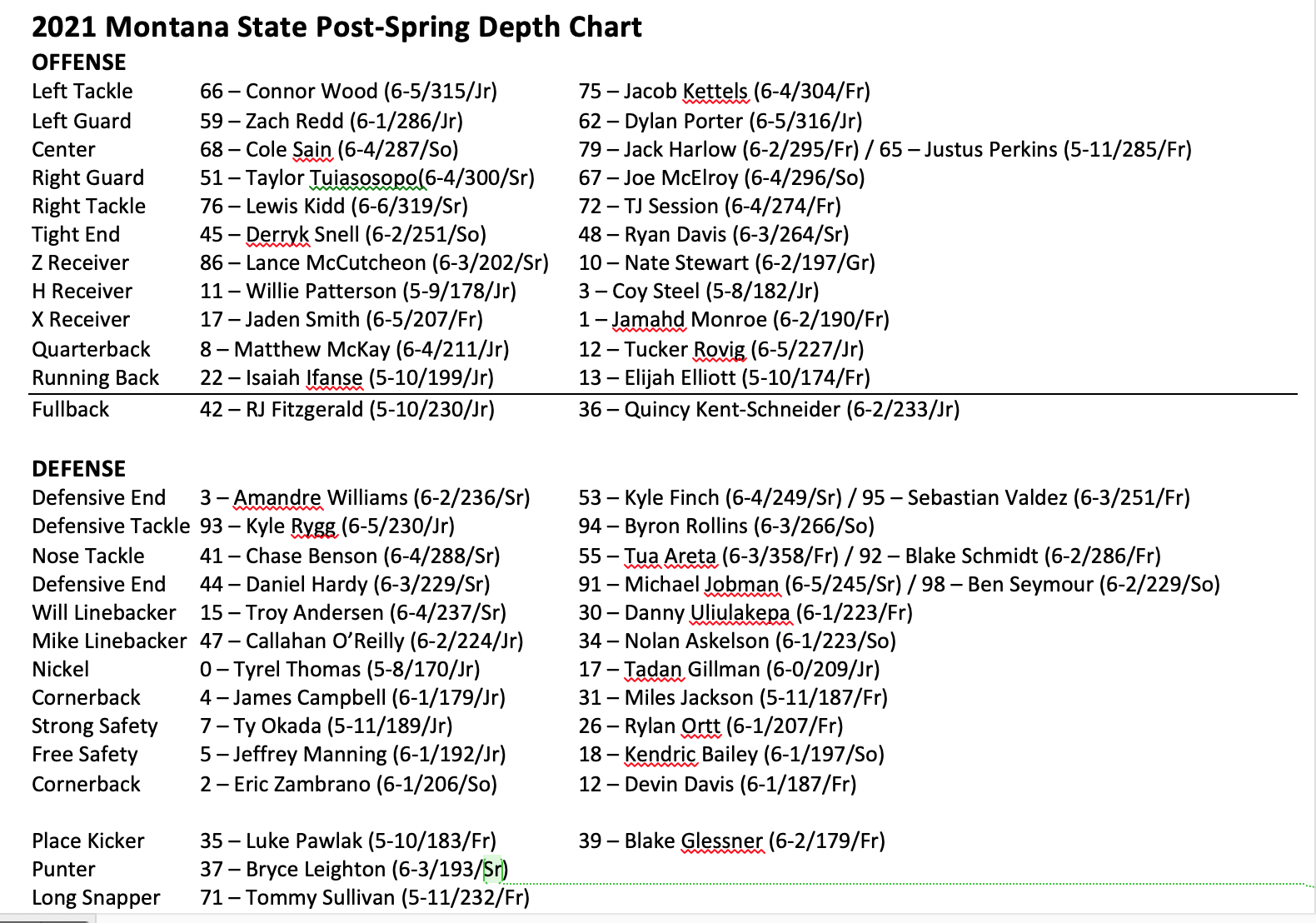
Other returning All-Big Sky Conference talents like senior honors candidates Troy Andersen, Amandre Williams, Lewis Kidd, Taylor Tuisosopo, Ryan Davis and Daniel Hardy are starters once again but at new positions.

Returning all-league juniors like Connor Wood, Zach Redd, Tyrel Thomas and Ty Okada are also acclimating to newer roles.

And a variety of first-time starters won jobs while other returning contributors are no longer atop the depth chart.

Here’s a look at Montana State’s spring 2021 depth chart and analysis about the defensive portion.

DEFENSE
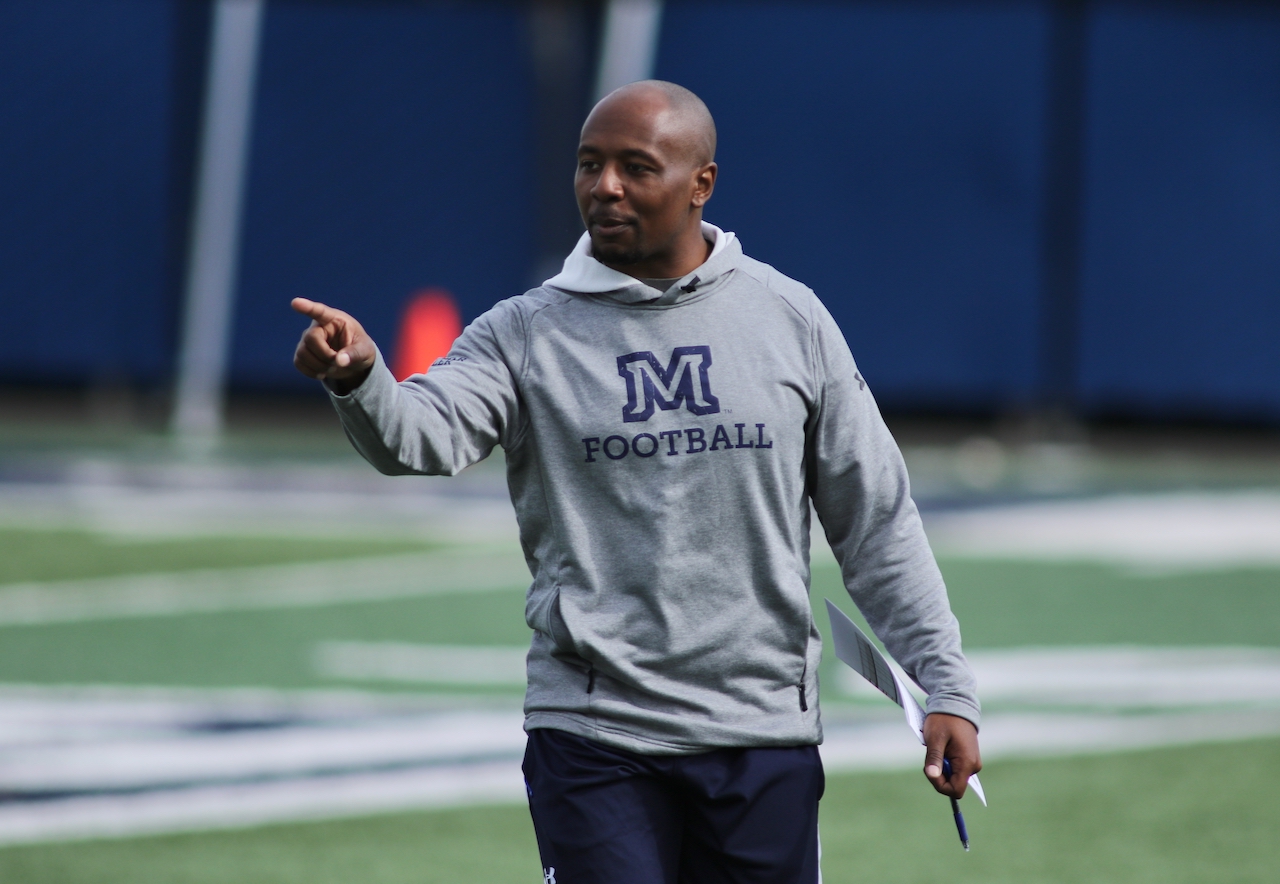
New Montana State defensive coordinator Freddie Banks/ by Brooks Nuanez

Montana State’s defense was among the best in all of college football the last two months of the season. If not for a handful of gash plays, the Bobcats basically gave up five points and less than 200 yards per outing during a six-game winning streak that helped them earn a semifinal berth in the FCS playoffs for the first time in 35 years.

[restrict paid=”true”]

MSU enters 2021 with some returning headliners defensively, but most if not all of them will be playing new positions in rookie defensive coordinator Freddie Banks’ 4-2-5 defense.

The Bobcats will have one last year with a former University of Washington transfer anchoring its defensive front. Williams, who was a third-team All-Big Sky selection a year ago as a Buck outside linebacker, will move full-time to defensive end.

MSU must find replacements for first-team all-conference talents like strong safety Brayden Konkol, inside linebacker Josh Hill, defensive tackle Derek Marks and defensive end Bryce Sterk.

The adjustments in slight position shifts for Williams, Benson, Hardy and, especially, Andersen, will be more important for the Bobcat defense than replacing any graduated player.

Defensive line

Montana State defensive tackle Chase Benson (50) vs. Norfolk State in 2019/by Brooks Nuanez

Choate put a high priority on reestablishing the long tradition of Montana State’s outstanding defensive line. The Bobcats had All-Americans in every decade of the Big Sky Conference era, including Caleb Schreibeis and Brad Daly winning consecutive Buck Buchanan Awards as the top defensive players in the FCS in 2012 and 2013, respectively.

But the last few years of the Rob Ash era, MSU’s defensive line was not nearly as prolific. And the Bobcat defense suffered.

From holdovers like Tyrona Fa’anono, Tucker Yates and Zach Wright who thrived under Choate to UW imports like Sterk and Williams adding top level talent to the steady development of Benson, a 6-foot-4, 288-pound senior from Helena, the Bobcat front has reestablished its fearsome reputation.

Can they maintain it? Much of that will depend on the three seniors listed atop the latest depth chart. Can Williams remain dominant making plays in space while having more responsibilities setting the edge? Will Benson be as much of a disruptor playing in between another tackle and another end rather than as the middle man in a three-man front? Will Hardy thrive playing a true end spot like he did in junior college?

Montana State junior defensive tackle Kyle Rygg gets past Taylor Tuiasosopo during spring ball 2021/ by Brooks Nuanez

The other factor for MSU’s defensive line to have success is the emergence of unproven players like junior Kyle Rygg, a 6-foot-5, 275-pound junior from Eugene, Oregon who is currently listed as the starter at defensive tackle next to Benson. He has six tackles in his career.

Kyle Finch, a 6-foot-4, 255-pound super-senior from Dillon, is listed as Williams’ backup. He will likely get plenty of playing time at both end spots along with maybe even playing on the inside on third downs. Finch played in 12 games last season, starting one and making 12 total tackles.

Byron Rollins, a 6-foot-3, 266-pound junior who graduated high school in 2015 before serving a two-year LDS mission, is listed as Rygg’s backup at defensive tackle.

Tua Areta, a mammoth at 6-foot-3 and 358 pounds (down from more than 400 following winter break) is Benson’s backup at nose tackle. Blake Schmidt, a 6-foot-2, 286-pound redshirt freshman who Choate praised over the last year-long off-season, is also listed as a backup to Benson.

Sebastian Valdez, a physically mature and naturally strong 6-foot-3, 251-pounder who like Schmidt hails from Monte Vista High School in San Diego, should also challenge for playing time at defensive end.

Michael Jobman is back playing on the front as a fifth-year senior. The 6-foot-5, 250-pounder from Huntley Project started 14 games and made 113 tackles, including 7.5 for loss, over the last two seasons playing mostly inside linebacker. He is listed as Hardy’s backup.

Ben Seymour, a 6-foot-2, 229-pound sophomore who previously played at College of the Canyons, is also listed as a backup to Hardy at defensive end.

Linebackers

Montana State linebacker Callahan O’Reilly (47) in 2019/by Brooks Nuanez

Although Jobman is no longer a linebacker and Chad Kanow, a part-time starter in 2018 and 2019, had to retire because of injury, Montana State’s linebackers have several familiar faces returning.

Callahan O’Reilly, a former Bozeman High quarterback, was one of the breakout players on the Bobcats as a sophomore in 2019. He earned a starting position at inside linebacker and led Montana State with 91 total tackles. The 6-foot-2, 230-pounder had 5.5 tackles for loss and a sack.

O’Reilly played Mike linebacker in MSU’s former scheme and still plays Mike linebacker in its current scheme. The two biggest differences: he’s no longer one of two inside linebackers lining up with four linebackers or in between two edges; and Andersen is now flanking him full-time at Will linebacker rather than playing Sam like Andersen did on the way to first-team All-Big Sky honors in 2019.

The legend of Andersen grew to unprecedented proportions coming out of a 2018 season that saw the former three-sport athlete earn unanimous first-team all-conference honors as a quarterback after guiding MSU to the playoffs for the first time since 2014.

Then in 2019, Andersen rolled up 11.5 tackles for loss and 6.5 sacks despite battling injuries and still playing a prevalent role offensively.

At Will, the 6-foot-4, 240-pound athletic freak will be asked to play in the box more often. Rather than chasing down ball carriers in space or coming off the edge, Andersen will have to deal with pulling guards, cutbacks and he will have to make way more plays at the point of attack.

Andersen is one of the most gifted athletes in the history of the league. So he’ll certainly be able to make the transition effectively. The question remains: is he better as an inside player piling up tackles and gobbling up ball carriers or is he best suited making plays in the backfield, erasing space, dominating the edge and chasing down ball carriers in the open field?

Danny Uluilakepa (30) celebrates during the Sonny Holland Spring Classic/ by Brooks Nuanez

During a solid redshirt freshman year, Nolan Askelson got some valuable playing time. The former Class AA Defensive MVP out of Billings Senior made six starts and racked up 32 tackles in 15 total games in 2019. The 6-foot-1, 223-pounder is listed as O’Reilly’s backup at Mike.

Blake Flovin is a senior who will get plenty of reps on special teams but true freshman Danny Uliulakepa impressed the new staff enough to earn the spot as Andersen’s backup on the initial depth chart. The 6–foot-1, 223-pounder was also a favorite of Choate’s after coming to MSU from Puyallup, Washington where he earned Washington 4A Defensive Player of the Year honors.

Secondary

Montana State defenders Jeffrey Manning (5) and Daniel Hardy (44) celebrate a fumble recovery/by Brooks Nuanez

In terms of sheer number of snaps, Montana State’s secondary loses the most of any position group on its roster. Down the stretch of the 2019 season, former defensive coordinator Kane Ioane (now the co-DC at Boise State) favored a three-safety look that got Konkol along with fellow seniors Jahque Alleyne and JoJo Henderson on the field.

During MSU’s first playoff win under Choate in 2018, Ty Okada had a breakout performance as a sort of big nickel back against Incarnate Word’s spread offense.

On the perimeter, Greg “Munchie” Filer III, Damian Washington along with twins Ty’Rhae and Ty’Rese Gibson each contributed at cornerback in 2018 and 2019.

Other than Okada, who is listed as MSU’s starting strong safety entering his junior year, none of those players still play for the Bobcats.

Okada makes the full-time move to safety while Tyrel Thomas, a starting cornerback for the last four years when healthy, moves to the No. 1 spot at nickel. Jeffrey Manning, a 6-foot-1, 192-pound rangy safety who transferred to MSU from Oregon State in the spring of 2020, is the starter at free safety.

The starting corners are currently listed as Eric Zambrano, a smooth 6-foot-1, 206-pound sophomore, and James Campbell, a 6-foot-1, 180-pound speedster who came to MSU as a high school quarterback from Florida who played wide receiver his first two seasons.

“There was maybe some surprise we put Tyrel in the nickel spot but he’d only practiced – that (Sonny Holland Spring Classic) was his only full practice,” Vigen said. “That was the only time he tackled. That just goes to show our depth there.

“We view the nickel spot no different than a starting corner. The competition for those five spots other than Tyrel, I still think there is some work to be done.”

Montana State cornerback Miles Jackson (31) intercepts a Tucker Rovig pass during the MSU spring game/by Brooks Nuanez

For the notion that depth exists on MSU’s back end to be affirmed, Montana State will need the emergence of some previously unproven players.

Tadan Gilman, a highly regarded linebacker prospect when he came out of Kalispell Glacier High, is now playing nickel behind Thomas.

Miles Jackson, a 5-foot-11, 187-pound freshman out of Portland, had one of the best springs of any young Bobcat. He had an interception in the spring game and should push for playing time early as Campbell’s backup.

Devin Davis, a 6-foot-1, 187-pound freshman from Vallejo, California, is another recruit brought in by Choate and staff who will push for time in the rotation. He’s listed as Zambrano’s backup currently.

Rylan Ortt, a former high school quarterback and state champion javelin thrower from Missoula Sentinel, has earned the praises of Choate and Ioane since joining the roster. Although he did not participate in the spring game, the 6-foot-1, 207-pounder is Okada’s backup at strong safety.

And Kendric Bailey, a 6-foot-1, 197-pound sophomore who previously transferred to MSU from Sacramento City College, is listed as Manning’s backup at free safety.

[/restrict]

Colter Nuanez

Colter Nuanez is the co-founder and senior writer for Skyline Sports. After spending six years in the newspaper industry with stops at the Missoulian, the Ellensburg Daily Record and the Bozeman Daily Chronicle, the former Washington Newspaper Association Sportswriter of the Year and University of Montana Journalism School graduate ('09) has cultivated a deep passion for sports journalism during his 13-year career covering the Big Sky Conference. In August of 2014, Colter and brother Brooks merged their passions of writing and art to found Skyline Sports.
Back to top button