


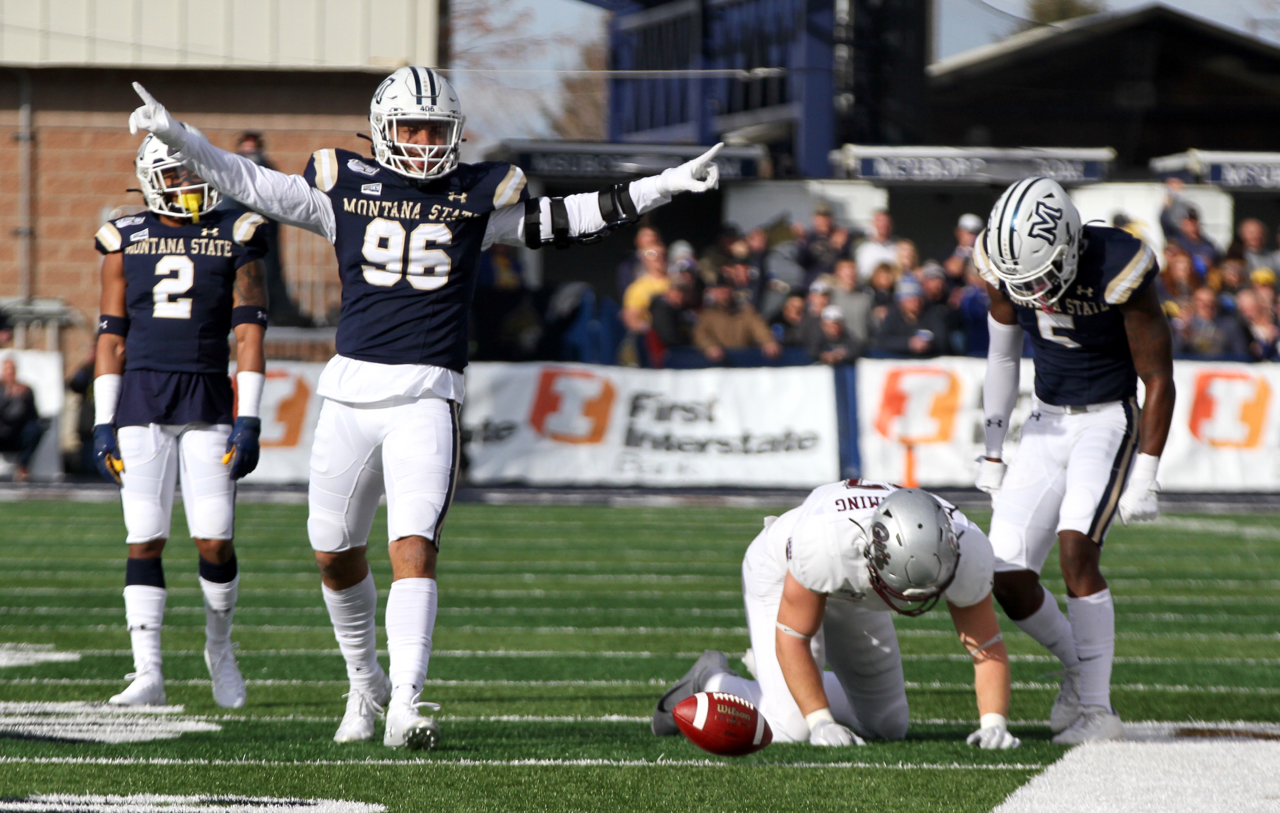
Montana State head coach Jeff Choate and MSU defensive coordinator Kane Ioane have each expressed regrets about the shortcomings of the Bobcat defense in a 34-21 homecoming loss to Sacramento State.
That afternoon, Sac State quarterback Kevin Thomson did whatever he wanted. On the way to earning Big Sky Conference Offensive Player of the Year honors, the fifth-year junior and Walter Payton Award finalist threw for 260 yards and three touchdowns while rushing in two more touchdowns against MSU as the Hornets continued their run through the traditional powers in the Big Sky.
Sac State handily beat Eastern Washington, Montana State and Montana in consecutive weeks on the way to the first Big Sky title in program history. Thomson and the Hornet offense had its way with basically every opponent last season. Yet Montana State still left that loss feeling like that Bozeman afternoon was filled with missed opportunities.
“If we take care of business that week or the next week, either or, we get a ring,” Choate lamented earlier this week.
The following week, Montana State looked dead in the water in an anemic 16-12 loss at North Dakota. But as the last three Bobcat teams have proven under Choate’s leadership, when the ‘Cats have their collective backs against the wall, that’s when they are at their best.
In the seven games following the Sac State loss, Montana State’s defense found its footing and blossomed into among the most dominant units in the FCS. Over those seven weeks, MSU gave up 14.1 points per game. Of the 99 points surrendered by MSU, 86 were actually allowed by the Bobcat defense. Of those 86 points, 28 came without Montana State’s starting defense on the field as the offense also found its groove. The 58 meaningful points allowed by MSU’s top defensive unit over a seven-week span means Montana State was allowing 8.3 points per game as the Bobcats surged into the semifinals of the FCS playoffs for the first time since 1984
Three plays — a wide receiver pass that resulted in North Dakota’s only touchdown that October afternoon in Grand Forks; a Marcus Knight touchdown that capped a 36-yard scoring drive by Montana that was set up by a 60-yard kickoff return by Malik Flowers; and a 58-yard Juwan Green touchdown on the third play of the game in MSU’s second-round playoff 47-21 playoff win over Albany — are outliers. Each score skewed the scoring defensive statistic, too.
Remove those three touchdowns from the equation and Montana State’s defense was been downright suffocating. Removing those 21 points from the sample size means Montana State surrendered 5.2 points per game entering a semifinal matchup at peerless powerhouse North Dakota State.
[restrict paid=”true”]
“The thing I appreciate the most about this team and the defense was how the guys just continued to get better week in and week out,” Ioane said in an interview in April. “It just felt like we played our best ball in November and in December during that playoff run.”

“That was because of the players and their attitudes, their attention to detail, their ability to carry over every week to want to get better and it’s a tribute to our coaching staff, starting with our head guy down.”
Montana State had a hard time finding its footing against All-American quarterback Trey Lance and the NDSU juggernaut. MSU fell 42-14. But that doesn’t disregard the momentum the Bobcats took into the off-season following an 11-4 campaign.
Although MSU made its deepest playoff run in 35 years and destroyed the rival Grizzlies (48-14) like no time since Sonny Holland roamed the sidelines in Bozeman, Choate’s team, particularly its defense, entered the months leading up to the 2020 season opener against Long Island with plenty of question marks.
Can MSU find a replacement for dominant end Bryce Sterk? Who could bring the edge to the Bobcat defense with the departure of instigating safety Brayden Konkol? Who would fill the void left by first-team All-Big Sky inside linebacker Josh Hill, arguably the surest tackler in the entire Big Sky Conference? Who would bring the leadership and crafty abilities to the interior of the Bobcat defensive front with the graduation of captain Derek Marks? Could MSU find another FBS transfer to provide the smooth athleticism of Jahque Alleyne?
“That’s what it’s all about, figuring out who we have within that room and what are their strengths?” Ioane pondered last month. “Are we going to be more of an odd front team because of the strengths of the players, or do we go to more of an even front? That’s an advantage of being a multiple-front defense; we’re very flexible in that regard. We can change some things up to make sure we’re getting the most out of the players in that room to take advantage of their strengths.
“For example, coming out of 2018 Bryce Sterk was a boundary outside linebacker/defensive end, but going into 2019 we moved him to the field end because we felt that was what he did best, and I felt like that benefited not only him but also our whole defense. So these are some things we can do this year, look at our personnel and figuring out where we can slide this guy or what can we do with that guy to make us the best front seven that we possibly can be.

Spring ball was set to be a fascinating one for MSU when it came to the evaluation of all three levels of the Bobcat defense. But then the Covid-19 global pandemic hit, canceling spring football at MSU and put the status of the college football season as a whole in question.
Still, rather than personnel evaluations, Choate is choosing to concentrate on the culture established within his program as the guiding light through uncertain times.
“I’ve said all along this all comes down to who can reestablish the standard and uphold their culture the quickest when we press go?” Choate mused. There can’t be a lot of dipping our toe in the water, thinking about what we are about. You are going to have to have some strong leaders in your locker room who say, ‘This is how we do things, we are not deviating.’
“Just because we are all back together does not mean we are going to have a rager up the Madison. We are here to work. We are on a different mission right now. You’ve had your vacation for the last two and a half months. The programs who approach it that way and have that strong leadership within their locker room are going to be fine. The ones that don’t, it’s going to be a struggle.”
Although MSU loses four All-Big Sky players defensively, the personnel remains loaded with talent. All-Big Sky Buck end Amandre Williams and all-league nose tackle Chase Benson are back for their senior seasons. Munchie Filer missed most of last year but was an all-conference pick at cornerback in 2018 after transferring from Compton College.
Tyrel Thomas is entering his fourth year as a starter at the other cornerback spot. Junior safety/nickel Ty Okada is one of the fastest rising players in the program. And a handful of other young defensive players have received praise from the coaches since the end of last season.
In an interview with Montana State sports information, Ioane called Benson “one of the top defensive tackles not just in our conference but in the country. Ioane said Williams “turned a corner down the stretch” over the last month and a half of last season. Ioane wants to move the former Washington transfer around to create mismatches in MSU’s front seven.

Senior Kyle Finch moves from Buck end, where he backed up Sterk then Williams over the last two seasons, to MSU’s “4I” strong end position. Ioane said he will be expected to play an elevated role both as a producer and a leader.
“All those guys we have coming back are talented players,” MSU fifth-year defensive line coach Byron Hout said. “Chase is our anchor inside. He’s played the position for a couple years now, and his football IQ is just growing and growing and growing year to year. He’s at what I’d consider now to be a Master’s level. He understands the fundamentals, the (defensive) scheme, the offensive scheme and how (offenses) are trying to attack us. He’s able to coach my (position) meetings now.
(Kyle) Finch is in the same boat, he knows what he’s doing, how offenses are trying to attack us. He’s a guy that’s going to be switching positions, going from that boundary hybrid end linebacker, what we call our Buck, to the field end, 4I. So he’ll make that position switch, I’m excited about him.”
The health status of All-American utility man Troy Andersen (the junior earned first-team All-Big Sky honors at outside linebacker last season) remains uncertain. But athletic senior outside linebacker Daniel Hardy emerged as a real player the final five games of 2019.
Hill leaves a presumed void in the middle, particularly from his ability to get the Bobcat defense lined up before each snap. But Callahan O’Reilly led MSU in tackles (91) as a sophomore last season. Michael Jobman started almost every game two seasons ago and contributed 40 tackles a year ago. Nolan Askelson showed major flashes during spring ball and fall camp last season, flirting with a starting job during most of his redshirt freshman season and finishing with 32 tackles.

On the back end, MSU added Arizona transfer safety Chacho Ulloa and Oregon State transfer Jeffery Manning Jr. in recent months. The Bobcat defense should also benefit from the additions of Washington graduate transfer tackle John Clark and College of the Canyons tackle Ben Seymour.
In an interview the first week of April, Choate said there was a slew of young players he was excited to watch. He included redshirt freshmen defensive linemen Marcus Wehr, Tua Areta and Blake Schmidt along with back-end players like redshirt freshmen safeties Rylan Ortt and Elijah King along with redshirt freshman corners Ty Bohanon and Eric Zambrano.
Ioane echoed his eagerness to see unproven players perform. That will have to wait until the next time the Bobcats hit the practice field.
“Those young guys that were redshirts or young redshirt freshmen that spot-played, we feel we have guys that have some talent, they’ve had a really good off-season as far as strength development and good development as far as overall student-athletes, and now it’s time to see what they can do come Saturday,” Ioane said.
“That’s where not having spring ball as far as actually being out on the field is a little bit of a worry because you don’t know exactly what you have yet. They’re unknown commodities. So with (redshirt freshmen and third-year sophomores), come fall camp, or however this plays out, whenever we can get them on the field to actually see what they can do, what kind of skill set they have, now we can really start to put the big picture together.”
[/restrict]

