


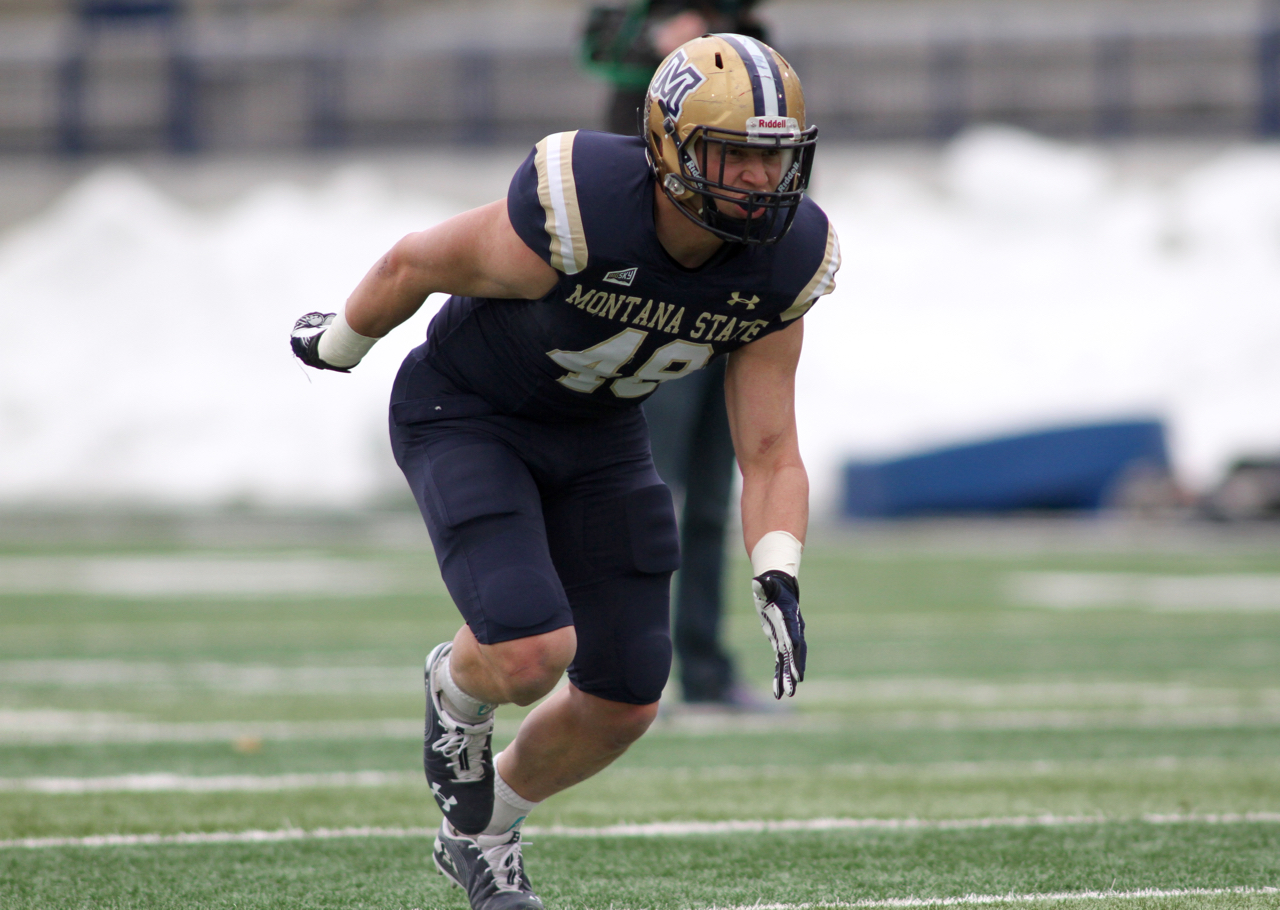
Editor’s Note: This is the first installment in Skyline Sports’ ELEVATED EXPECTATIONS series profiling Bobcat football players and position groups likely to see elevated roles this season for Montana State.
BOZEMAN, Montana — It’s not as if Jeff Choate did not favor playing tight ends. In fact, Choate and his string of offensive coordinators played as many snaps with multiple tight ends on the field as anybody in the Big Sky Conference.
The Bobcat tight ends just hardly ever touched the football, particularly in the red-zone.
Conner Sullivan, a converted wide receiver from Ennis, caught 29 passes for 387 yards and just one touchdown despite starting for the first three years of Choate’s tenure as Montana State’s head football coach from 2016 until 2018.
That’s as many touchdown catches as Wilson Brott, a converted offensive tackle who served as MSU’s “heavy” tight end in short-yardage situations, caught among his two career receptions.
Curtis Amos, who primarily served as Montana State’s H-back style tight end, caught six passes for 56 yards in his career despite coming to MSU as a highly touted pass-catching tight end who averaged 20 yards per catch and caught nine touchdowns during his senior year at Centennial High in Burleson, Texas.

Amos, Brott and Sullivan frequently played, often times next to at least one of the other two, and frequently all three would play at once. But balls were hard to come by for an offense that provided limited opportunities in the pass game across the board.
For example, senior Ryan Davis, a 6-foot-3, 265-pounder out of Billings, has started the last two seasons, yet hasn’t caught a pass since his senior year at Billings Skyview.
During the Choate era, tight ends caught a total of 59 passes in four seasons. Jason Scrempos, a defensive tackle caught as many touchdowns (two) as Austin Barth, Sullivan, Amos and Brott did in their cumulative careers.
That’s a far cry from about a decade-long stretch that saw Montana State roll out a string of some of the best tight ends in the Big Sky Conference. From Blake Wolf and Brandon Bostick during the Mike Kramer years to Kyle Begger, Steven Foster, Tiai Salanoa and Beau Sandland during Rob Ash’s tenure, Montana State landed seven tight ends on the Big Sky’s first or second-team all-conference offenses between 2004 and 2015.
[restrict paid=”true”]
With a new offensive-minded head coach in Brent Vigen and a young, brash offensive coordinator in Taylor Housewright calling the plays, Montana State’s tight ends are expected to have elevated expectations entering and throughout the 2021 season.
“Frisbee catching dogs now,” Davis said with a charming smile. “We are getting balls thrown to us left and right. We actually becoming a threat in the offense, actually getting targeted during practice, which builds our confidence and hopefully builds the quarterback’s confidence to keep dumping it down to us.”

Sandland, a freakish and gigantic former Miami transfer, caught 37 passes for 642 yards and nine touchdowns during his lone season with the Bobcats in 2015 before being selected in the 7th round of the following spring’s NFL Draft by the Carolina Panthers.
Tight ends caught a total of four touchdowns the following four seasons under Choate, including two during the 2019 season, each by Derryk Snell. The former Alaska Gatorade Player of the Year snared nine catches for 84 yards overall during his redshirt freshman season.
Snell, Davis and R.J. Fitzgerald, a 5-foot-10, 240-pound junior fullback/tight end from Dillon, should all get more opportunities in the passing game in Housewright’s personnel-based spread offense.
“It’s evolved from strictly being a run blocker to being involved and being able to go out on a play-action pass and help in that regard,” Fitzgerald said on MSU’s media day August 5. “As opposed to being in there strictly on run downs. That’s really been a big thing we have focused on since the spring and into the summer as a unit: catching the football.”
Part of Montana State’s lack of offensive production from its tight ends stems from how prolific the Bobcat run game has been. MSU led the Big Sky and ranked among the most productive teams in the FCS when it came to rushing yards per game and average yards per carry in 2018 and 2019.

In 2019, MSU rushed the ball 681 times for a school-record 3,871 yards, averaging 258.1 yards per game, 5.7 yards per carry and scoring 44 touchdowns on the ground on the way to a semifinal berth in the FCS playoffs. Even though the Bobcats only threw for 168 yards per game, the team still averaged nearly 33 points per game.
Although Vigen comes to Montana State with a reputation as a quarterback guru — he helped recruit and develop Brock Jensen, Carson Wentz and Easton Stick at North Dakota State, Josh Allen at Wyoming — Snell and the rest of the tight ends are well away that the Bobcats will still lean heavily on their run game.
“We are a run-first team,” Snell said. “We pass when we need to and we have the dudes to do it, especially in the tight end room. Me, Ryan, R.J., we have more people coming in like (redshirt freshman) Treyton Pickering. We are excited for them and we are excited for the entire team with the pass game.
“We know to achieve the goals we want to achieve, we have to pass the ball,” Fitzgerald added.
Once upon a time, Pickering was a lanky, thin six-man football player living a few miles south of the Canadian Border in Sunburst. After accepting a preferred walk-on offer to the Bobcats, he first burst onto the Montana scene with an MVP performance in the annual East-West Shrine Game.

Then he tore his ACL, forcing him to redshirt in 2018. He played in three games in 2019 but could not crack the rotation.
Since the Bobcats last played, it appears just by looking at the sophomore that Pickering has lived in the lunch line and the weight room. The 6-foot-4 tight end is up over 240 pounds and looks the part of a powerhouse.
“I think Treyton is going to be exciting these next few years,” Davis said. “I think he’s going to become one of those Bobcats a lot of people talk about for years to come.
“He’s got all the talent in the world, the size, a wicked frame. I wish I had his frame, his size, his height, his speed, his athleticism. I can’t wait to see what’s next for him. Greatness is right there for him, he’s just got to grab it.”
Snell, who is 6-foot-2 and 252 pounds, perked up when Pickering was mentioned as well.
“Oof,” Snell said. “He’s going to be exciting for the next few years. We are excited for him and hoping he stays healthy. He’s going to be dangerous.”
And then there’s the local product fighting for an opportunity. When Ryan Lonergan first signed with Montana State out of Bozeman High School in February of 2019, Choate said he thought the talented 6-foot-4, 230-pound local product was a Mountain West Conference-level athlete.
Vigen said the hierarchy at the position is still sorting itself out as MSU’s season-opener at Wyoming on September 4 fast approaches.
“I think as we figure out how we are going to play that tight end-fullback position, I think that’s one that is still out in front of us,” Vigen said. “We have different guys, different skill sets across the board.

“R.J. Fitzgerald has played the most football, him and Ryan Davis, probably and they are quite a bit different. You have Derryk Snell in between them. Treyton Pickering is a guy, is he finding his way? Ryan Longergan…I think that’s the position, I don’t think it’s necessarily we are going to play the first three guys we mentioned and who else is going to make their way into the mix?
“It’s going to be a three or four-headed monster and I think that’s how it’s certainly playing out.”
[/restrict]
Photos by Brooks Nuanez. All Rights Reserved.


