


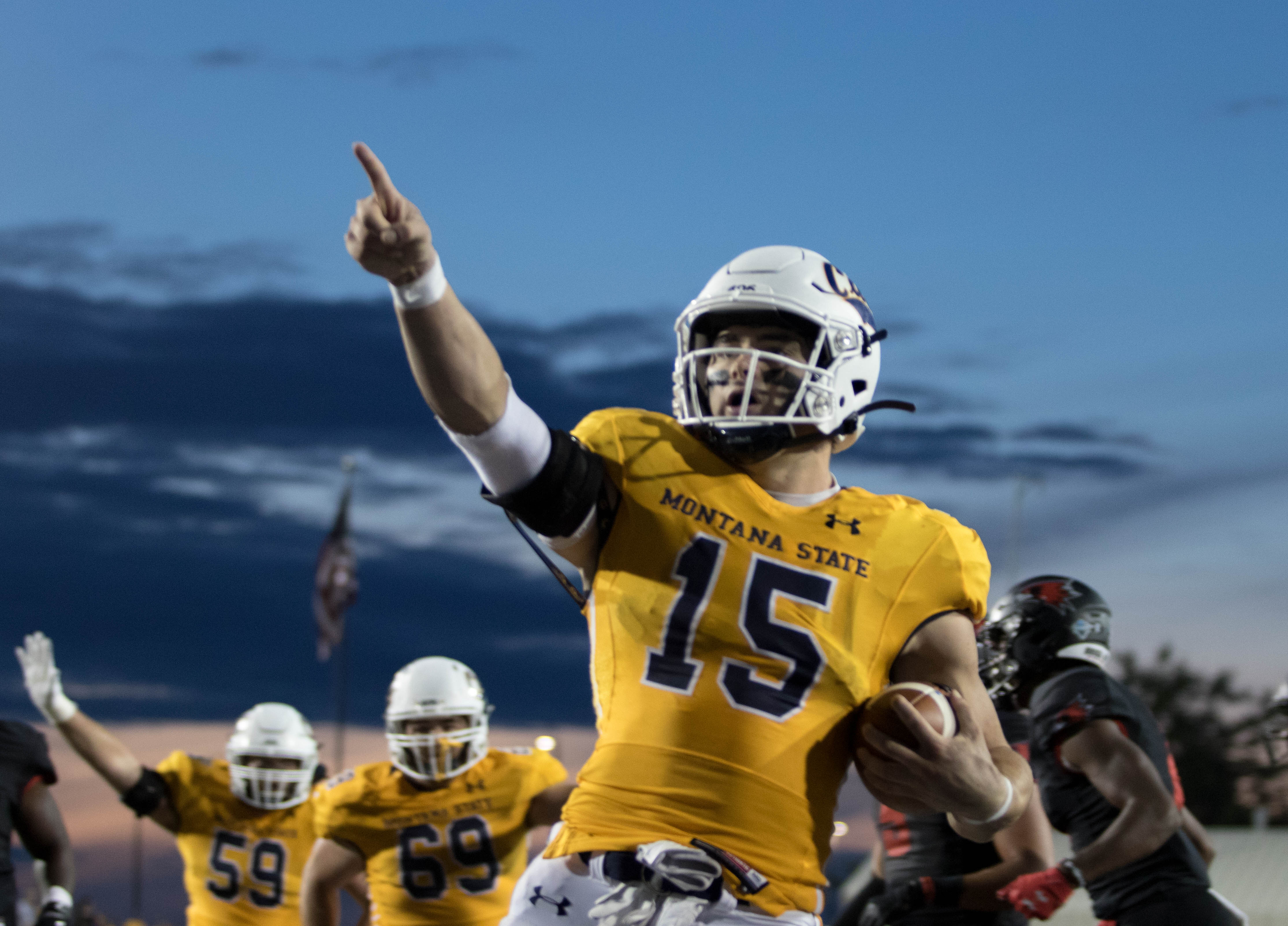
Montana StateMontana State fall camp 2021

Following historic 2019 run, Bobcats enter fall with plenty of questions

BOZEMAN, Montana — Montana State mounted its most successful run since Ronald Reagan was the President of the United States the last time the Bobcats took the field in the fall of 2019.

Yet MSU, a squad led by quartet of senior All-American candidates who have led the revitalization of toughness across the program, enters the 2021 season with as many questions as any in the Big Sky Conference.

Montana State finished as one of the final four teams in the country, winning seven games in a row to advance to the semifinals of the 2019 FCS playoffs, marking MSU’s first run to the semis since its most recent national championship in 1984.

Fearsome stalwarts like linebacker Troy Andersen, offensive linemen Lewis Kidd and Taylor Tuiasosopo along with defensive tackle Chase Benson and defensive end Amandre Williams lead the charge for a team that was voted No. 7 in the nation in the preseason FCS poll presented by STATS Perform yet was picked fourth by both the Big Sky Conference’s coaches and affiliated media in the league’s preseason polls.

Headliners like junior running back Isaiah Ifanse, junior offensive lineman Zach Redd and senior cornerback Tyrel Thomas will also have a say if MSU is to chase its third straight playoff berth and its first Big Sky title since 2012.

The most central questions for a Bobcat team harboring lofty internal expectations center upon shaking off the rust after not playing any games in almost 23 months; the transition to a new coaching staff; and the efficiency at which these Bobcats pick up new offensive and defensive schemes.

[restrict paid=”true”]

The off-season saga at Montana State was nearly as rich as the intriguing surrounding Jeff Choate’s 43 months as the Bobcat head coach. Choate’s tenure was highlighted by four consecutive wins over the arch rival Montana Grizzlies and consecutive playoff appearances. It was also low-lighted by a constant revolving door of assistant coaches (particularly offensive coordinators), significant roster overturn and next to no answers at quarterback for a program with one of the richer lineages of signal-callers in the modern era of Big Sky football.

Montana State head coach Jeff Choate during MSU’s FCS quarterfinal win over Austin Peay on December 15, 2019/ by Brooks Nuanez

First, the Big Sky delayed its fall season until the spring. Then Choate became a finalist for the open head coaching vacancy at Boise State, a place Choate spend 2006 until 2011 as an assistant and special teams coordinator, helping the Broncos reach unseen heights.

Then the Bobcats opted out of the spring season. And finally, Choate bolted, abruptly taking a co-defensive coordinator position on Steve Sarkisian’s staff at Texas in February.

Enter Brent Vigen, an accomplished offensive coordinator who helped lead North Dakota State to three consecutive national titles between 2011 and 2013 before spending the last seven seasons as the OC on Craig Bohl’s staff at Wyoming.

Vigen takes over a locker room flush with talent and a team with among the most defined identities in the FCS.

For better or worse, Montana State spent the last four seasons bludgeoning, or at least attempting to bludgeon, every opponent it encountered. It worked many times — MSU gave up less than five points per game down the stretch in 2019 while also leading the league in rushing in consecutive seasons — but also left something to be desired other times.

During his time at NDSU and Wyoming, Vigen recruited and developed quarterbacks like Brock Jensen, Carson Wentz, Easton Stick and Josh Allen. All four were drafted into the NFL. But taking over this version of the Bobcats isn’t as easy as finding a quarterback and rolling the dice.

New Montana State head football coach Brent Vigen/ by Brooks Nuanez

It’s a lot deeper than that.

“Losing Coach Choate was tough and we didn’t expect it but like he taught us and like we all believe, Montana State is a players’ program first and foremost,” Kidd, a 6-foot-6, 311-pound fifth-year senior from Minneapolis, said at the Big Sky Kickoff media event in Spokane on July 26.

“The culture is set. We worked hard to set that culture. It’s not changing.”

Vigen retained offensive line coach Brian Armstrong, linebackers coach Bobby Daly, secondary coach Kyle Risinger, tight ends coach Nate Potter, offensive coordinator turned receivers coachJustin Udy and running backs coach Jimmy Beal from Choate’s staff.

Only Armstrong remains from Choate’s 2016 staff. The 2019 season marked the first at MSU for Daly, a former Bobcat All-American (2007, 2008) linebacker, and Potter, a former NFL Draft pick as an offensive lineman out of Boise State.

Risinger has been at MSU since 2017. Beal, who played at Montana State a few years before Daly, has never coached a game at his alma mater. Neither has Udy, who like Housewright cut his teeth at the Division II level.

MSU will have new coordinators this fall. Taylor Housewright, a 32-year-old former Division II All-American quarterback, will serve as an offensive coordinator for the first time in his career.

Montana State first-year offensive coordinator/ by Brooks Nuanez

Freddie Banks, a 33-year-old who played cornerback at North Dakota State most recently in 2010 and spent last season as the as the defensive backs coach at Nevada, takes over in his first Division I defensive coordinator role.

The acclimation process for the players has been extended. Montana State did not participate in the most recent spring season, joining Montana, Northern Colorado, Sacramento State and Portland State as schools who opted out. Vigen said he and his staff have played the “long game” when it comes to familiarizing themselves with the team.

“I certainly had some ideas based on my experience what I thought it should look like but also understood it was not broke by any means,” Vigen said. “Allowing some of those ideas to sink in with me…we got to the end of spring and really tied it all together.

“We certainly, coaching-wise, schematic-wise, made some changes right from the get go but from a culture perspective the way things were done, I really wanted to let that continue to marinate so to speak.

“I think when you bring in new coaches or a head coach and a combination of assistants, you are bringing in a collective experience too, one that is not just relative to mine but is relative to everybody’s collective experience. We’ve been able to mix things together well.”

The charisma and ability to preach his vision Choate possessed will not soon be replicated at Montana State. But Choate proclaimed a vision of building a player’s program, although, while incredibly well liked and respected, the identity of the Bobcats began and ended with Choate since the day he was hired in December of 2015.

Montana State center Zach Redd (59) with MSU offensive line coach Brian Armstrong/by Brooks Nuanez

Although a culture rebuild akin to what Choate embarked on when he took over for Rob Ash five years ago is not necessary, Vigen and his staff have tried to instill a new-age dialogue in the locker room, allowing the players to have some empowerment in what the program is all about.

“I think the biggest thing with our guys is to allow them to communicate. Allow them to tell me and our assistants the things that are important to them and maybe some of the things that aren’t so important to them,” Vigen said. “A little bit of psychology, a little bit of analysis all wrapped up into one.”

Housewright — who most recently learned under Joe Moorehead at Oregon last season and Mississippi State the season prior — has followed a similar train of thought while implementing his multiple, personnel –based offensive philosophies into MSU’s arsenal.

“Being a younger guy, I want confident guys,” Housewright said. “There’s the Nick Sabans of the world who don’t necessary do it this way, but I want guys to tell me on the field that I’m doing it wrong as a coach because that means they are confident and they are at a point where they know the system, they know what they are doing.

“I think that’s a modern-age thing. It’s not the old school, ‘Hey, we do it this way, I don’t want to hear a word from you.’ I want these guys to have fun.”

https://open.spotify.com/episode/1OFT0z4q9Wr2bzTVkwPguA?si=zWvRsT8DQ0mSXUU8Px5zyg&dl_branch=1

Among Choate’s most famous lines among a catalog of one-liners: drag our opponents into deep water by the fourth quarter and then watch, or help, them drown. Although Vigen comes to MSU with a sharp quarterback acumen, he has also had a strong penchant for running the football throughout his entire football life.

The Bobcats are stacked with talent, boasting one of the elite players in the country in Andersen along with an elite offensive line and defensive front. And North Carolina State transfer quarterback Matt McKay could be an x-factor in the league title race.

Montana State quarterback Matt McKay (8)/by Brooks Nuanez

More than personnel or scheme, an adjustment in identity will prove to be the crucial factor for the Bobcats in Vigen’s first season.

“We won’t take anything for granted,” Kidd said. “We have a lot to prove. We were a pretty good outfit in 2019, the best we’ve had at MSU in awhile. It was exciting to see the fans, to see the excitement around the state and throughout our program.

“What is motivating us is just getting back out on the field and being able to just compete again.”

[/restrict]


Photos by Brooks Nuanez or noted. All Rights Reserved.

Colter Nuanez

Colter Nuanez is the co-founder and senior writer for Skyline Sports. After spending six years in the newspaper industry with stops at the Missoulian, the Ellensburg Daily Record and the Bozeman Daily Chronicle, the former Washington Newspaper Association Sportswriter of the Year and University of Montana Journalism School graduate ('09) has cultivated a deep passion for sports journalism during his 13-year career covering the Big Sky Conference. In August of 2014, Colter and brother Brooks merged their passions of writing and art to found Skyline Sports.
Back to top button