


AnalysisFootball

POCKET PRESENCE: evolution of QB position touching all levels of football

To hear Jeff Choate tell it, quarterback play in the modern era is actually “just like back to the future.” And the ability to “find an eraser” is taking priority across all levels of football.

The evolution has been at the same time rapid and incremental.

Ever since the infamous moment when New York Giants linebacker Lawrence Taylor came off the edge and crushed Joe Theisman, snapping the leg of the Washington Redskins’ quarterback in front of a national television audience on Monday Night Football more than 30 years ago, the importance of protecting a signal caller’s “blind side” has been a top priority for football teams at all levels. 

Other than the man under center, the NFL rapidly evolved into a league that prioritized paying players who can protect the quarterback and players who can get after the quarterback above all other positions.

That trend held through the 1990s and into the 2000s. But over the last 10 years, an influx of hyper-athletic quarterbacks who can press the edge, extend plays, implement spread option concepts and elude pass rushers have helped drive a sudden infiltration of college-style offensive concepts into the NFL game.

And what the NFL has mimicked in the college game has only inspired college teams to put an even higher priority on athletes who can move the pocket when it comes to choosing their quarterback.

Anyone who watched the matchup between Kyler Murray and the Arizona Cardinals against Russell Wilson and the Seattle Seahawks the last Sunday Night Football in October saw a pair of the most athletic players in NFL history to ever command offenses.

Their unbelievable ability to extend plays in the pocket, keep plays alive, throw on the run and the athleticism to weaponize their feet provided the perfect example of the elite advantage. That advantage has taken over football and has teams across all levels scoring at a record pace.

[restrict paid=”true”]

Former Eastern Washington quarterback Vernon Adams was one of the most elusive QBs in league history/ by Brooks Nuanez

“The bottom line is if your offensive line can’t block a certain human being, then you better have a way to have an eraser,” Choate, Montana State’s fifth-year head football coach, said earlier this fall. “That eraser is Patrick Mahomes, Lamar Jackson, Russell Wilson, Kyler Murray.

“It’s back to the future because all the RPO stuff, whether it’s the plus-one run game, and even the built in options like pulling the ball and then spitting it out later on a bubble screen…those are all elements of triple option, it’s just window dressed and done in a flashier way.”

In fact, the NFL did not set the trend of mobile quarterbacks wreaking havoc on defenses. Call if a trickle up affect stemming from the recent massive success transcendently athletic quarterbacks like Murray, Jackson and former Clemson quarterback DeShaun Watson, among others, had at the college level and the subsequent the impact their influence has had on the league.

“A quarterback who can run but more importantly who can extend plays, it’s a huge advantage if you can have it,” Montana State first-year offensive coordinator Justin Udy said in a one-on-one interview with Skyline Sports last month. “It allows you to gain that extra guy the defense has to account for.”

Since Choate took over at Montana State leading up to the 2016 season, his teams have been quarterbacked by some of the most explosive running threats in Big Sky Conference history.

In 2016, Chris Murray rushed for 860 yards and scored 12 rushing touchdowns on the way to earning Big Sky Freshman of the Year honors despite only starting half the season. The following year, Murray rushed for 1,124 yards and scored 10 more times. But his inconsistencies with the operational side of guiding the MSU offense and his limited passing ability meant he led MSU to just seven wins as a starter, although two were over rival Montana.

Montana State linebacker Troy Andersen (15) looks for space vs. Northern Arizona in the open field/by Brooks Nuanez

In 2018, MSU went with Troy Andersen, a converted running back and linebacker who had earned Freshman of the Year the previous year. The former high school quarterback from Dillon is built like a linebacker and runs like an antelope. His peerless explosiveness helped him rush for 1,412 yards and score 21 rushing touchdowns, the former the most by a quarterback in Big Sky history and the latter the single-season record by a Bobcat.

But the ability to throw the ball remained largely lacking for the Bobcat offense. During the second half of last season, Tucker Rovig proved he could hit a few deep shots each game to keep defenses honest, allowing Montana State to steamroll opponents with the most physical and diverse run game in the league.

Entering Choate’s fifth season, he understands to take the next step, either an improvement in offensive balance spurred on by a quarterback consistently converting on crucial downs or the emergence of a mobile quarterback who can throw with proficiency, will be a key if MSU wants to advance further than last year’s trip to the semifinals, MSU’s first Final Four since 1984.

To cultivate competition, the Bobcats brought in a few talented quarterback recruits in the off-season along with hiring Udy, MSU’s fifth offensive play caller in as many seasons.

Matt McKay, a former 3-star recruit who started five games during his time at North Carolina State, transferred to MSU and joined the team last January. In his limited time performing in practice for the Bobcats, McKay has shown traits that are becoming more coveted at all levels of football.

“The whole thing about Matt is what you are going to immediately notice is what he can do outside of the offense,” Choate said. “He’s at his best when he is on the move. He is actually a more accurate passer when we do pocket movement stuff than when he’s in the pocket. And his ability to create outside the offense gives us the added element of the plus-one run game.”

Montana State quarterback Tucker Rovig (12) throws on the run vs Norfolk State in 2019/by Brooks Nuanez

A month after adding McKay, Montana State signed Tommy Mellott, the 2019 Montana Gatorade Player of the Year and an all-state quarterback who led Butte High to the Class AA state title game. In his three years as the Bulldogs’ starter, Mellott threw for 7,089 yards and 69 touchdowns while rushing for 2,499 yards and 31 more scores. As a senior, he threw for 2,940 yards and 30 scores while rushing for 1,217 yards and 16 more touchdowns.

If the next time the Bobcats take the field is in the spring and the games played don’t count toward a player’s eligibility, Choate said Mellott could be featured at times in the offense.

The 6-foot-5 Rovig is hardly a runner. It’s unlikely Andersen plays quarterback again, outside of his spot duty as a Wildcat QB in certain offensive packages. Casey Bauman, a 6-foot-7, 235-pound sophomore who actually beat out Rovig in 2019 before relinquishing the starting job three games into the campaign, also returns with limited mobility compared to McKay, Mellott or other dual threats around the Big Sky.

Although Choate and Udy each acknowledge the definitive advantages running quarterbacks can provide an offense, Choate said MSU’s battle for starting quarterback honors remains wide open.

“I’m telling you right now, we have a lot of depth and talent at the quarterback position,” Choate said. “I would venture to guess there’s not another program in the country that can say, ‘Hey, I’ve got three quarterbacks who have all started Division I games and two have won Division I games for our team.

“Clearly, Tucker has the most command of the offense because he’s played the most in it,” Choate continued, noting that Rovig has started 13 games over the last two seasons. “Casey would be No. 2 in that regard. But Casey has also elevated in terms of his leadership and that’s what has separated him a little bit. And then you have Matt with his added athleticism. It’s a very interesting group.

“Everybody has their own strengths and weaknesses. Like I tell them, I really don’t care how it looks. The only thing I care about is what the scoreboard says at the end of the day.”

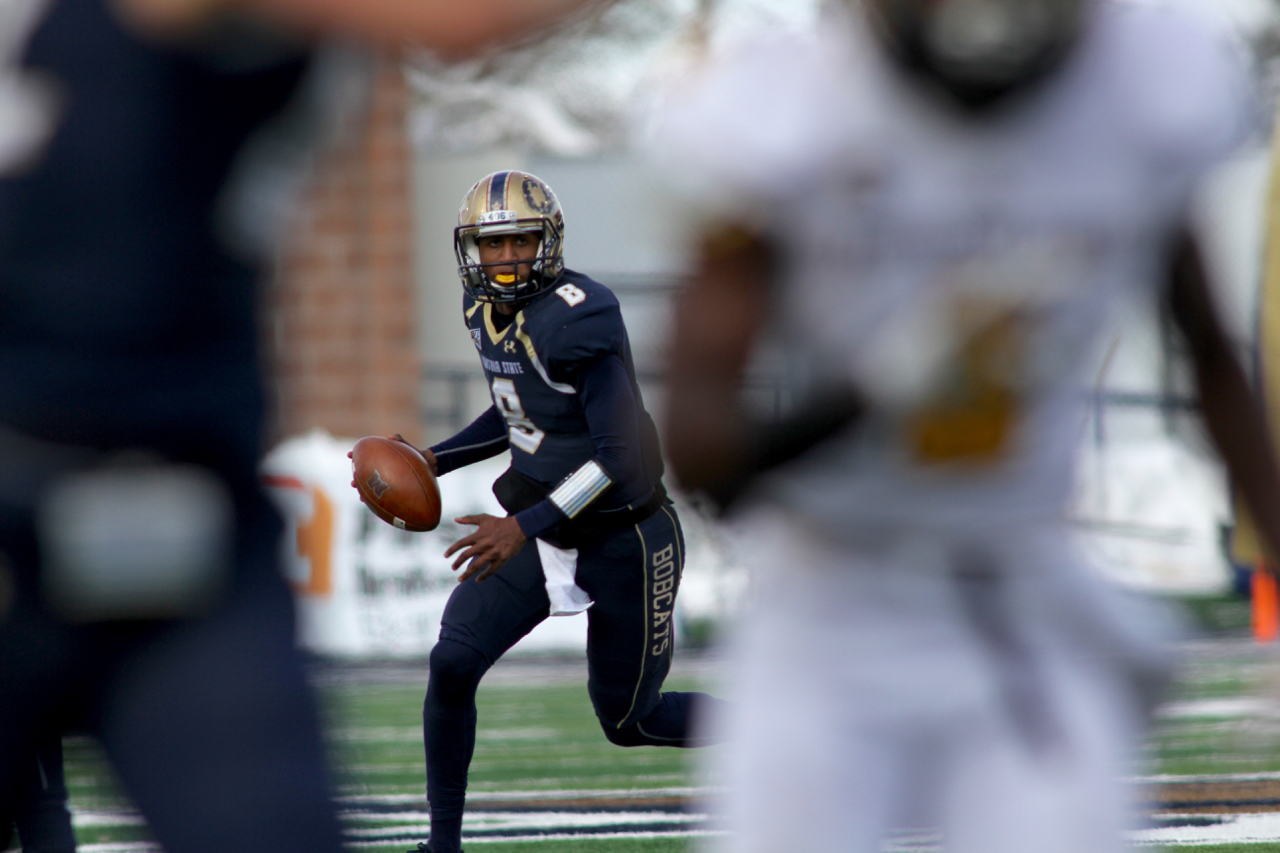
Former Montana State quarterback Dakota Prukop (5)/by Brooks Nuanez

Even with Rovig entrenched as the starter for the duration of the Big Sky season and the playoff run, the Bobcats played a variety of players at QB. Andersen, wide receivers Travis Jonsen and Kevin Kassis and running back Isaiah Ifanse all took snaps behind center.

The run-first, run-only quarterbacks are something Montana State has weaponized more than any team in the league. The combined prolific production of Murray and Andersen is like nothing the Big Sky has ever seen before.

Mobile quarterbacks who can stretch the pocket are nothing new in the Big Sky, particularly since the league moved up to Division I-AA in 1978. And plenty of them have been among the most elite passers in FCS history.

Over the last four decades in the Big Sky, players like Idaho’s Doug Nussemier, Montana quarterbacks like Dave Dickenson, John Edwards, Jordan Johnson or Dalton Sneed, Montana State quarterbacks like Travis Lulay, DeNarius McGhee or Dakota Prukop each showed the ability to shred defenses with their legs, their arms and the ability to improvise on the fly.

“College football is not the NFL in that some guys, if things start to fall apart defensively and you can get yourself into an extended play situation, someone with the right skill set is going to ultimately use that play-making ability and ability create explosive plays and use their legs and creativity,” Udy said.

“If we have a guy or two like that, that’s really hard to ignore.”

A dual-threat quarterback who can keep plays alive and dice defenses like former Northern Arizona league MVP Jason Murrietta, former Sac State playmaker Garrett Safron or former Weber State MVP Cam Higgins have helped turn their teams into playoff contenders.

Former Eastern Washington quarterback Gage Gubrud (8) in 2018/by Brooks Nuanez

And players like Vernon Adams and Gage Gubrud at Eastern Washington turned the Eagles into perennial national championship contenders.

Choate has shown the eye to find the best pure runners to ever line up under center in league history. Last year, Rovig proved the Bobcat run game could still be league leading even without the extra man for defenses to account for.

Montana State was a Final Four qualifier a year ago. MSU has posted a fourth straight win over the rival Griz. But the Bobcats are still in search of their first Big Sky title since McGhee helped MSU complete a BSC three-peat in 2012.

Choate is still in search of his first Big Sky title. And the Bobcats are still trying to find the right formula to compete with North Dakota State, winners of eight of the last nine national titles and the team that eliminated MSU from the playoffs each of the last two years.

“Quarterbacks who can move and throw are added elements when you are defending an offense and they always have the pen last. That’s the trick,” Choate said. “Because the guy with the ball can pull a rabbit out of his hat, that’s the trend everyone is going to. That’s what we are hoping to find.”

[/restrict]

Photos by Brooks Nuanez or noted. All Rights Reserved.

Colter Nuanez

Colter Nuanez is the co-founder and senior writer for Skyline Sports. After spending six years in the newspaper industry with stops at the Missoulian, the Ellensburg Daily Record and the Bozeman Daily Chronicle, the former Washington Newspaper Association Sportswriter of the Year and University of Montana Journalism School graduate ('09) has cultivated a deep passion for sports journalism during his 13-year career covering the Big Sky Conference. In August of 2014, Colter and brother Brooks merged their passions of writing and art to found Skyline Sports.
Back to top button