


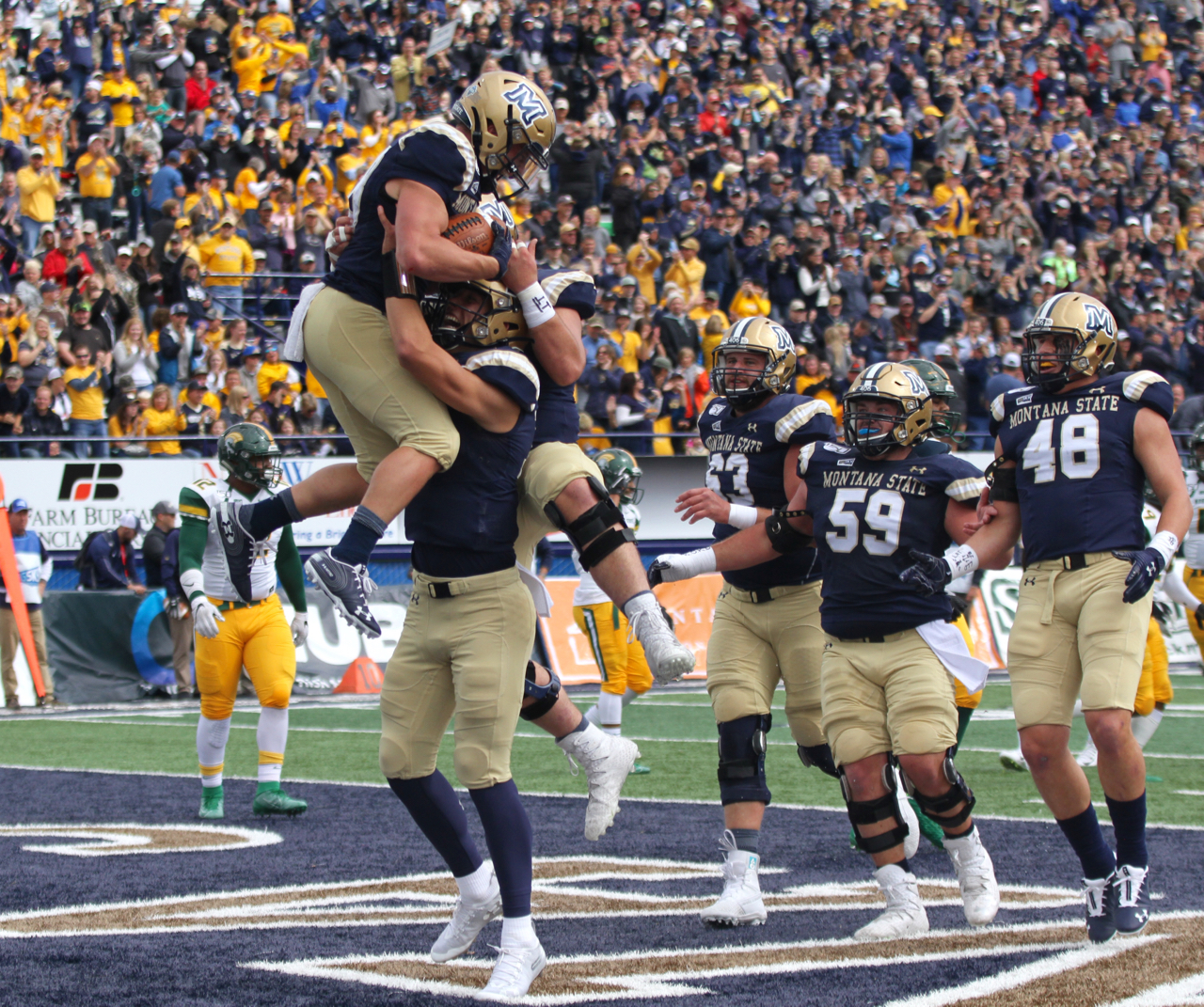
BOZEMAN, Montana — The last two weeks, Jeff Choate has been asked by the Bozeman Chronicle to describe his unbalanced yet explosive, productive offense.
Leading up to his Montana State team’s 35-point explosion to rally from a 31-14 third quarter deficit to post a 49-31 win, Choate said the thing that made him most happy was “watching defensive linemen on their backs with our offensive linemen laying on top of them.
Last week, Montana State threw for 163 yards and rank 63 total offensive plays yet still scored 34 points in a six-point overtime win over Cal Poly. This week, questions about MSU’s quarterback situation and overall offensive execution rose again.
Montana State is throwing for 164 yards per game in 2019. But the Bobcats are averaging nearly 430 yards of total offense per outing thanks to a rushing attack pounding out a Big Sky Conference-best 265 yards per game.
[restrict paid=”true”]
Montana State is averaging 5.8 yards per carry despite the limited services of unanimous first-team All-Big Sky ball carrier Troy Andersen and Isaiah Ifanse, who became the first Bobcat to rush for more than 1,000 yards as a freshman.
MSU is averaging 35 points per game this season, including 40 points per game in FCS games. Montana State has won nine of its last 10 FCS games, the lone loss coming at No. 1 North Dakota State in the second round of the FCS playoffs last November. Since the first week of November last year, Montana State is averaging 34.8 points per game outside of the 10 points it scored at North Dakota State and the 10 points it scored at Texas Tech to open this season.

Since Matt Miller took over as the Bobcats’ offensive coordinator the final week of October last season, MSU has scored at least 34 points seven times in 11 FCS games. The Bobcats have done it despite playing Andersen, a 6-foot-4, 220-pound converted running back/linebacker, at quarterback last season and a mixture of Tucker Rovig and Casey Bauman under center this season.
MSU is averaging nearly 60 yards of total offense more per game, including 23 more through the air than last season. The Bobcats are scoring a touchdown more per game. And MSU is ranked No. 6 in the country.
So when Choate fielded a question about what he envisioned for MSU’s offense and how his current offense might compare to that vision, Choate chose to focus on the strong suits of an attack that is unquestionably one of the hardest to defend in the Big Sky.
“It’s a really interesting question because I don’t really know that I envision anything,” Choate said. “My job is for me to do what we need to do to win. I’d love to say we are going to put Tom Brady back there and let him pick a defense apart. But, for example, I thought Tucker (Rovig) in the first half was really efficient and played really well. And then for whatever reason in the second half, he didn’t make as good of decision and he didn’t place the ball as well. And that kind of slowed our offense down because of what (Cal Poly) was doing defensively. He hits a couple of slants to guys in the open field and let’s then run with the ball, it’s probably a little different game.

“What do you have to do at that point? You have to do what you have to do to win. What do I envision? I envision Ws. If that’s 3-0, 2-0, I don’t care. It doesn’t matter how. It just matters how many.
“I know fans love to see explosive offense and all that stuff. That’s sexy and I get it. But I think we have the ability to be explosive. And at the end of the day, in overtime, give the ball to 10 (Travis Jonsen) and let him run three plays, score and put an end to it. That’s sexy to me.”
Jonsen has been particularly important as MSU’s quarterback carousel continues to spin. Bauman started the first three games of the season. Rovig has led MSU on a three-game winning streak but has completed 49 percent of his passes over the last two weeks for a total of 269 yards, one touchdown and two interceptions.
Jonsen has operated his revamped role behind center at a nearly unstoppable level. With Andersen nursing a collection of maladies, Jonsen has continued thriving as an outside receiver while also taking over as Montana State’s Wildcat quarterback.

Jonsen rushed 13 times for 105 yards and two touchdowns against NAU. He carried the ball 11 times for 85 yards and two touchdowns, including the game-winner to lift MSU over Cal Poly. He caught five passes for 36 yards against NAU and three more for 70 yards against Cal Poly. He is averaging 99.2 yards per game from scrimmage and has counted for five touchdowns.
“I just love seeing everybody have fun,” Jonsen said after the NAU win. “I was having a blast out there, especially when we kept pounding them and pounding them, telling the offensive line we were going to run the same play. It’s great seeing them fight.”
MSU rushed for 244 of its 340 yards after halftime. At one point, the Bobcats called 23 straight running plays, most of them read option plays with Jonsen as the triggerman.
“We knew we were wearing them down,” Jonsen said. “Then we started creasing them. By the second half, our offensive line was pancaking and putting them on their butts.”
Since Cal Poly joined the league in 2012, the Mustangs have been not only the top rushing team in the Big Sky but one of the most prolific in the FCS. Cal Poly’s triple option consistently churns out more than 325 yards per game and upward of 400 in its best seasons.
The last three seasons, Montana State has dueled it out with CP for the league team rushing title. MSU finished third in the league in rushing yards per game in 2016, Choate’s first season, 141 yards per game less than Cal Poly.

In 2017, electric quarterback Chris Murray’s 1,124 yards helped the Bobcats lead the league at 249.5 yards per game. Montana State rushed for 231.8 yards per game, third in the league behind Cal Poly (330.8) and Eastern Washington (255.9).
MSU is again on top of the league in 2019. And the maturation of the offensive line deserves a great deal of the credit. With the exception of the 7.6 carries per game that Jonsen is getting, the Bobcats have done it with less quarterback run and an arsenal of running backs.
Six different Bobcats have rushed for 100 yards or more in a single game this season, including walk-on Shane Perry and partial scholarship redshirt freshman Lane Sumner. Senior Logan Jones leads the team with 416 yards and five touchdowns despite a nagging shoulder ding.
It’s the offensive front that has been the consistently dominant force.
“They are confident and when you can roll off the ball and you know where guys are going to be and all you have to do is do your job, that helps a ton,” Choate said.
Senior left tackle Mitch Brott has a streak of 41 straight starts and is an All-American candidate. Junior Taylor Tuiasosopo is back to full health and is dominating opposing defensive linemen. Sophomores Zach Redd, who has gotten plenty of reps at guard, Denver Krone, MSU’s starting center, and right tackle Connor Wood have all made the necessary strides.
And 6-foot-6, 312-pound junior right guard Lewis Kidd has turned the corner from a player with massive potential to a blossoming NFL prospect.

“The biggest thing for us is mentality,” Kidd said following
the NAU win. “It’s easy for teams go to into halftime and have a half like we
did and say, ‘Dang, this isn’t working. What do we do? What do we change?’ But (offensive
line) Coach (Brian) Armstrong came in and said we are not going to change
anything, keep running our DNA stuff. Those little chunk plays turned into big
runs. Trusting in that and continuing to pound the rock like we do took trust
in ourselves.”
“That’s what we do and that’s what we are used to. At the end of the day, if
it’s working, it’s working. The offensive line prides itself on making holes
and blasting lanes open.
And that’s why, even if Montana State does not have a prototype quarterback like Tom Brady or even Kevin Thomson, the quarterback for Sacramento State, this week’s MSU opponent, Montana State will have a chance in every league game this season.
“Whatever we have to do to get the W. That’s what I envision,” Choate said. “I think that’s what good coaching is to a large degree is recognizing who your playmakers are and what you have to do to be successful against a given team and then be able to adjust and adapt during the course of the game when they are taking certain things away.
“Because guess what? They have 63 scholarship players and their coaches get paid to do this too. So it’s not going to go to script. I think the greater general public, they forget that we are not just rolling the ball out and playing against East Junior High here. There’s a lot more to it than that.”
[/restrict]
Photos by Brooks Nuanez. All Rights Reserved.

