


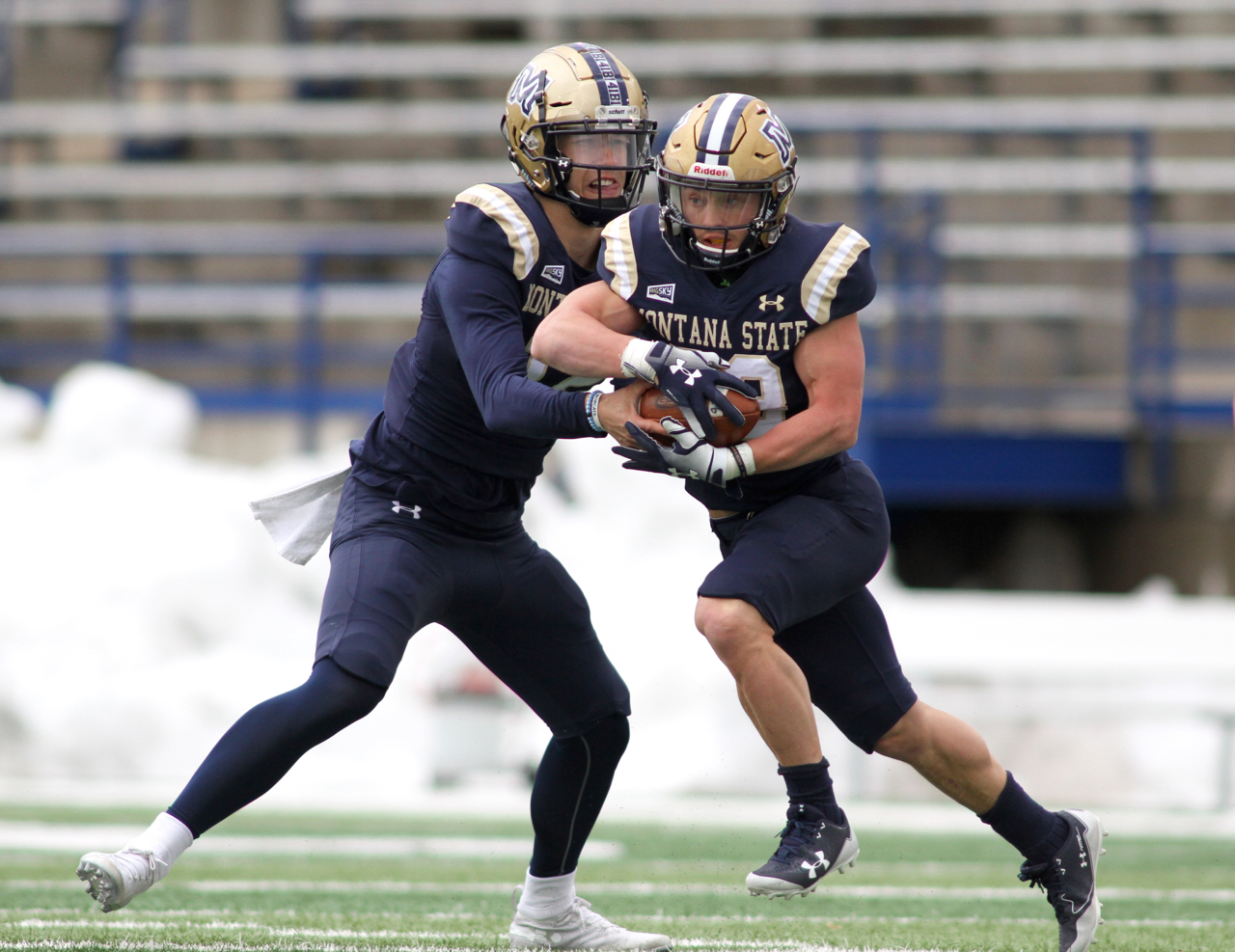
Montana State fall camp 2019

Four storylines to watch at Montana State fall camp

BOZEMAN, Montana — Montana State opens its fourth fall camp under head coach Jeff Choate on Friday, August 2. This edition holds a distinctly different aura than the previous three.

Choate took over a program that advanced to the FCS playoffs four times in five years between 2010 and 2014 only to see its more ambitious recruiting efforts and commitment to a high-powered, high-scoring offense backfire in its face. Choate’s staff immediately went to work on a rebuilding project that included a roster and schematic overhaul coupled with a different mentality centered upon character, accountability and toughness rather than flash and prevalent scoring.

During his tenure, Choate had been generous and forthcoming in the projection and crafting of his vision, laying out a blueprint with influences from his near-decade as a high school coach in Idaho and another dozen years as an FBS assistant. Montana State’s structure, vision and ambition most accurately resemble those of the ideals Choate learned in seven total seasons working under revered head coach Chris Peterson, first at Boise State, then at Washington.

[restrict paid=”true”]

Montana State lost its first six Big Sky Conference games under Choate in 2016. But the Bobcats finished with a flourish, winning consecutive games to cap the season, including a signature 24-17 victory in Missoula over bitter rival Montana despite completing just two passes.

In 2017, MSU was up and down but capped the season with a 31-23 win over the Griz, Montana State’s first in Bozeman over UM since 2005. That win capped a 5-6 mark that moved Choate’s overall record to 9-13 entering his third season.

Montana State junior Troy Andersen (15) running the ball vs Incarnate Word in the 2018 FCS Playoffs/by Brooks Nuanez

The Bobcats experienced a break through in 2018, advancing to the FCS playoffs for the first time since 2014 thanks to a three-game winning streak in November that included a come from behind 29-22 victory in Missoula over the Grizzlies. Last year’s Bobcats pounded opponents with a throwback offense filled with Wing-T and option principles with do-everything athlete Troy Andersen running the show at quarterback.

Entering Choate’s fourth season, the narrative has shifted. Montana State has real expectations for the first time since Rob Ash’s ninth and final season in 2015. That year, the Bobcats entered the campaign as the No. 7 team in the FCS and the preseason favorites in the Big Sky Conference. That team finished 5-6 despite leading the nation in scoring offense at nearly 42 points per game.

This season, Montana State is picked to finish fourth or fifth in the Big Sky preseason polls, by the media and coaches’ respectively. But Athlon Sports ranked the Bobcats No. 8 nationally in its preseason poll. MSU is expected to be in the thick of the race for the 24-team playoff field and the other nation polls have the Bobcats ranked in the mid-teens.

MSU’s roster is flush with experience, featuring 17 returning starters, including three preseason All-Americans: senior left tackle Mitch Brott, senior defensive end Bryce Sterk and Andersen. Montana State also landed senior safety Brayden Konkol and senior cornerback Gregory “Munchie” Filer III on the preseason All-Big Sky team. Senior safety Jahque Alleyne is back after leading the league with five interceptions.

Montana State’s offensive line returns four starters. The wide receivers have as much diverse talent as any pass catching crew in the league. Isaiah Ifanse became the first Bobcat true freshman to ever rush for more than 1,000 yards last season.

And despite the loss of stalwart seniors Tyrone Fa’anono, Tucker Yates and Zach Wright — each All-Big Sky selections in their careers — the Bobcat defensive front should be one of the elite units in the league thanks to Sterk’s freakish attributes, senior captain Derek Marks’ consistency, junior nose tackle Chase Benson’s toughness and the intriguing additions of Washington transfers edge Amandre Williams and tackle Jason Scrempos.

All that said, Montana State’s preseason expectations are clouded by the uncertainty regarding MSU’s ever-rotating door at quarterback and the intangible dynamic of learning how to handle high expectations. MSU has played one of the FCS’ toughest schedules each of the last two seasons. But the best wins of the Choate era, save last season’s 35-14 win over Incarnate Word in the first round of the FCS playoffs, have been against a Montana team that has missed the playoffs for three years running.

The fall camp due to ensue Friday on the MSU campus is the most intriguing in Bozeman since 2014. Five years ago, a team that had won three straight Big Sky championships but disappointingly missed the 2013 playoffs was in search of a starting quarterback to replace two-time league Offensive Player of the Year DeNarius McGhee.

Montana State head coach Jeff Choate/by Brooks Nuanez

Choate’s squad has depth, talent and a schedule conducive to success. MSU does not play preseason Big Sky favorite Eastern Washington or two-time defending Big Sky champion Weber State. MSU’s game against 2018 co-Big Sky champion UC Davis does not come until the second-to-last week of the season. And the Bobcats get Montana at home.

The 2019 season is a make or break season for the Bobcats in many ways. Choate has accurately professed his vision to this point. But rebuilding has to evolve into real success. After an eight-win season without a real quarterback, Montana State now has more lofty goals entering this fall.

What follows is a breakdown of the our biggest story lines entering this fall camp as Montana State continues pushing to return to the ranks of the nationally elite.

How do the Bobcats operate with QB battle raging?

The last two seasons, Choate has used all of Dyche Field to conduct high-energy fall camp practices filled with prevalent reps for every player in attendance. The Bobcats run two full 11-on-11 sets and sometimes as many as three during team sessions. This means as many as three quarterbacks are operating offenses during those periods of practice.

Montana State enters this fall camp with a quarterback battle expected to be a crucial factor in MSU’s overall success. Sophomore Tucker Rovig appears to be the front-runner entering Friday’s fall camp opener, but redshirt freshman Casey Bauman has the best arm talent on the roster and among the strongest arms in the league.

MSU will also need to have redshirt freshman Ruben Beltran along with true freshmen John Knight and Blake Thelen operate efficiently for the competition amongst the otherwise largely veteran roster to thrive.

Rovig, a 6-foot-5, 205-pounder out of Meridian, Idaho, showed renewed confidence and leadership during MSU’s spring drills. Bauman, a 6-foot-6, 235-pounder from the Nooksack Valley in Northwestern Washington, is still trying to grasp Montana State’s offense and adjust to the speed of the Division I game despite his talent bordering on prodigious.

All eyes will be on the quarterback battle during the month of August. But the way MSU’s quarterbacks operate will also have a significant impact on the progression of the rest of Montana State’s position groups.

How does the defense adjust to new DC Kane Ioane and how does the MSU linebacker rotation play out?

Montana State buck end Bryce Sterk (37 rushes Wagner quarterback TJ Linta (9) in 2018/by Brooks Nunaez

Choate shook up the landscape of football in Montana when he hired longtime Montana defensive assistant and coordinator Ty Gregorak. The man players referred to as Coach Ty helped a variety of Grizzlies to the NFL and contributed to UM’s run of seven straight Big Sky titles between 2003 and 2009.

In December of 2018, Gregorak and Choate came to a mutual agreement that Gregorak would resign as MSU’s defensive coordinator. Within a week, Choate hired Kane Ioane to replace Gregorak.

Ioane was a four-time All-American safety and one of the greatest defensive players in the history of Montana State during his career playing for Mike Kramer between 2000 and 2003. He began coaching at his alma mater in 2005, eventually rising to defensive coordinator in 2015.

Ioane was one of three coaches retained by Choate following Ash’s firing. After a year coaching linebackers, he left MSU to take a job as a defensive analyst at Washington. In Seattle, Ioane studied under UW defensive coordinator Pete Kwiatkowski, MSU’s DC from 2000 until 2005.

Montana State’s defense was disastrous in 2015. But Ioane is not fully to blame. After Jamie Marshall seemingly secured an FBS coordinator job only to lose it before returning to MSU to occupy a co-defensive coordinator role, the play-calling was muddy at best for a team that finished 5-6.

Ioane will take over calling Montana State’s defense and coaching MSU’s safeties. With Gregorak out, former Bobcat All-American Bobby Daly — Ioane’s first elite pupil during his standout playing career from 2003 to 2007 — takes over coaching Montana State’s linebackers. It will be an interesting transition considering how much admiration and respect Gregorak garnered from his players throughout his coaching career.

Outside of quarterback, Montana State’s position battles at linebacker are the most intriguing of this upcoming fall camp. How does the group react to new coaching and a new scheme?e

How will two new coordinators put their stamp on MSU’s schemes?

Although Gregorak coached some great units and elite players during his time coordinating defenses with the Griz, the scheme he brought from Montana was not the scheme Choate implemented for the Bobcats.

Montana State offensive coordinator Matt Miller in 2018/by Brooks Nuanez

Gregorak essentially had to learn how to endure the heat of live action calling a different scheme than the traditional 4-3 he favored at UM. Choate’s odd-man front proved to be an adjustment for Gregorak.

By last year, MSU turned the corner in terms of rushing the passer and taking away the football. The Bobcats developed more playmaking in the secondary, allowing more diverse coverage in the back end. But Montana State’s defensive production was inconsistent, as opponents notched 28.5 points per game.

Ioane has learned under Kwiatkowski and co-defensive coordinator Jimmy Lake, himself a former defensive assistant at MSU, over the last two years. The scheme Montana State employs is very similar to the one the Huskies run. Analysts cannot coach players or recruit. To hear Choate say it, Ioane is “back from finishing school.”

Montana State’s offense found a semblance of flow after wide receivers coach Matt Miller took over as the primary play caller following the demotion of offensive coordinator Brian Armstrong and the dismissal of Bob Cole.

The Bobcat offense averaged 37 points, 434 yards of total offense and 320 rushing yards per game during a four-game win streak that earned the Bobcats a date with perennial powerhouse North Dakota State in the Round of 16 in the FCS playoffs. Can that momentum continue even with the Bobcats set to have their fourth different opening-day starting quarterback in the last four years?

MSU’s influx of defensive talent — Williams and Scrempos along with JC transfer end Tyson Regimbal and JC transfer inside linebacker Blake Flovin plus phenom freshman linebacker Jaharie Martin — and Montana State’s elite returning talent make the Bobcats man-for-man one of the most talented defenses in the Big Sky. If Ioane can bring harmony and continuity to Choate’s philosophies, the Bobcats have a chance to be the best defense in the conference.

The quarterback position remains a giant question mark. The wide receivers are flush with talent, including senior captains Kevin Kassis and Travis Jonsen along with standout junior Lance McCutcheon and pending senior Jabarri Johnson. The running backs, particularly if Andersen consistently spells Ifanse, should be top-notch. And the offensive line continues to progress into one of the better units in the league.

If Miller can maintain his momentum as a successful leader for MSU’s offense and the Bobcats can decide on a quarterback they trust, the Montana State offense could take a step forward after largely being one-dimensional in Choate’s first three seasons.D

Does the vibe match the expectations?

When a team enters a fall camp leading up to a campaign highlighted by lofty goals, one of two overwhelming factors usually prevails. Either the team embraces the expectations and attacks the season like a necessary, and welcome trial by fire that is the ignition point for a run to a championship. Or the team buckles under the weight of expectations.

Former Montana State defensive lineman Tucker Yates (92) 1-on-1 vs. tackle Mitch Brott (63)/by Brooks Nuanez

The foreshadowing for either outcome can be seen clearly during fall camp. If Montana State’s defense consistently harasses MSU’s unproven quarterbacks, a domino effect could ensue for the development of the entire offense. If the weight of expectations or the inconsistencies of the offense infiltrate the attitude of the team, MSU’s postseason aspirations could hit some speed bumps.

If Montana State embraces the expectations and the incoming transfers give the roster a boost, MSU has the depth, ability and schedule to win the Big Sky Conference.

[/restrict]

Photos by Brooks Nuanez. All Rights Reserved.

Colter Nuanez

Colter Nuanez is the co-founder and senior writer for Skyline Sports. After spending six years in the newspaper industry with stops at the Missoulian, the Ellensburg Daily Record and the Bozeman Daily Chronicle, the former Washington Newspaper Association Sportswriter of the Year and University of Montana Journalism School graduate ('09) has cultivated a deep passion for sports journalism during his 13-year career covering the Big Sky Conference. In August of 2014, Colter and brother Brooks merged their passions of writing and art to found Skyline Sports.
Back to top button