


AnalysisBig Sky ConferenceFeaturedFootballGame DayMontana

Hauck’s return engenders confidence, apprehension simultaneously

The return of Bobby Hauck as the head football coach at the University of Montana in December of last year was many things. Quiet was not one of them.

From the clamoring of a football fan base beset by recent mediocrity to the protestation of dissidents who experienced the announcement as an affront to the painful inroads made against violent and sexual crime; Hauck was a splash hire if ever there was one; for better and worse.

In the days following Hauck’s hiring the objectors articulated everything from concern to outright accusation against him. And those were addressed, though likely not allayed, by Hauck at his introductory press conference, then again when he was joined in a town hall meeting by UM athletic director Kent Haslam, newly hired President Seth Bodnar, and several community members including Lisa Davey.

Ms. Davey found herself both the mouthpiece of those decrying the hire, as well as the victim of defaming, web-based attacks on everything from her appearance to sexual orientation to intellect. The malicious comments were both disgusting and sadly unsurprising given the perceived anonymity provided by the Internet. Those aspersions also served as a stark reminder that whatever culture shift has taken place in Missoula, there is still much ground to cover. Further, it gave those opposed to the hire, justly or not, evidence that Hauck could be the inflammatory link to the dark underbelly of drunken, chauvinistic football hooliganism which inculturated itself in Missoula.

Ambiguity, however, makes assessing and assigning blame notoriously difficult.

[restrict paid=”true”]
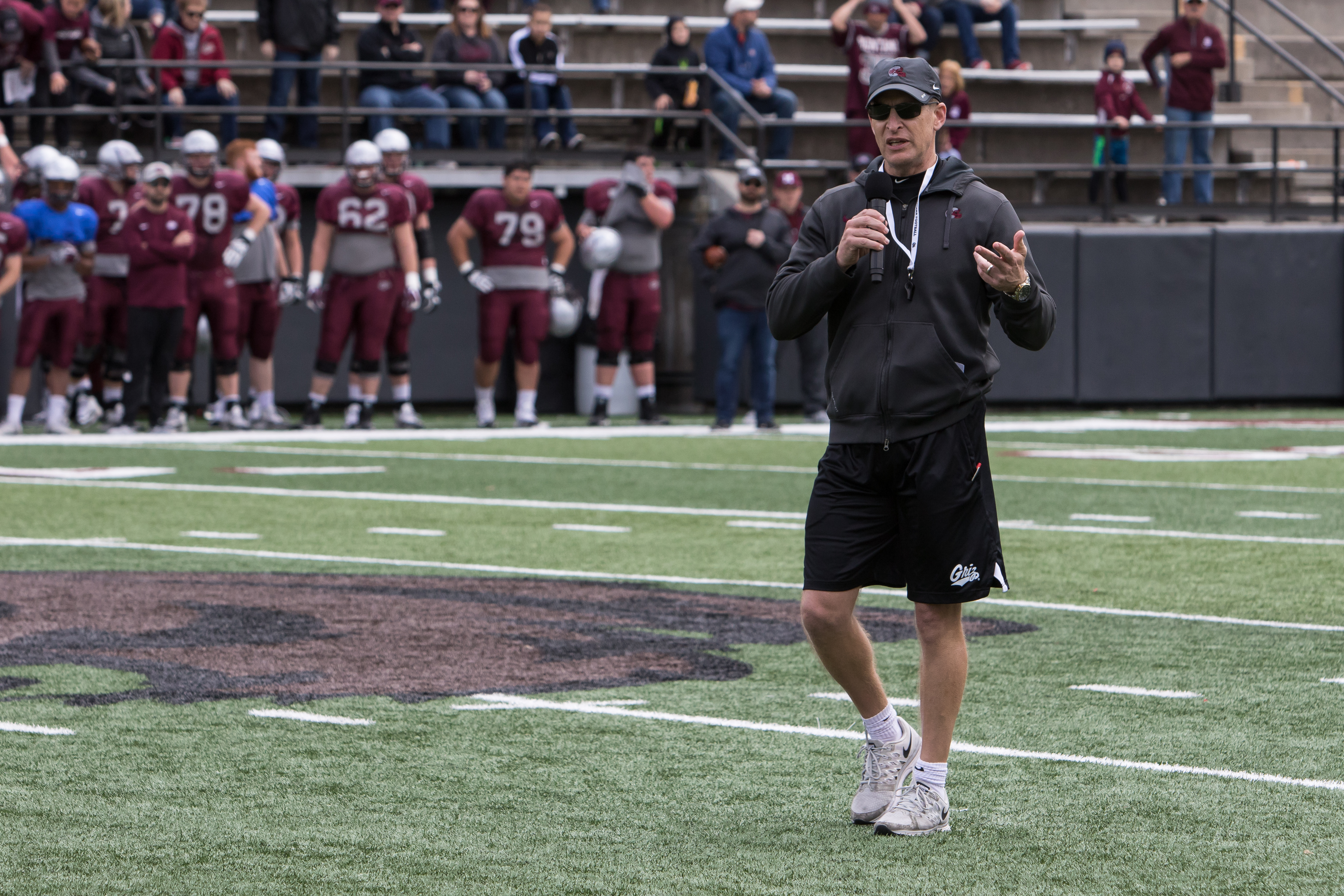
Montana head coach Bobby Hauck opened his first fall camp at UM since 2009 on Wednesday/ by Jason Bacaj

Evaluating what happened, but more crucially, how and when, a culture of sexual violence infiltrated a Rocky Mountain town and thereby derailed not merely a football program, but an entire university and community, is a very important, but brutally complex question to answer. I’ll not attempt to here. Suffice to say Bobby Hauck made mistakes for which he deserves blame and should (and to some extent has) taken accountability. However, to lay the failings and demise of an entire institution and city at the feet of a single individual is simply irresponsible. Determining how much blame one man deserves and if that should preclude him from consideration to return as a coach is an open question.

Hauck’s supporters point to the fact that no player was accused of sexual crime during his first tenure as head coach between 2003 and 2009. And while (egregious) violent crime was perpetrated by players he hand-picked to play at Montana, punishment and expulsion were swift and steadfast. Moreover —and this matters — he went 80-17 in seven seasons at Montana, including three national championship game appearances and a four-season stretch where his teams went 51-6 with four of those loses coming in the FCS playoffs. The last four seasons under Hauck, the Griz lost two…TWO, regular season games. In a community where the university in general and the football team in particular is a grossly inordinate economic driver, hosting multiple playoff games each year (to say nothing of simply making the playoffs) coupled with attendance during the regular season is truly crucial to the fiscal wellbeing of the community. And that doesn’t even touch on the civic pride (or depression) that is a felt reality to boot.

Enter Bob Stitt. 

In three seasons as the head coach at Montana, Stitt’s teams went 21-14, missing the playoffs each of the last two seasons following devastating and embarrassing losses to Montana State. Yes, when you lose to a team that completes two passes in a game, it is embarrassing. Further, a precipitous drop in attendance coupled with a palpable lack of enthusiasm that frankly matched Stitt’s own demeanor, proved to be his undoing.

Former Montana head coach Bob Stitt did not have his contract renewed following a second straight loss to rival Montana State in 2017/ by Brooks Nuanez

During Stitt’s tenure, Griz players were, relatively speaking, choir boys. Two DUI’s, one much overblown happenstance involving several players sneaking into a house still under construction, and one fight (on another campus in another state). Perhaps better to point out what didn’t occur. No (Zero) sexual assault accusations (to say nothing of convictions), no (Zero) domestic violence accusations, no weapons charges, no kidnapping, no rape. As D-I football teams go, the Griz were about the best-behaved group in the country. They deserve credit for that. Bob Stitt deserves credit for that.

But they didn’t win. At least not enough to make all the stuff you’re supposed to do anyway, matter. 

Welcome to the lurch. A university decimated by declining enrollment, a mediocre football team — which segments of the community truly rely on for survival — and an uninspiring, though morally respectable, football coach now on the outs after a failed three year experiment. What to do?

Reenter Bobby Hauck

There is such a thing as ‘fit’ and in the world of coaching it matters a ton. Hauck may not have fit at UNLV (in his defense, given the Rebs history, it doesn’t appear that anyone has). Stitt certainly did not fit at Montana. Brett Bielema didn’t fit at Arkansas, Charlie Weiss didn’t fit at Notre Dame, Brady Hoke didn’t fit at Michigan…you get the point.

What is clear: Bobby Hauck fits at Montana. Other places he’s abrasive, arrogant, and inflexible; at Montana he’s tough, confident and unwavering. He fits in this place because he is of this place. The work ethic, the commitment to greatness and the genuine love you can only have of the place you call home – that’s Bobby at the University of Montana. That’s Bobby as a Griz. 

Griz football Head Coach Bobby Hauck works with a player during the first day of spring practice in Washington-Grizzly Stadium on March 5, 2018.

When Bobby Hauck entered the room at his introductory press conference it took about thirty seconds for him to have more laughs, more command, and more support than Bob Stitt had in three years. Part of that of course, is that he’s not new. Nonetheless, his presence is undeniable.  Hauck’s ability to work a room of Montanans as a Montanan is superlative and is more stark given the overlay of the three years prior to his re-arrival.  It also gives him great sway even in the midst of dissent.  It’s a great strength and one this football team, this university and this town needed desperately – provided it doesn’t become a weakness.

Being welcomed back into the fold by throngs of old friends – and make no mistake, the number of people who support Hauck’s return outnumber (likely dwarf) his outspoken opposition – is good until it’s bad.  When those in the public eye find themselves surrounded by friends, they also easily become insulated from the real climate they inhabit.

Friends, wittingly or not, often become enablers.  It is therefore a necessity that Hauck have honest and sober counsel from people who aren’t influenced by his persona.  But this much also seems true: Hauck isn’t changing for anyone.  And that’s just fine if you are of the persuasion he did nothing (or little) wrong in his first tenure.  It’s not fine if you don’t.

Whatever you believe about Hauck’s seven season’s at Montana, the way he conducted himself and the players he brought in, even his most staunch supporters must acknowledge at least this much:  The University of Montana made a decision to bring back an individual who forced Missoula to revisit a painful, recent past that it has spent considerable time and grief attempting to rectify and move beyond.  How much responsibility for the transgressions that stained a team, a school and a region fall at the feet of Bobby Hauck?  Hard to say.  What is sure though; he is easily, and reasonably, symbolic of the perceived win-at-all-costs mentality that seems to pervade college football.  A mentality that was certainly an umbrella over several heinous crimes that damaged lives.

It is important to be prudent though, when a symbol is also a person.  Reality is often far different from perception and in the case of Bobby Hauck we need to ask if the unacceptable recent past that, in some people’s minds, he has come to symbolize, is actually true of the man.  Time will be the ultimate test.  Nonetheless, UM could have hired anyone; they chose to hire the individual, who excites the emotional extremes of this community in a way no one else can; and in so doing Montana takes a risk, a BIG risk.  The rewards, gargantuan – the failure, catastrophic.

The Griz sing Montana’s fight song with the crowd at the end of their spring game at Washington-Grizzly Stadium on April 14, 2018.

At Montana the die has been cast. The athletic department is banking on a coach that can make #RTD a reality, in turn lifting the spirits and coffers of an entire region, while simultaneously gambling that either Hauck has changed, or that he wasn’t to blame in the first place. Make no mistake, when the transgressions come – and they will – Hauck is going to have a short leash and little benefit of the doubt. Whether he actually recognizes that, or even cares, is anybody’s guess.

In either case, if the UM football team endures even a mid-level scandal involving players and any sort of sexual crime, the search for a new coach and AD will commence immediately and the football program will continue to regress. If however, Bobby Hauck can run a program whose weakest links off the field resemble that of his predecessor, the Griz have their coach for the next two decades. Under Bobby Hauck, the Montana football team will ascend to heights not seen since the last Hauck era, and the Griz will carry the university, the city and the region with them.

How this grand narrative unfolds is impossible to know. But the stakes simply could not be higher. Whether it’s with expectation, indignation or anticipation, everyone in Griz nation is glued to the drama. And if they’re honest, so is everyone in the Big Sky.

September 1, WGS, 7pm – Book 2, Chapter 1.  This is going to be a hell of a ride.

[/restrict]
Ryan Tootell is the program director at ESPN Missoula. He hosts a daily radio show, Tootell and Nuanez, from 4-6 p.m. Monday through Friday on 102.9 FM. 

Back to top button