


Game DayMontana State

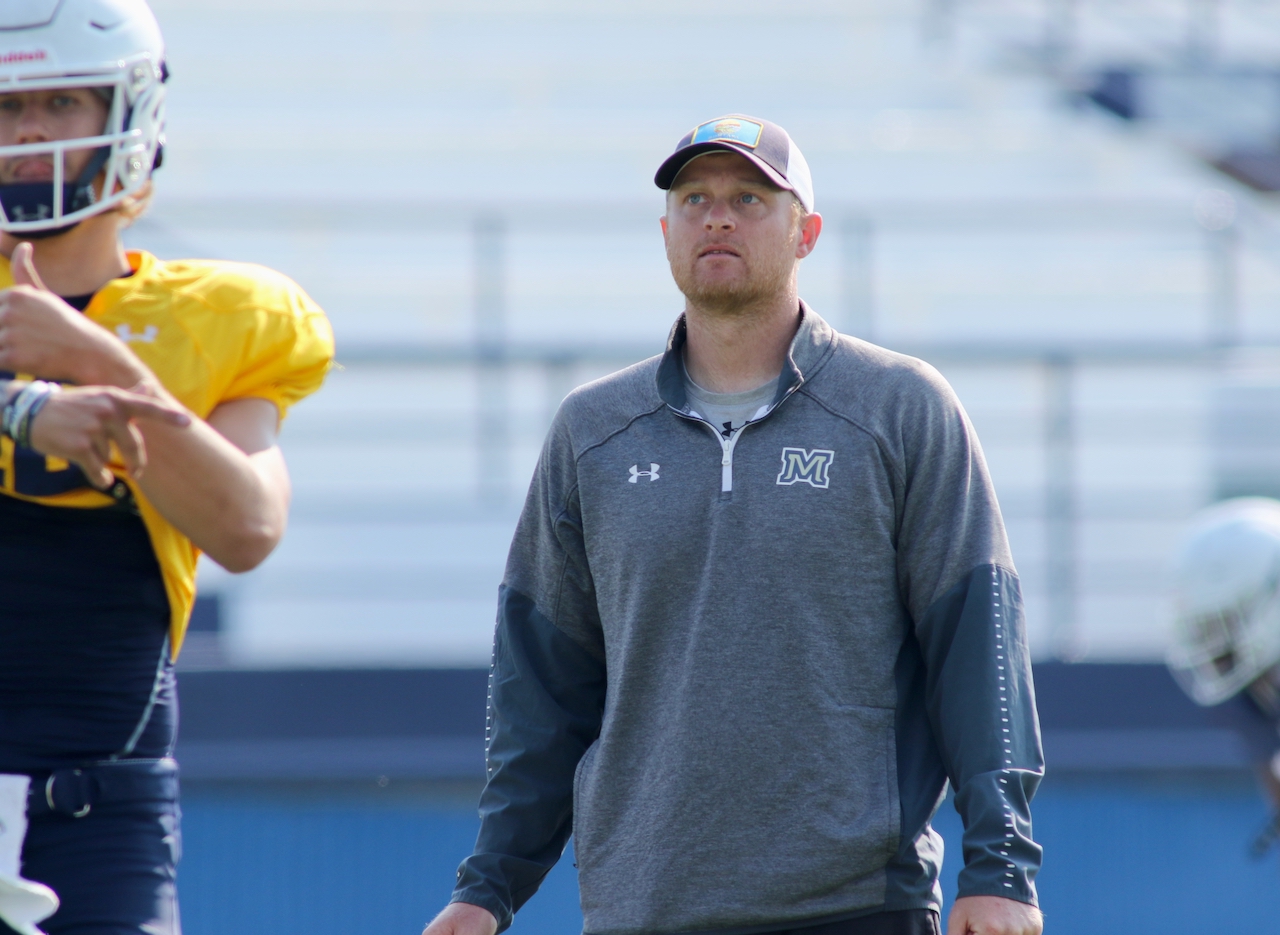
Housewright’s fingerprints all over revamped Montana State offense

BOZEMAN, Montana — Matt McKay almost seemed like he was going to fake a fake, then double clutched the football before deceiving the San Diego defense with a sort of false step that initially indicated he might be running a sort of quarterback power play.

Once the Toreros bit on the variety of deception, McKay stopped and tossed to a wide-open Elijah Elliott. The freshman running back raced to a 65-yard touchdown, watching himself all the while on the jumbotron in the North end-zone of Bobcat Stadium during the first touchdown run of Elliott’s young Bobcat career.

That score was the second touchdown of the first quarter by a Bobcat offense that is suddenly creative, diverse, innovative and efficient. That’s a far cry, in certain ways, from a team that has relied almost exclusively on a destructive run game and a fearsome defense that spearheaded playoff squads in 2018 and 2019.

Elliott’s touchdown came on a sort of run-pass option that took advantage not only of McKay’s deft ball skills but also the notion that Montana State can run the ball out of the shotgun between the tackles with its running back or quarterback; that the Bobcats are efficient while operating zone-read options and also have the element of executing RPO plays when the quarterback is the run in the RPO equation.

In other words, welcome to Taylor Housewright’s concept-based, diverse, read-dependent spread offense.

[restrict paid=”true”]

“Coach Housewright brings a lot of energy, wants to have a lot of fun, has a lot of knowledge in his head and he coaches us really hard because he wants the best out of us,” Montana State junior quarterback Matt McKay said.

“(Former offensive coordinator) Matt Miller was just a charismatic, fun guy to be around and Coach Housewright, he brings that even more,” added Montana State senior tight end Ryan Davis. “The change could’ve gone either way but the change has gone the right way. We are very blessed to have that.”

Montana State offensive coordinator Taylor Housewright/ by Brooks Nuanez

During the direction of five offensive coordinators in four seasons under former head coach Jeff Choate, Montana State bludgeoned opponents with a relentless rushing attack that led the conference in yards per game on the ground for two years in a row. MSU is the only team other than Cal Poly to lead the league in rushing since the Mustangs joined the league in 2012. Cal Poly, infamously, ran the triple option for more than 20 years between Rich Ellerson and Tim Walsh’s tenures leading the Mustangs.

MSU’s impressive rushing attack was accompanied by a passing game that peaked at adequate and average. McKay is the fifth opening day starting quarterback in five seasons for the Bobcats. T

he volatility in play calling and play-callers seems to be a thing of the past at Montana State, even if the sample size under Housewright is only three games old.

Montana State head coach Brent Vigen/ by Brooks Nuanez

“He’s done well,” Montana State first-year head coach Brent Vigen said as his team prepares to open up Big Sky Conference play on Saturday. “It’s a situation where it’s on the job training. You can simulate some stuff in scrimmages when no score is being kept, time is not going, you don’t have to get calls in in 40 seconds, 25 seconds, you aren’t dealing with the play clock. But to really deal with the ebbs and flows of the game that’s the challenge. You have to be help the quarterback from the press box and you have to be able to communicate with him.

“I’ve seen what I was looking for in Taylor. He’s innovative. We share a very similar philosophy about how offensive football should look. I think having worked with him, he understands me and I understand him. I’m pleased with him and I understand it’s a work in progress and I might have a greater appreciation of that work in progress being in that chair as long as I was.”

Through three games, Montana State is averaging 37.7 points per contest, third behind Eastern Washington (53.3 points per game) and UC Davis (44 points per game) among Big Sky Conference teams. The ‘Cats have averaged 432 total yards per game, including 191.7 yards per game on the ground, which ranks third in the league as well.

Cynics would say MSU’s offensive production is a product of playing consecutive teams from the non-scholarship Pioneer Football League at home. But Montana State has looked exponentially more diverse and balanced regardless of opponent, as evidence by nine touchdown passes, including two to tight ends. For reference, tight ends caught four touchdowns in Choate’s four seasons.

Montana State tight ends Derryk Snell and Treyton Pickering celebrate after a Snell touchdown in September of 2021/ by Brooks Nuanez

“Having a new OC in Housewright, the offense has changed a little bit and it’s been nice to be more involved in the passing game and to help out that way,” said MSU sophomore tight end Treyton Pickering, who caught a go-ahead touchdown, the first of his career, in MSU’s 19-16 loss at Wyoming. “All the tight ends are excited and everybody is thrilled to be more a part of the offense and be more dynamic.”

Last week when Montana State reached the red-zone during its first possession, the Bobcats lined up on the San Diego 7-yard line in a three-wide receiver set that also included a wing tight end. Left wide receiver Jayden Smith ran his man into the chaos in the middle of the field and McKay faked a handoff to Isaiah Ifanse, who had lined up behind Derryk Snell in a pistol formation.

McKay tossed to Snell, a tight end from Alaska, who walked into the end-zone untouched.

“He’s a very passionate guy, very upbeat, gets us going,” Snell said of Housewright during Montana State’s media day. “Today, we had a meeting and we were all laughing with him but when it comes to business, he’s serious so we are 100 percent on board with that.”

Housewright, a 32-year-old former All-American quarterback, grew up in Ashland, Ohio, where he then became as a three-year starter for the local Division II power, Ashland University. Growing up in Northeast Ohio, Housewright loved LeBron James and still follows the King’s Lakers.

Housewright also remembers seeing a Montana versus Montana State rivalry football game while “in elementary or middle school”. He said he remembered that exposure and that he always thought in the back of his mind that he “wouldn’t mind living in Montana.”

https://open.spotify.com/episode/1OFT0z4q9Wr2bzTVkwPguA?si=zWvRsT8DQ0mSXUU8Px5zyg&dl_branch=1

After finishing as a Harlon Hill Trophy finalist as a senior in 2012, Housewright started his coaching career as a graduate assistant at Miami of Ohio. He spent 2015 as the wide receivers coach at Division III Wittenberg before returning to his alma maters to coach receivers in 2016 and Ashland’s defensive backs in 2017.

He first crossed paths with Vigen as an offensive quality control assistant at Wyoming during the 2018 season when Vigen as in his fifth of seven seasons as the offensive coordinator on Craig Bohl’s staff for the Cowboys.

“I’ve been at D-III, D-II, low end of Division I or Group of 5, Power 5; I’ve seen every level thus far and where that really helps you is from a recruiting standpoint,” Housewright said in a press conference before MSU opened fall camp. “I know what a good Division III player looks like, what a good Division II player looks like or an All-American at both. Or a good group of five or Power 5 players.

Montana State offensive coordinator Taylor Housewright/by Brooks Nuanez

“It helps you to relate so you are not going after a guy who is not as good as he should be for that level to win championships.”

Housewright spent the last two years shadowing Joe Moorehead, one of the highest paid offensive coordinators in college football. The 47-year-old Fordham alum has made more than $900,000 a year between two-year stints at Penn State (OC in 2016 and 2017), as the head coach at Mississippi State (2018, 2019) where Housewright first signed up; and in 2020 as the offensive coordinator at Oregon.

“It was so impressive to see how hard he worked and that that level, to see what it looks like,” Housewright said. “It’s not that everybody doesn’t work that hard but you are on a bigger scale and when you are making the money he’s making, you can’t have those screw ups. “

The transition to the FCS is something that Housewright welcomes as someone that has experience in every level of college football.

“I think the coolest thing at this level is these guys get an opportunity to get scholarships and pay for their school but it still has that small college feel where guys are playing for the love of it,” Housewright said. “I think that’s the biggest thing: you get a D-III guy and he is paying full boat, busting his butt and still working as hard as a guy at Oregon on a yearly basis but he’s paying his own dime because he absolutely loves it.

“Then you go to Oregon and you got guys there that are five-stars, all this media and news hyping them up and I think sometimes the love of the game goes away. At the I-AA level right now, it’s the best of both worlds.

“We have our stuff but these guys are still grinding through it. It’s not like they are all over the news and SportsCenter and those things. Probably rarely do you have four or five star guys at this level unless it’s a transfer.

“But still really good players that develop and want to stay for four or five years and go from an 18-year-old kid who wasn’t going to Alabama at that age because they weren’t physically developed and in five years when they are 23, they have made huge gains. For you to see that and see them make that progress is definitely awesome.”

Montana State offensive coordinator Taylor Housewright/by Brooks Nuanez

The Bobcats will look to keep Housewright’s offense humming on the road this weekend. The Bobcats open Big Sky Conference play at Portland State, a place MSU has not played since 2018. That afternoon, Troy Andersen set a league record by rushing for 211 yards, the most ever by a Big Sky Conference quarterback in a single game.

No matter what Housewright has up his sleeve, it almost certainly won’t include an evolutionary Wing-T operated by a 240 pound running back and linebacker. Housewright is optimistic about the upcoming conference run because what he sees in the culture of his new team.

“Xs and Os, it doesn’t matter; if you have a good team, good players, a good culture, it doesn’t matter what offense you run,” Housewright said. “If you are all on the same page, none of that matters. If everyone knows that everything you are doing on a daily basis is for the best of you and your team and the program, that’s what you want.”

As much as Choate inspired his troops and got the most out of Montana State from a toughness and physicality standpoint, MSU’s offense had plenty of room for polish. And part of the change in philosophy comes with a prioritization on having a good time.

“Any time you can have fun, that’s what you are looking for,” MSU fullback R.J. Fitzgerald said. “The moment you stop loving football, you should stop playing it. If our mentality during the season is we are having fun, we are going to be able to put together a football team and that’s what Coach Housewright does.”

[/restrict]

Photos by Brooks Nuanez. All Rights Reserved.

Colter Nuanez

Colter Nuanez is the co-founder and senior writer for Skyline Sports. After spending six years in the newspaper industry with stops at the Missoulian, the Ellensburg Daily Record and the Bozeman Daily Chronicle, the former Washington Newspaper Association Sportswriter of the Year and University of Montana Journalism School graduate ('09) has cultivated a deep passion for sports journalism during his 13-year career covering the Big Sky Conference. In August of 2014, Colter and brother Brooks merged their passions of writing and art to found Skyline Sports.
Back to top button