


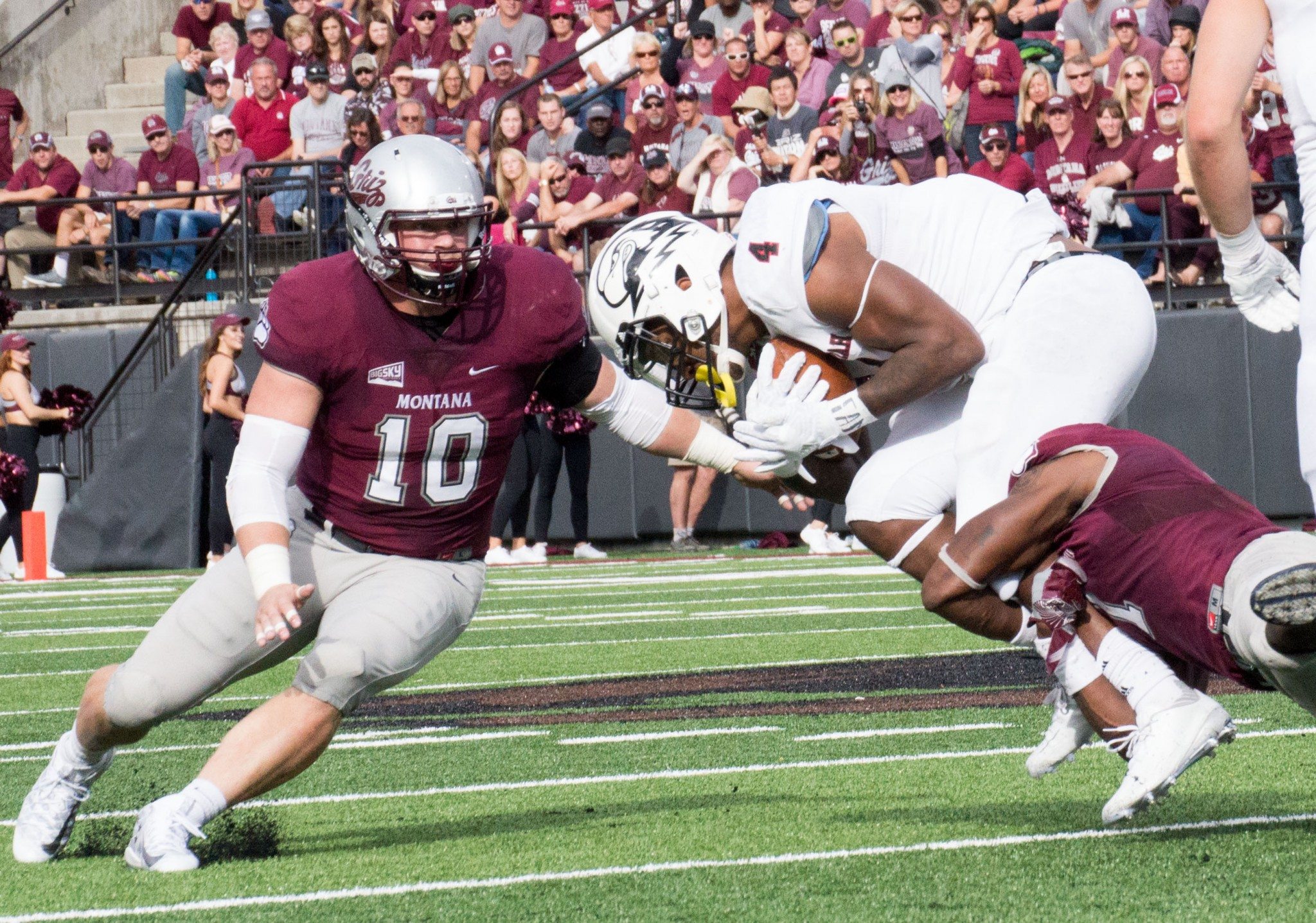
The plays came in what felt like an avalanche of yards as Montana Griz followers watching both inside Northern Arizona’s Walkup Skydome and through screens in their living rooms no longer recognized the defense that once engendered so much faith.
First came a 74-yard touchdown on the first snap of the game in Flagstaff. Then a 26-yard completion, then a 39-yard reception. Of the first five passes NAU senior quarterback Blake Kemp attempted during Northern Arizona’s 45-34 on October 22, four were thrown over the top of Montana’s defense.
Considering Montana entered the game atop the Big Sky Conference in pass yards allowed and opponent pass efficiency at the time, it seemed the Lumberjacks’ game plan was daring. But during the week of preparation it became clear to the NAU staff that they had just one option if they wanted to upset the 10th-ranked team in the nation.
[restrict paid=”true”]
“They were daring us to do it so we were going to do it,” NAU coach Jerome Souers said following his third win in four tries against Montana, a program he coached at for more than a decade before taking over at NAU in 1998. “That’s what our game plan was coming out. They are a stout defense. They are really good. We had to do the only thing we could which was throw our way out of it. (Junior wide receiver) Emmanuel Butler, Blake Kemp did a great job today.”

In the weeks following Montana’s loss to the ’Jacks, other teams have picked up their blueprint. Taking advantage of the Griz defense includes: quick passes, full slide protections with max personnel and double moves in route running that make it tough for defensive backs to cover. It worked for Eastern Washington and it’s array of receivers in a 35-16 win. It worked for Idaho State before quarterback Tanner Gueller was forced by injury to miss the second half of the Grizzlies’ 62-44 win.
And if one Big Sky coordinator is to be believed, it’s likely what 18th-ranked Montana will face this Saturday against Northern Colorado.
“I think Northern Colorado is going to be an interesting game because I do think they throw the ball well,” the coordinator, who interviewed with Skyline Sports anonymously, said earlier this week. “I think they could be an interesting challenge for them.”
That, in the estimate of various coordinators around the Big Sky, has become the only method for beating Montana’s ultra-aggressive defense: You must be able to throw the ball.
“You can’t just line up and run the ball because they have too many guys at the line of scrimmage,” said one Big Sky coordinator, “and their No. 37 (Caleb Kidder) is such a fantastic player that you can’t run the ball too much because he is going to disrupt so much up front. Then No. 10 (Connor Strahm), the linebacker, is such a great player and it’s just difficult to get to both of those guys on a run play.’
Montana’s defense mostly dominated its opponents during a 5-1 start and the defensive statistics were impressive. With a new-age approach designed by first-year defensive coordinator Jason Semore, the Griz were dragging quarterbacks to the turf as well any defense in the nation. They were plugging up the run game, even holding Mississippi Valley State to -61 yards rushing to set a school record. And most importantly they weren’t allowing points.

By the midpoint of the season, hours of film had piled up. Mostly, the film showed what opposing coordinators had already figured out: Montana was going to use various fronts, unpredictably attacking gaps to confuse offensive linemen and quarterbacks. It was sending six, sometimes seven pass rushers and relying on its defensive backs to smother receivers for the few seconds the front seven needed to get home.
For the most part it worked. But some coaches noticed the weaknesses have been developing.
“The disappointing thing about it is you get back and you watch the film and you are leaving some plays out there that you practice and you execute against the same looks,” Sacramento State coach Jody Sears said in the days after his team’s 68-7 loss at Washington-Grizzly Stadium. “There were a bunch of plays out there and we just didn’t execute. They are big and they are physical and they have a great scheme and they are going to do what they do and they are going to challenge you. … When you don’t execute, they sack your quarterback when you have a receiver running wide open.”
One Big Sky coordinator attributed some of the Grizzlies’ early season success to the defense’s overhaul under Semore. When he was the safeties coach for a year under previous Montana defensive coordinator Ty Gregorak, now at Montana State, the Griz were a base look, Cover 4 team that was built to bend but not break. He identified Northern Iowa as a team wholly unprepared for the changes.
Under Semore, the unit has begun to earn the reputation that it was either going to break you, or break under its own pressure.
“A lot of people have said that it gives off the vibe that they’re saying, ‘Well, we’re either gonna make you go three-and-out right away because we’re going to bring everybody or you’re going to score right away and the ball is going to get back in the offenses’ hands,’” the offensive coordinator said. “They always talk about that. They want a bunch of plays and all that (on offense) and I think that’s kind of what — it seems that’s what they’ve kinda been told: this is how it’s going to go.”
This was a realization Semore knew opposing coordinators would come to eventually and he has implemented some schemes to guard against it. Though they played primarily man-under coverage at NAU, the Griz have recently implemented some zone concepts to varying degrees of success.
“Previous two games we’re trying to do a little transition from man coverage and get some zone coverages installed and there is some growing pains,” said Semore, who identified Montana’s primary issue against the Bengals as tackling. Semore said the Griz had 14 missed tackles that allowed nearly 300 yards of offense.
The additions to the team’s coverage concepts are being used to prepare the Griz for possible playoff matches — if the Griz can make it that far. Semore sees the likes of Sam Houston State, South Dakota State, Lehigh and a possible rematch against Eastern Washington, which threw for 381 yards and four touchdowns against Montana.
But the Grizzlies’ focus hasn’t all been on the back end. In recent weeks, Montana’s pass rushers have been met with with a new problem to solve.
“We’ve been getting a lot of full-line slide and teams are keeping six or seven guys in there to combat our pass rush and our blitzes,” senior defensive end Ryan Johnson said Monday. “They’re getting the ball away quick so it’s tough on us to get home when guys are getting it off in 2 seconds.”
During its run through September and October, Montana consistently confused pass protections by employing various fronts. Sometimes it used four-down linemen, sometimes three and other times none at all. This was intended to keep blockers from identifying which defender it would block. But as teams have switched to full slides, that responsibility has been replaced and blockers now just have to stay true to their assigned gap.

“I think anytime you go against, what we would call a “max blitz team” people that bring more than 6 guys, the only protection you really can call is slide protection,” said one Big Sky coordinator.
While opposing teams locate the weaknesses in Montana’s scheme, the Griz are using the final two weeks — and the three prior — to add new wrinkles in the hopes that if they extend their season deep into winter, they will be prepared for what’s to come.
“If that’s what people are going to do with us, full slide with 12 personnel and max protect everything and two-man routes, you have to play some kind of zone coverage,” Semore said. “That’s something that we’re going to keep working on and keep getting better at.”
[/restrict]
Photos by Brooks Nuanez. All Right Reserved.


