


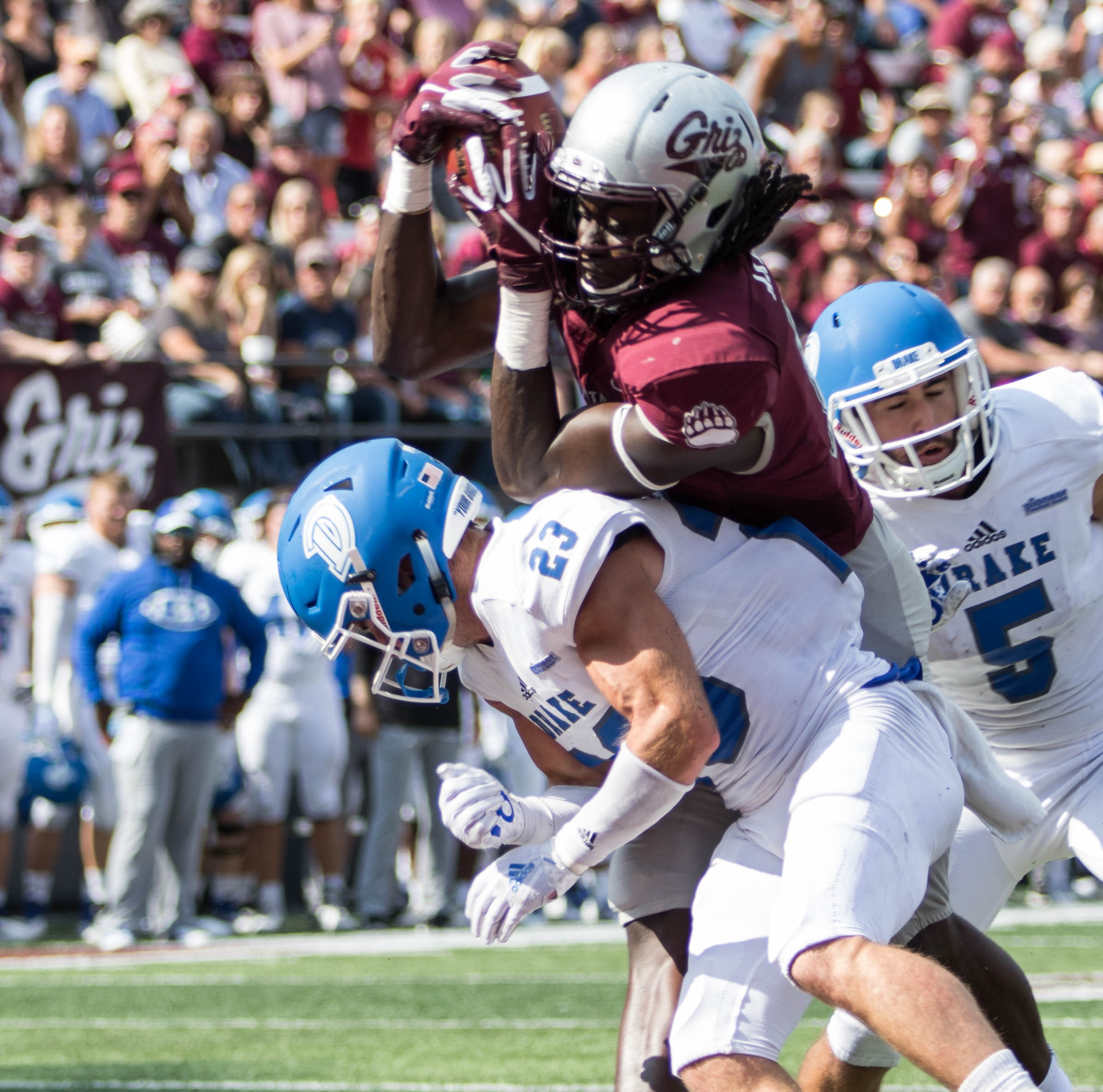
Montana

The highs and lows of Montana’s 2018 season have been striking

It’s no secret that the Montana Grizzlies have struggled with streakiness and momentum this year.

The stats are jaw-dropping.

The Griz have been quite good at times, outscoring opponents in a half 26-0, 38-13, 31-7 and 21-3, for a combined margin of 116 to 23.

When they’re bad, though, they’ve been atrocious. Montana has been outscored 46-0, 34-0, 23-0 and 13-0 in four difference halves of football this year, for a combined margin of 116-0.

It’s not a case of playing extremely bad or good opponents, either. Two pairs of halves on the list above came in the same game.

It just seems that the Griz have either flown high or nosedived this entire year, with no in-between.

Bobby Hauck was short when asked how momentum affected his team.

[restrict paid=”true”]

“I think you create your own [momentum], so we need to do that,” Hauck said at the weekly press conference.

Senior wide receiver Keenan Curran was a little more forthcoming when asked why the Grizzlies have so sporadically inconsistent.

“I think it’s just us putting it together completely,” Curran said. “There are games where the quarterback is playing phenomenal, and us as receivers, we’re not doing our jobs. … And I think a lot of it is we’re getting our chemistry still. I don’t want to say we’re in a new system, because at this point, it’s not new, but it’s still getting chemistry and getting trust between everybody.

“If you do have a game where your quarterback is playing lights out, and then your receivers aren’t, it fidgets with your trust a little bit. Your quarterback is like, ‘Okay, can I trust him?’ Or a receiver [thinks that] when he’s running and maybe doesn’t get the ball that he wants.”

Montana tight end Colin Bingham (88) celebrates a touchdown with teammates against Northern Iowa on September 1, 2018/by Brooks Nuanez

It’s been a season-long trend. In the first game of the season, Montana went up 26-0 on Northern Iowa in the first half but ended up surviving a comeback in a 26-23 win.

Against UC Davis last week, the Griz had the No. 6 team in the country on the ropes early, taking a 21-3 lead at halftime, but then got eviscerated in the second half, being outscored 46-0 and losing 49-21.

“When you feel that [the opposition] has momentum, we still have to make the little plays,” Curran said. “We still have to do the little things right. We feel like they’re coming back, and we’re like, ‘Hey, we need to make a big play or something like that.’ It [should be] like, ‘Hey, do the little things, keep our drives alive, make sure we’re making our third down catches, or we’re hitting the hole on our third down runs, or making the right reads.’”

It’s been a total team effort. When things go badly, the defense starts leaking points in a hurry, the offense can’t put drives together to keep them off the field, and the special teams can’t come up with a big play to put either in an advantageous position.

It all adds up to an avalanche of points going the other way, and it usually comes at the worst possible time for Montana.

The Griz have outscored their opponents in every quarter — except the fourth, when they’re being dominated, 98 to 60.

Against Davis, the Griz gave up points on seven straight drives in the second half, with six touchdowns. That could have put the offense in a shootout, but quarterback Dalton Sneed, who was 15-for-21 passing in the first half with two touchdowns and an interception, threw two picks and fumbled in the second half while experiencing constant pressure from UC Davis edge rusher Mason Moe and the Aggie defnse as Montana gained just 121 yards in the last 30 minutes of the game.

“Inevitably, the turnovers, every game that we’ve lost, we’ve lost the turnover battle, and it’s shown significantly, and that’s what’s led to the losses that have been on my shoulders,” Sneed said. “I think we just have to come out in the second half with the same energy as the first. We’re running around, having a good time in the first half, and then kind of let off the gas there in the second half.”

The quarterback is the most important player on the field, and the Grizzlies’ fortunes have often seemed to follow those of their mercurial signal caller.

Sneed plays with an apparent fire, and when he’s going well, that momentum can lead to scoring blitzes. When he’s not, though, things can spiral in a hurry. And the Griz need their quarterback to play well.

Six of his seven interceptions this season have been thrown in Montana losses.

“[When we’re struggling], just get back to the roots,” Sneed said, echoing Curran. “It starts off with hitting a throw or getting a run. I wish there was a definite answer for you, but there’s really not, as far as getting a spark, getting it clicking how you were in the first half.”

Curran said that the Griz can’t ignore momentum switches.

Montana quarterback Dalton Sneed clutching his right (throwing) shoulder/ by Jason Bacaj

“I think it’s a big part of all sports,” Curran said. “When a team starts to come back, they have that confidence. Their confidence is building, and so they’re thinking, ‘We got this, we got this.’ And our confidence, you probably see the little things, the little things start to slip, because we’re like, ‘Oh, we need to make a big play,’ or we need to do something big.”

There’s still a lot for Montana to play for. Three wins in three games would get them to 7-4 and at least force the FCS playoff committee to consider the Griz. Two would avoid the program’s second losing season since 1985. Plus, there’s always the 118th rendition of the fierce rivalry against Montana State.

But unless they’re able to play a full 60 minutes in their remaining games, all of that might be off the table.

Curran is optimistic that the Griz can find more of an even keel, keeping the good stretches and jettison the ugly ones.

“Have you heard of the Stockdale Paradox? … It’s basically, I think it was an admiral in the Navy, and he was a prisoner of war,” Curran said. “And what he did is he had a realistic optimism. So what that is, is knowing where you’re at, but knowing, hey, I’m optimistic about where I’m going. I’m optimistic that we’re going to win these three games, focusing on the Southern Utah one, but at the same time, I’m realistic about where we’re at. See ourselves on film, break that down, and then say, ‘Hey, what do we need to work on this week to correct what didn’t go right last week?’”

[/restrict]

Andrew Houghton

Andrew Houghton grew up in Washington, DC. He graduated from the University of Montana journalism school in December 2015 and spent time working on the sports desk at the Daily Tribune News in Cartersville, Georgia, before moving back to Missoula and becoming a part of Skyline Sports in early 2018.
Back to top button