


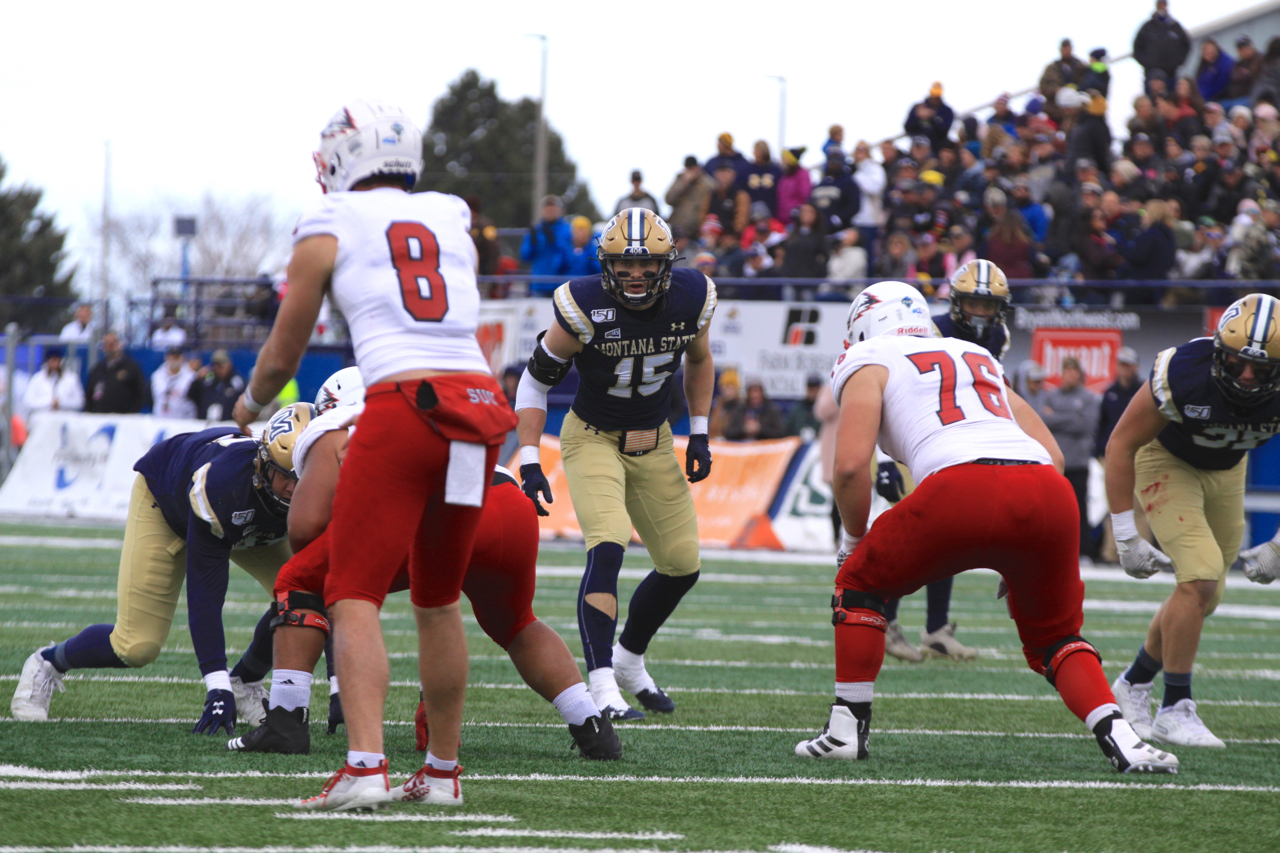
Montana State fall camp 2021

Six story lines to watch at Montana State 2021 fall camp

BOZEMAN, Montana — Replacing one of the most decorated and successful classes in program history is a tall task. Doing it under the direction of a new head coach and new offensive and defensive coordinators adds to that challenge.

That’s what scenario Montana State faces entering Brent Vigen’s first season at the helm. The former North Dakota State and Wyoming offensive coordinator takes the reigns of a team that made its first run to the semifinals of the FCS Playoffs since 1984 during the 2019 season.

Vigen took the job about six months before opening MSU’s first fall camp in the post Jeff Choate era. He brings new coordinators in offensive play-caller Taylor Housewright and defensive play-caller Freddie Banks, although most of the other assistants from Choate’s staff remains.

That change will be accompanied by the race to replace some of the best individual players in the history of Montana State football.

[restrict paid=”true”]

Mitch Brott started an MSU-record 50 games across the Bobcat offensive line, capping his career as a first-team All-American. Travis Jonsen, a former 4-star quarterback who started his career at Oregon, is now a Super Bowl champion Tampa Bay Buccaneers at wide receiver. If not for a global pandemic, fellow captain wide receiver Kevin Kassis might also be making money north of the border in the Canadian Football League.

Montana State safety Brayden Konkol (41) in 2019/by Brooks Nuanez

Belgrade product Brayden Konkol capped four years as a starting safety with first-team All-Big Sky Conference honors. So did Kalispell product Josh Hill, a hard-nosed inside linebacker. Bryce Sterk’s talents are so prodigious, the defensive end led MSU in sacks in consecutive seasons before getting a shot as a tight end in the NFL with the Miami Dolphins.

That’s not to mention the graduation of standouts like former Virginia Tech transfer safety Jahque Alleyne, multiple-year starting cornerback Damian Washington and unsung safety JoJo Henderson.

Still, Montana State harbors lofty expectations entering the 2021 season. All-American candidate seniors like linebacker Troy Andersen, offensive tackle Lewis Kidd, offensive guard Taylor Tuiasosopo, defensive tackle Chase Benson and defensive ends Amandre Williams and Daniel Hardy lead an exceptionally talented squad gunning for a third straight playoff appearance. A trip to the post-season would be Montana State’s seventh since 2010.

Roster overturn is the story of college football teams across the country. Learning a new way to win — Choate used the defined method of bludgeoning opponents with a physical, blue-collar style — under a new coaching staff is a less common, yet still common, endeavor.

“Our guys have worked tremendously hard this summer,” Vigen said during MSU’s media day the day before fall camp opened last week. “(Strength and conditioning coach) Sean Herrin and his staff, he was tasked when we got to May to get our guys positioned to be in a better place in August. And the work they put in with him in June and July, not only from a strength and conditioning perspective, but he really challenged them mentally. And I really appreciate their efforts.

“Excited to be in this place, excited to hit the field tomorrow and excited about 2021 for Bobcat football.”

Montana State opens the 2021 season on the road in, of all places, Laramie, Wyoming, the town Vigen made home for seven seasons.

Over the next month, Vigen and his staff will have a variety of questions to answer and positions battles to settle. Here’s a look at several of the primary story lines for Montana State during fall camp 2021.

Who will replace one of the most talented safety trios in the league?

Lost in Montana State’s impressive run to the FCS Final Four in 2019 was the fact that the Bobcats employed a more unorthodox defensive look that most even realized during that spurt.

Choate and defensive line coach Byron Hout helped install a 3-man front that emphasized athleticism on the edges of MSU’s front seven. But the final two months of the season, MSU also went with a three-safety look that helped get some of their best athletes on the field.

Brayden Konkol was a first-team All-Big Sky selection. Jahque Alleyne snared six interceptions in two seasons and showed some of the best ball skills in the league at the position. And Henderson was an unsung standout for the Bobcats.

“JoJo with his knowledge, ‘Que with his play-making ability, Konkol with being the guy he is, his aggressiveness, those are tough losses,” said MSU junior safety Ty Okada, who started half a dozen games at safety last season. “But I feel like we have the guys in place to replace them. They were the ones who set that foundation. And now we know what we need to do to prepare to do our jobs to do the best of our abilities. We learned that from them.”

https://open.spotify.com/episode/4QBL6EwcWahHfogow12uSw?si=0DN1X–mRLaWkorp7oGM_g&dl_branch=1

Okada will be one of the primary subjects expected to help replace the departed trio. Before Choate’s departure, he also helped bring in Jeffrey Manning, a 6-foot-1, 192 pound Los Angeles native who spent from 2017 until 2019 at Oregon State.

During 2018, Manning played in 12 games, starting two. He recorded 35 total tackles, including seven against Washington and five each against Arizona State and Washington State. He missed most of the 2019 season with an injury. Manning joined the Bobcats in January of 2020 and has been on campus for more than a year. He is the front-runner to start next to Okada.

Okada has risen through the MSU program since walking on from East Ridge High in Woodbury, Minnesota. He broke onto the scene when he started at nickleback during UM’s 35-14 win over Incarnate Word in the first round of the FCS Playoffs, the first post-season win of the Choate era.

As a sophomore in 2019, Okada started seven games, notching 15 tackles and two tackles for loss while recovering a fumble.

Montana State has recruited the safety position heavily in the last two recruiting classes so there are plenty of bodies waiting in the wings. Rylan Ortt, a 6-foot-1, 205-pound redshirt freshman from Missoula Sentinel, received the praise of Choate before Choate skipped town to Texas. The former high school quarterback has also received good feedback from Vigen and Banks as well.

Who will emerge other than Tyrel Thomas at cornerback?

Greg “Munchie” Filer III, a 2018 All-Big Sky selection, now plays at Sacramento State. Twins Ty’Rhae and Ty’Rese Gibson transferred out of the last season. Washington graduated.

That leaves senior Tyrel Thomas as the most experienced among a largely unproven group of cornerbacks.

Montana State cornerback James Washington (4) rushes a punt in 2019/by Brooks Nuanez

Banks’ new scheme will feature a four-man front and a five-defensive back look that is different than the 3-safety look MSU favored in 2019. Instead, the defense will feature a true nickleback. And Thomas will almost certainly be the main man at that spot.

“Tyrel Thomas will be playing nickleback,” Banks said. “Nickle now is a corner who can hold up in the box. Tyrel Thomas, that’s him. Thick guy, maybe be in the run fit, can get backs down consistently, could end up in the box with some motion adjustments but you can also keep him out of the box schematically.

“And he’s a guy who can line up and win one on one matchups with some of those slots. It’s a mix between toughness and athletic ability. Not everybody who plays cornerback play nickel. He’s got a unique skill set.”

Against heavier offensive sets, Tadan Gilman, a converted outside linebacker, will serve as Montana State’s “big” nickel.

The battle to man the outside will fall to a bunch of Bobcats who might not be household names yet. But the talent is there, at least according to Banks.

“The goal is that we leave camp as a disciplined group,” said Banks, a former North Dakota State corner who doubles as Montana State’s secondary coach. “We are talented but we have to be disciplined. We have to be able to execute at a really high level. If we can get that out of those guys, if we can end camp and we are a disciplined group, we have a chance to win a lot of football games.”

The front-runners to step into Montana State’s cornerback spots are sophomore Eric Zambrano, junior converted wide receiver James Campbell, sophomore Level Price or perhaps a freshman like speedy Miles Jackson.

Zambrano was thrust into action was thrust into action as a true freshman, playing in 14 of MSU’s 15 games in 2019. He made 10 tackles and broke up a pass. The 6-foot-1, 208-pounder received consistent praise from Choate. Banks has liked what he’s seen.

“EZ is a baby but EZ is going to be good,” Banks said. “He’s really talented, he loves football and he comes to work every day. He’s going to be really good for us.”

Price, a 5-foot-8, 190-pounder out of St. John Boscoe Prep like Thomas, played in 15 games and made 21 tackles.

Campbell is a 6-foot-1, 179-pounder from Palatka, Florida with speed to burn. The former high school quarterback has not been able to crack the rotation at wide receiver but has stood out on special teams. He switched to cornerback during the off-season and got starter snaps during the Sonny Holland Spring Game.

“James Campbell is probably the most impressive player coming out of the spring,” Banks said. “I swear he’s in my office every day watching film and learning little details. James made big strides during the spring. He was one of the corners who got all the reps. I don’t think he missed any reps. It was a big jump for him.

“Look for James to have a big fall.”

Jackson is a 5-foot-11, 185-pounder from Portland that helped Central Catholic High win the Oregon 6A state championship in 2019. He showed flashes of his significant potential during the spring

Who can replace Jonsen, Kassis as big-play threats & offensive leaders?

Although Montana State never had much of a penchant for throwing the ball during Choate’s four seasons at the helm, the Bobcats have recruited and developed several of the most talented receivers in the league over the last few years. Case and point: Jonsen, a converted quarterback, is in the NFL.

Replacing a prodigious talent like Jonsen is virtually impossible. Expecting a player to thrive like Kassis did during his four years as a starter and unquestioned leader of the Bobcats.

Montana State wide receiver Willie Patterson (11) in 2019/ by Jason Bacaj

But Montana State has options in spades at wide receiver even if many of those vying for snaps aren’t proven commodities.

Vigen mentioned senior Lance McCutcheon along with juniors Coy Steel and Willie Patterson as “players who actually have proven themselves to a certain extent.

“But I think there is talent beyond that that needs to continue to come along. That’s a situation where you are trying to pair eight, nine guys down to six. That receiver position has opportunities still out there.”

Steel fought through injuries during 2019, yet still started eight games. He was MSU’s third-leading receiver, catching 23 passes for 334 yards and four touchdowns. The former Wyoming Gatorade Player of the Year has played in 26 games between 2018 and 2019 since walking on to Montana State.

McCutcheon, a hyper athletic 6-foot-3, 202-pound Bozeman native, has been in the rotation since he was a true freshman. But the opportunities have been few and far between. He enters his senior year with 31 career catches and four career touchdown catches.

Patterson, a 5-foot-9, 175-pound sparkplug from Tacoma, caught 19 passes for 204 yards in 2018. He had seven catches for 59 yards in seven games in 2019 before an injury ended his season.

Three of the more talented young receivers Choate and his staff brought in were part of the last two recruiting classes. And Choate helped the Bobcats add Nate Stewart, a 6-foot-2, 200-pound graduate transfer from Akron who caught 76 passes for 1,1126 yards and five touchdowns during his time with the Zips.

The three youngsters primed to make an impact include a pair of cousins from Texas. Jayden Smith, a 6-foot-6, 206-pounder from Kennedale, caught a touchdown in MSU’s 42-7 win over Southern Utah in 2019 yet still maintained his redshirt. Charles Brown, Smith’s cousin and the first early enrollee in Montana State history — he graduated early from Arlington High — is a 5-foot-11, 170-pounder who might be the fastest offensive player on the Bobcats.

The other wide receiver who has turned heads the first week of fall camp is the other Patterson: Andrew Patterson, a true freshman from Desert Edge High in Goodyear, Arizona right outside of Phoenix. The 5-foot-10, 170-pounder hauled in 53 passes for 1,165 yards and 13 touchdowns, helping him earn offers from Colorado State, New Mexico, NAU, Idaho, New Mexico State, Washburn, Southern Utah, Gardner Webb, North Dakota, Abilene Christian, Weber State, Valparaiso and Fordham.

Although Justin Udy is a hold over from Choate’s staff, it’s worth noting that former wide receivers coach Erik Frazier is now interning in the NFL and Udy is coaching wide receivers for the first time after being hired following 2019 as the offensive coordinator.

Who will get carries behind Isaiah Ifanse?

Ifanse, the former Washington Gatorade Player of the Year out of Bellevue High outside of Seattle, is one of the most violent, fearsome running backs in the West. He has had some of the biggest rushing performances of the decade for the Bobcats, including a legendary 175-yard, three-touchdown performance in MSU’s 48-14 dismantling of rivalry Montana in November of 2019 in Bozeman.

Ifanse’s only obstacle has been his health. His aggressive, contact-seeking style has caused him to miss eight starts in his two seasons as MSU’s starting tailback. Yet he still enters his junior year 13th in Bobcat history with 1,838 career rushing yards.

Montana State running back Lane Sumner (24) vs. Southern Utah in 2019/by Brooks Nuanez

“Elite backs only have so much tread on the tires and Isaiah hasn’t made it through a whole season,” Vigen said at the Big Sky Kickoff in Spokane in July. “I think our continued development of depth there is a priorty.

“Having an elite back and an elite depth is important. If you want to be serious about running the football, you can’t be average back there.”

Vigen believes he has an elite back in Ifanse. And he is hoping he has elite depth for an offense that will lean on a veteran offensive line and an already established identity as one of the best ground games in the Big Sky.

“Running back-wise, it’s a situation where we have better depth there,” Vigen said. “We aren’t relying so much on putting the burden on Isaiah in particular.”

The primary subjects to get carries behind Ifanse include freshman DeMareus Hosey, a former 3-star recruit from Dallas who showed many flashes as a freshman who maintained his redshirt in 2019. It also includes freshman Elijah Elliot, a multi-faceted playmaker from Portland who was one of the breakout Bobcats during the elongated off-season. And it includes Lane Sumner, a speedy sophomore from Huntley Project who rushed for 424 yards and five touchdowns in 2019.

If Vigen’s offensive scheme follows the trends of his time at Wyoming, all of the above will get opportunities within Montana State’s offense this fall.

Can Bobcats survive with young specialists?

Perhaps the most unheralded player of the Choate era is Jered Padmos, a punter from Boulder who was a four-year starter and one of the best field position-altering players in the Big Sky Conference. 

Padmos rarely if ever made errors. He consistently flipped the field on opponents. Many would argue he was the MVP of the 2016 and 2018 Cat-Griz games in Missoula, each contest that ended in landmark wins for MSU. 

Montana State kicker Bryce Leighton (37) in 2021/by Brooks Nuanez

The place kicking under Choate wasn’t nearly as consistent. From the Luke Daly saga to solid but not spectacular play from Tristan Bailey, MSU’s special teams left something to be desired despite Choate’s ST acumen when he took the job. 

To replace Padmos, Choate and his staff landed Bryce Leighton, an Under Armor All-American who is the first national honoree of that sort to sign with Montana State. He is penciled in as MSU’s starting punter. 

“Bryce has a big leg and he’s mobile enough to do the things from a punt perspective that Jered was able to do,” Vigen said. “I think he’s a guy that, maybe not immediately, can be a game-changer from a field position perspective, his ability to turn the ball over. He’s diligent. They’re all young, but their approach is what you like.”

The kicking competition will also be headed up by a freshman. It remains to be seen whether that freshman is Luke Pawlak, a 5-foot-10, 180-pounder from Sylvania, Ohio who started his career at Kent State, or Blake Glessner, a 6-foot-2, 172-pounder from Woodinville, Washington who is the front-runner to be MSU’s kickoff specialist this fall. 

The long snapper is likely to be Tommy Sullivan, a 5-foot-11, 230-pounder out of Archbishop Murphy High in Everett, Washington.

“It’s a real diligent group, first off. It’s a group that hasn’t been here too long, hasn’t been on the game field for the Bobcats, but they understand they’re inexperienced and they’re getting there. 

“Bryce and Tommy don’t have immediate competition, but the important thing is to make sure they understand they’re competing against their own standard. With Luke and Blake, we’re making progress there. We haven’t really kicked off yet, but it’s going to be a daily battle for them. I like their approach, but we certainly have a ways to go.”

All MSU’s young specialists are talented. But talent won’t help athletes nail crucial field goals during road games like MSU has at Weber State or flip the field like Padmos did consistently in Missoula against the Grizzlies. 

How will MSU’s outstanding talents adjust to new defensive positions?

Williams was an All-Big Sky selection as a Buck end. Benson was an All-Big Sky defensive tackle pick while primarily playing nose tackle. Andersen was a first-team All-Big Sky pick while playing Sam outside linebacker. All of those players, along with senior Daniel Hardy and junior inside linebacker Callahan O’Reilly (MSU’s leading tackler in 2019) will be playing “new” positions in Banks’ 4-2-5 scheme. 

How will they adjust? Will Andersen be able to stay healthy playing inside the box for the first time? How will Williams and Hardy, a former outside linebacker himself, adjust to playing on the front four? Will Benson be as dominant playing multiple techniques?

Montana State linebacker Callahan O’Reilly (47) in 2019/by Brooks Nuanez

The good news for the Bobcats is that the talent levels of all the primary defensive players are among the best in the league. And MSU will have had seven months to adjust to the new coordinator and the new responsibilities.

“We’ve done a great job – the defense requires you to be a lot more disciplined with your eyes, being in the right spot because it’s very specific with where you need to be but also playing off of other guys, getting used to it on the back end seeing what your 4-tech is doing, seeing if he’s going in or out, playing off of him a lot of the times, we’ve gotten so much better at that,” Okada said. “On paper, it may look different than on the field but we make those adjustments on the fly.”

“At the end of the day, defense is defense and you’ve gotta run to the ball fast, tackle and make plays. I have no doubt we will be able to do that.”

Although Vigen, a former tight end at NDSU, has made his living for the duration of his coaching career as an offensive coach, including spending the last 12 years as an offensive coordinator, he has been a part of multiple programs that put a high priority on playing physical defense. 

Banks said he wants his unit to be “the most physical in the entire conference, which will give us a chance to be one of the most physical in the entire country.”

Vigen agrees and has similar goals for a unit that, if the talent coalescences, could be ferocious just like it was in 2019. 

“Accountability and trust, very similar words, but defensively in particular, that’s what we need,” Vigen said. “Everyone has a job to do. And you need to do one. You shouldn’t do two and you shouldn’t try to do two. And that’s a system. And we feel like we have a system that is sound and if executed correctly, will give us a chance to win a lot of football games.”

Montana State opens its season on September 4 in Laramie, Wyoming. 

[/restrict]

Photos by Brooks Nuanez. All Rights Reserved.

Colter Nuanez

Colter Nuanez is the co-founder and senior writer for Skyline Sports. After spending six years in the newspaper industry with stops at the Missoulian, the Ellensburg Daily Record and the Bozeman Daily Chronicle, the former Washington Newspaper Association Sportswriter of the Year and University of Montana Journalism School graduate ('09) has cultivated a deep passion for sports journalism during his 13-year career covering the Big Sky Conference. In August of 2014, Colter and brother Brooks merged their passions of writing and art to found Skyline Sports.
Back to top button