


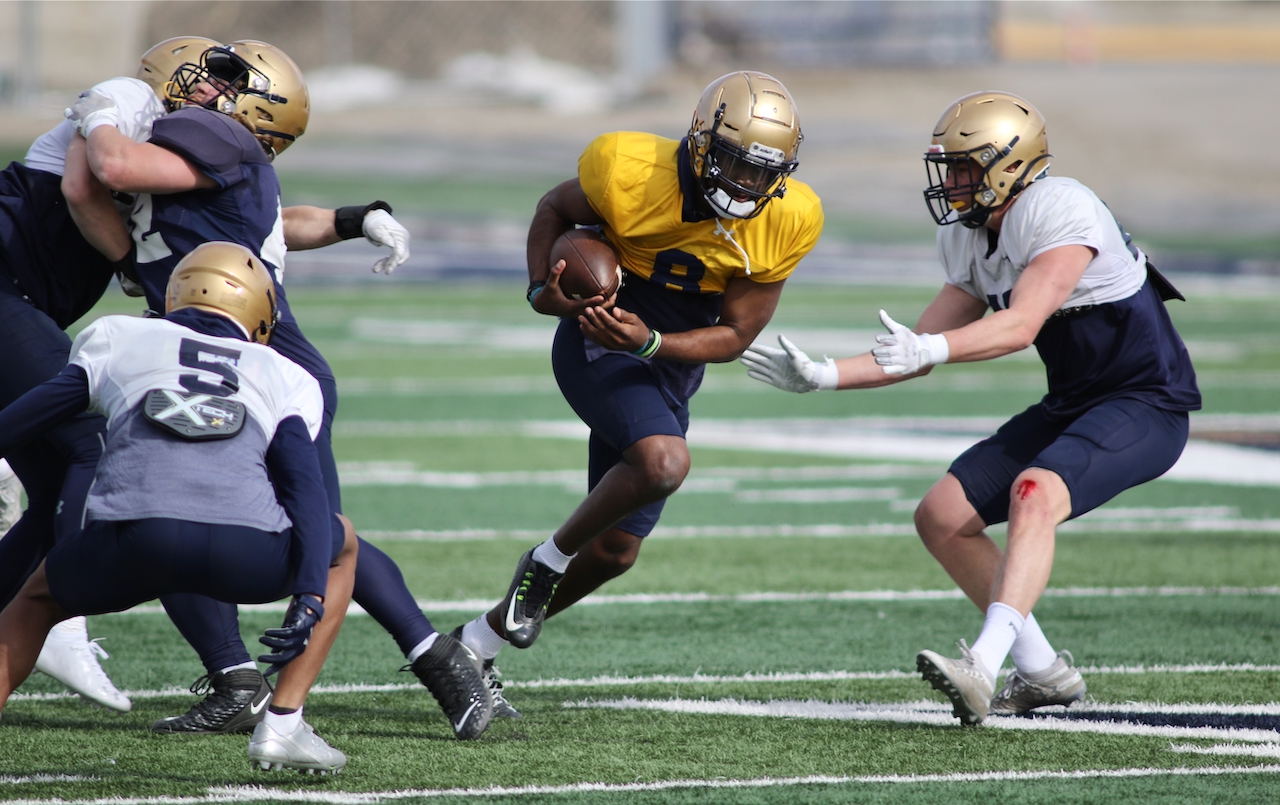
Montana State Spring Football

Bobcats acclimating to new practice style in first spring ball under Vigen

BOZEMAN, Montana — During a red-zone period on the first day of full pads of a new coaching era, Montana State’s quarterbacks threw touchdowns three times in the span of just a few minutes.

The method of scoring symbolized at least one of the differences as the Bobcat football team transitions to the leadership of new head coach Brent Vigen and his staff.

After Willie Patterson caught a well-thrown corner route for the third of the three passing scores early during Saturday’s two-plus hour session at Bobcat Stadium, a few of Patterson’s offensive teammates celebrated with him in the end-zone.

But new offensive coordinator Taylor Housewright and transitioning wide receivers coach Justin Udy (formerly the OC) had to holler at the rest of the offense to go dance with the confident slot receiver after the score.

It’s not as if veteran offensive linemen Lewis Kidd and Connor Wood don’t know how to revel in the fun of a touchdown. After all, the Bobcats scored 64 touchdowns during their run to the semifinals of the FCS Playoffs in 2019, the best playoff surge of the last 35 years at Montana State.

Rather, it’s all part of the process of learning how to practice football again. Since losing to No. 1 and eventual national champion North Dakota State on December 21 of 2019, Montana State has had as much time away from the field as any team in the Big Sky Conference or the FCS.
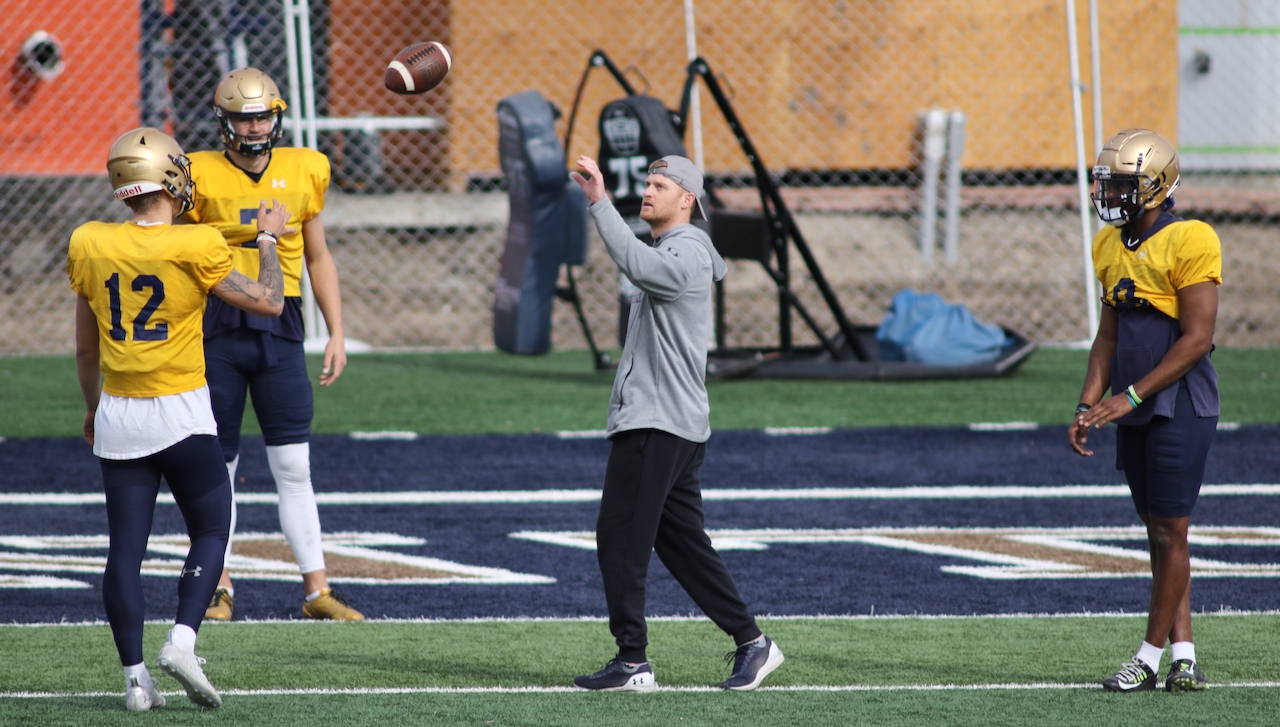
Montana State offensive coordintator Taylor Housewright coaching up quarterbacks Tucker Rovig (12), Casey Bauman (7) and Matt McKay (8)/by Brooks Nuanez

[restrict paid=”true”]

MSU did not engage in any football practices in the spring of 2020. Montana State had “fall ball” last fall but under a different coaching staff. And the last 16 months have been impeded by the global pandemic that has threatened to gut the core of small-school college football across the country.

In January, Montana State opted out of the championship portion of the current spring season that seven Big Sky Conference teams are participating in.

Weeks later, head coach Jeff Choate left to take the co defensive coordinator job on Steve Sarkisian’s staff. And in February, Vigen was hired as the 33rd head coach in the program’s proud history.

Saturday marked the completion of the second week of spring drills and the first full-contact, fully padded team session of Vigen’s second month leading the Bobcats.

Montana State’s players are tasked with adjusting to a new style — Vigen’s disposition is more tempered and steady than the passionate yet sometimes volatile Choate — while learning new schemes offensively and defensively.

Montana State head coach Brent Vigen looks on during a team drill/ by Brooks Nuanez

And more than anything, these current Bobcats are simply trying to figure out how to practice again, both in the operation asked by the coaches and in general after taking such a substantial amount of time off from the gridiron.

“When a kid goes from high school to college, I think they just roll with it and they accept it (practice) is going to be different. When you have a coaching change at the college level, you are so ingrained in one way of doing things that it takes time to learn a new way,” Vigen said from his office following Saturday’s session. “I think kids these days can work with ‘this is what we want to do,’ but they also want to know why.

“We’ve done a lot to say not only, ‘This is how we are going to do it’ but also, this is why. As we’ve practiced now for two weeks, they are figuring out the why and understanding the method of how we want to do things. They are starting to see the results and that’s when kids really start to buy in.”

Vigen, who spent the last seven seasons as the offensive coordinator at Wyoming, retained seven assistant coaches from Choate’s staff.

Brian Armstrong is back for his fifth season at Montana State coaching the offensive line. Special teams coordinator and director of high school operations B.J. Robertson has also been at MSU since Choate was first hired. Cornerbacks coach Kyle Risinger began his full-time coaching career as a defensive assistant in Choate’s first season in 2016.

“The strangest thing — and the kids went through it as well, and we chose to get into this profession so we understand things like this come and go in this profession — but going back all the way to Christmas, the Boise State position came up for Coach Choate and we got through that limbo period, exhaled, and then the opportunity for Texas,” Robertson said. “It ended up being a longer limbo than any of us expected.

Montana State special teams coordinator B.J. Robertson/ by Brooks Nuanez

“But Coach Vigen, he’s a small-town football guy from Buxton, North Dakota, played nine-man and I played eight-man (Sheridan) so he understands that rural part of Montana. He really fits the state of Montana.”

Linebackers coach Bobby Daly, a former All-American linebacker for the Bobcats, and Nate Potter, a former NFL offensive lineman who played at Boise State when Choate was an assistant there, were in their first seasons as position coaches during the 2019 season.

Justin Udy, who was hired as offensive coordinator following Matt Miller’s departure to Boise State upon the completion of the 2019 season, is now coaching wide receivers but has not coached a game at MSU. Jimmy Beal, who played for the Bobcats in the mid-2000s, has been the running backs coach since the same off-season Udy was hired, but has yet to coach a game as well.

“As a coach, if you work in a system for any extended period of time, you get ingrained in those methods,” Vigen said of the retained coaches. “If you bounce around, you are maybe more adaptable. But a bunch of the guys have been on this staff for awhile. At the same time, they are soldiers and they will do what they are tasked to do. No question, it has been an adjustment.”

Since his hiring, Vigen has added a pair of new, young coordinators — Taylor Housewright will coordinate the Bobcat offense while Freddie Banks will coordinate the MSU defense, as well as a new defensive line coach in Shawn Howe.

New Montana State defensive coordinator Freddie Banks/ by Brooks Nuanez

Without delving too much into schematics for a team that is dead set on keeping as much of its play-calling a surprise heading into the 2021 season, the way the Bobcats operate on both sides of the ball will be distinctly different. And that might alter the identity of a program that has hung its hat on playing smash mouth football, employing a bruising running attack and a suffocating defense.

Housewright is likely to run an offense that is more personnel based while Banks is implementing a more traditional 4-3 defense that will be a big transition after MSU employed an odd-man front the last four seasons that featured some of the most talented edge players in the conference.

“Your first time around as a coordinator, you figure out pretty quickly it’s not about calling plays as much as it is about working with a bigger group,” Vigen said. “Whether it’s working with the staff on the other side of the ball — and I’ve been really pleased with both Taylor and Freddie and their ability to work with their respective staffs — but then it’s about getting in front of that whole group as opposed to just your position group like you might’ve done in the past.

“They are different personalities. They need to be themselves. They have high expectations; a high bar and we want to continue to climb to that bar on the other side of the football. It’s a work in progress but to this point, I’ve been pleased with both of them.”

Montana State quarterback Matt McKay/ by Brooks Nuanez

Both Matt Miller’s offense and Kane Ioane’s defensive schemes in 2019 were at the same time complex in their pre-snap deception and simplistic in their post-snap requirements. As the Bobcats try to adjust to running Housewright and Banks as the primary play callers, Vigen knows there will be a learning curve.

“With a new system general on both sides of the football, you generally are taking a step back on the front end,” Vigen said. “Hopefully, we’ve seen it through two weeks and even before that when we were meeting and walking through, our progress has been pretty consistent.

“You start talking about the fundamentals of blocking and tackling, that’s the thing to me that needs to continue finding a better level of consistency. We will tackle more as time goes on with the two scrimmages.”

Montana State still employs personnel along its offensive and defensive lines, particularly on the offensive front, that should help the Bobcats remain one of the Top 10 teams in the country next season barring injury or disaster.

The offensive line returns a collection of talented veterans, headlined by All-American candidates Kidd and Taylor Tuiasosopo. Kidd was an All-Big Sky selection at guard in 2019 but is now working in at offensive tackle. Tuiasosopo was an All-Big Sky guard in 2019 but took significant reps at center, although he left practice Saturday with what appeared to be a ding to his shoulder.

Montana State senior end Amandre Williams battles junior Connor Wood during spring practice in 2021/ by Brooks Nuanez

Junior Zach Redd has spent time at guard and center but worked mostly at guard on Saturday. Junior Connor Wood, who was an All-Big Sky tackle as a sophomore, is now working at guard. Cole Sain, a transfer from Riverside Community College who started his career at Montana, could also challenge for a job at an interior position while redshirt freshman T.J. Sessions is also a candidate to start at offensive tackle.

On the defensive line, MSU must replace All-American Bryce Sterk off the edge while also adjusting to players like Amandre Williams and Daniel Hardy playing with their hands on the ground. John Clark, a graduate transfer from Washington, has retired. But senior Chase Benson should be one of the best interior players in the league and the eventual return of All-American Troy Andersen (he’s recovering from off-season surgery) will bolster the front seven.

“What we are realizing is we have good players on both sides of the ball that are going to make each other better and going against each other more and more is the best tool any one of them have individually,” Vigen said. “We are a little nicked up on the defensive side right now. We have guys playing new positions who are playing well through two weeks. We have two groups who want to accept that responsibility as being among the team’s best.”

By the second Saturday of April, the Bobcats will have three weeks and eight practices under their collective belts as MSU enters the second half of its first spring ball under Vigen. The new head coach hopes his team begins to turn a corner and is able to play faster each time they take the field.

Montana State junior Ty Okada tackles freshman running back Elijah Elliott/ by Brooks Nuanez

“The charge every day is knowing we are going to make some mistakes but let’s correct those and go out and play a little faster the next day,” Vigen said. “My goal for next week is we will have eight practices underneath us, which is a good chunk of our installation. Come Saturday, we can pull the coaches off the field. There will be no barking out instructions before plays. The guys will just be out there playing. I’m looking forward to that.”

[/restrict]

Photos by Brooks Nuanez. All Rights Reserved.

Colter Nuanez

Colter Nuanez is the co-founder and senior writer for Skyline Sports. After spending six years in the newspaper industry with stops at the Missoulian, the Ellensburg Daily Record and the Bozeman Daily Chronicle, the former Washington Newspaper Association Sportswriter of the Year and University of Montana Journalism School graduate ('09) has cultivated a deep passion for sports journalism during his 13-year career covering the Big Sky Conference. In August of 2014, Colter and brother Brooks merged their passions of writing and art to found Skyline Sports.
Back to top button