


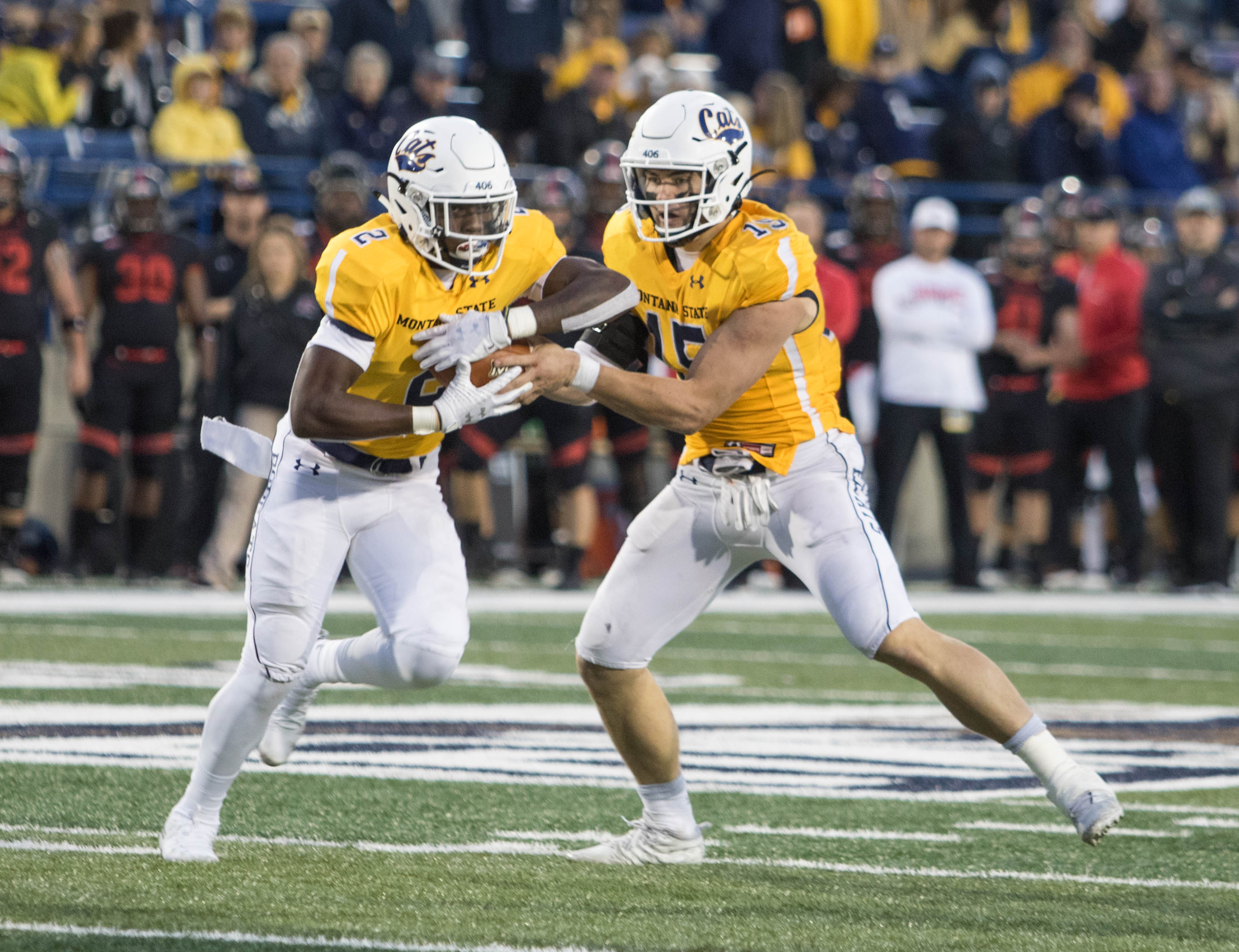
Editor’s Note: This story is the part of a four-part mini-series that will be included in a short series on the Montana State football program despite the cancellation of spring football practices across the Big Sky Conference. Quotes provided through exclusive interviews by Skyline Sports or provided by Montana State sports information.
Spring football practices seem monotonous for upper classmen who simply want to maintain health and sanity entering the final years of their careers. But the 15 practices each spring allotted to teams across the Big Sky Conference, the FCS and college football as a whole provide important evaluation opportunities for coaching staffs across the country.
Spring football also elicits excitement among fans and a chance for media outlets like this one to observe, evaluate and analyze the composition of a roster. Many players who spent the previous season either sitting out as redshirts or waiting their turns as young players get their first live reps. And often times those reps come against some of the best players on the “varsity”.
The Montana State Bobcats won 11 games last year, advancing to the semifinals of the FCS playoffs for the first time since 1984. That team was led by a talented senior class, many who grew up in Montana, a key factor in helping MSU reach a crescendo in Jeff Choate’s fourth season at the helm.
The Bobcats return All-American do-everything senior Troy Andersen, who has earned an array of accolades on both sides of the football during his three years as a Bobcat. MSU also returns All-Big Sky Conference players like senior offensive linemen Taylor Tuiasosopo and Lewis Kidd, junior right tackle Connor Wood and junior tailback Isaiah Ifanse.
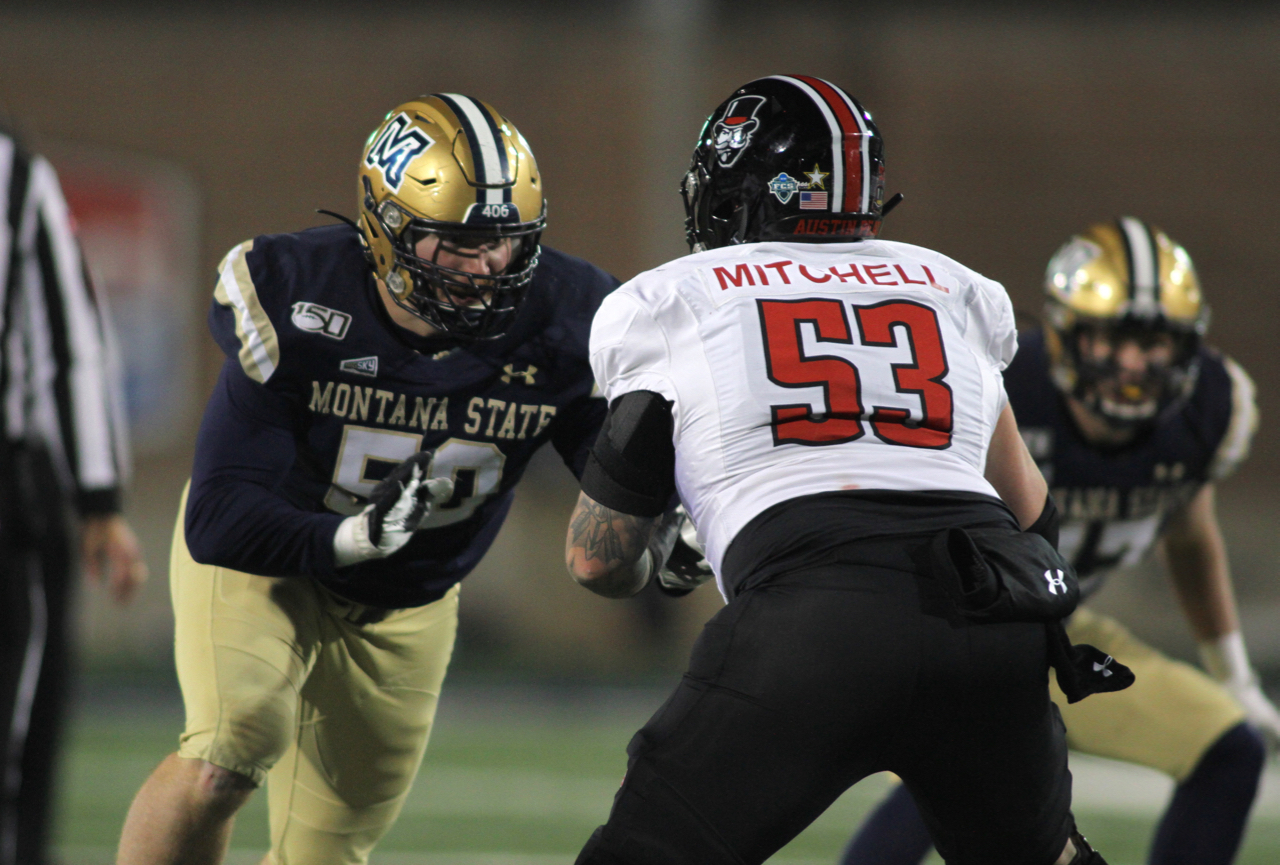
The MSU defense returns all-league tackle Chase Benson, all-conference outside linebacker/Buck end Amandre Williams plus experienced corners Munchie Filer and Tyrel Thomas, all of whom will be seniors.
But the Bobcats must replace several players who won’t soon be forgotten by those who follow MSU football. Montana State needs a new starter at left tackle after All-American Mitch Brott started 50 games in a row.
Montana State will also be in the market for a replacement for first-team all-league defenders safety Brayden Konkol and inside linebacker Josh Hill along with second-team all-league picks tackle Derek Marks and end Bryce Sterk. MSU also needs to find replacements for steady cornerback Damien Washington and athletic safety Jahque Alleyne.
Offensively, MSU returns most other than Brott and competitive, athletic captain wide receivers Kevin Kassis and Travis Jonsen.
Although Montana State’s spring football session (slated to start on March 30) has been cancelled, those within the Big Sky coaching ranks remain optimistic that the 2020 season will take place despite the world being shaken by the COVID-19 pandemic.
Here’s a look at the players Skyline Sports were most intrigued to watch during spring drills, players that will need to have good off-seasons to help Montana State continue driving forward as a national FCS force during Choate’s fifth season at the helm.
[restrict paid=”true”]
Bobcats to watch – Offense
Matt McKay, quarterback, junior
Montana State will have a quarterback competition during fall camp for the fifth August in a row. And McKay, a 6-foot-4, 211-pound transfer from North Carolina State, figures to play prominently in that battle.

During Choate’s first season, transfer Tyler Bruggman lasted half a season before getting the hook in favor of 17-year-old true freshman Chris Murray.
Entering 2017, Murray had to hold off redshirt freshman Tucker Rovig. Entering 2018, Rovig couldn’t take advantage of elevated opportunities to beat out Murray during spring ball. His confidence faded again in the summer and fall camp. Andersen ended up winning the starting job with Murray not able to participate because of academic issues.
Last season, redshirt freshman Casey Bauman got a leg up for the starting job over Rovig coming out of the spring, then won the right to start MSU’s opener at Texas Tech by beating out Rovig during fall camp.
By the fourth week of the season, Rovig was the starter. He led MSU to a 9-3 record by throwing for 1,969 yards, 15 touchdowns and five interceptions.
The 6-foot-7, 235-pound Bauman returns as a sophomore still ripe with potential, particularly when it comes to arm talent. So does Rovig, although the upside isn’t as great. But Choate and his staff still elected to bring in McKay to compete.
To complicate MSU’s cancellation of spring drills, the Bobcats are trying to work in a fifth offensive coordinator in five seasons as well. Justin Udy takes over his first Division I OC job but will not have a spring ball to get his feet wet or get accustomed to his three main quarterbacks.

During five games as a starting third-year sophomore at N.C. State last season, McKay threw for 910 yards with three touchdowns. He also had 25 rushes for 63 yards and four TDs before being replaced. The exit of multiple offensive coaches from head coach Dave Doern’s staff combined with the surge of freshman Devin Leary caused McKay to look for a fresh start.
McKay found his way to MSU because of a previous connection with former Bobcat quarterback DeNarius McGhee, an assistant on Choate’s staff the last three seasons before taking a job with the Houston Texans earlier this year.
McKay will certainly be in the mix with Rovig and Bauman for the starting job. Do the current Bobcats follow his lead this summer? Can the quarterbacks work together if MSU is allowed to practice in big groups during the weeks and months leading up to the season? It will be a pivotal factor to giving the Bobcats a leg up heading into fall camp.
“We will provide some structure for them,” Choate said when asked about player-run practices, a responsibility that usually falls to veteran quarterbacks. “You are always going to give them a framework to work with. Tucker and Casey too, they both have been through this and have both been the primary leaders in how the structure was going to go and keeping the time and keeping everyone on task so the practice flows with good rhythm.
“I think Matt is like that too. He’s a football junky. He started five games at N.C. State and I’m sure he was responsible for running those there. I don’t get hung up on that. I think if we give these kids the right structure and set the expectations the right way, they are all capable of leading.
“The good news is, if you would’ve asked me that question three years ago, I would’ve been terrified. But right now, I feel pretty good about our guys.”

Montana State has been one of if not the best rushing teams in the league four years running. With six players with starting experience on the offensive line returning plus the presence of Ifanse, DeMareus Hosey, Lane Sumner and Shane Perry, MSU should be prolific once again.
But Udy has said multiple times already that one of his primary goals for the Bobcats this season is to add a consistent down the field passing game to compliment the bruising rushing attack. And for that, the quarterback position, particularly how McKay fits into the mix, will be crucial for MSU.
“There’s no doubt in my mind that the quarterback position has to lead us in 2020, and those guys have approached it like they’re are going to be able to do that,” Udy said in an MSU press release.
DeMareus Hosey, RB, redshirt freshman
Montana State knows exactly what it loses from its offensive backfield. And the Bobcats have a pretty darn good idea of what they return.
The only somewhat unknown is just how talented is Hosey, a highly recruited, athletic running back from Dallas who played in four games last season while still maintaining his redshirt.
The Bobcats’ rushing attack led the Big Sky Conference in yards per game 258 ypg, including 275 in Big Sky play), a statistic made even more impressive by the fact that Ifanse was never really healthy and neither was Andersen.

MSU must find a replacement for explosive big-play running back Logan Jones, who finished his senior season with 915 yards on 147 carries (6.2 yards per rush) and scored nine total touchdowns.
Even with Ifanse (813 yards, 6 TDs) on the shelf for most of the first half of the season and Andersen (7 rushing TDs) either lightly used or put on the shelf the second half of the year, Lane Sumner (424 yards, 5 TDs) and Shane Perry (226 yards, 2 TDs) each proved to be more than adequate options.
Karl Tucker II transferred to Montana Western in the off-season. But most of the rest of MSU’s ball carriers, tailbacks or otherwise, return for an offense that gave 20 individual players rushing attempts.
In his limited action last season, the 5-foot-10, 200-pound Hosey looked both explosive and smooth. He showed excellent vision on zone-read option and gap scheme plays, using his natural one-cut ability to get into the second level consistently on his 24 carries.
He finished the season with 116 rushing yards, averaging 4.8 yards per carry. He had his best outing in a 38-17 win over No. 13 Southeast Missouri, rushing six times for 21 yards, including a nine-yard touchdown that gave MSU a 17-10 lead it would not give up.
During his prep career at Northwest High School in Justin, Texas, Hosey rushed for 3,393 yards and 41 touchdowns over his junior and senior seasons. He rushed for 1,933 yards and 26 scores his senior year alone, earning second-team all-state honors from the Texas Associated Press.
If he could add a consistent explosive element to MSU’s run game, he could be a deadly compliment to Ifanse & Co.
Unproven wide receivers —
On paper, the three position groups that lose the most from the Bobcat roster: the defensive line, wide receiver and safety. The defensive line must find replacements for Marks and Sterk. Konkol and Alleyne along with fellow senior JoJo Henderson made up the best safety trio in the Big Sky.
But the combination of elite leadership and pure athletic talent that MSU’s senior captain wide receiver pair encompassed is going to be tough to replace.
Last season, captains Kevin Kassis and Travis Jonsen brought Montana State’s previously non-existent passing game to life, making Rovig look good often down the stretch. Kassis in particular had a knack for making gigantic plays when MSU needed them most while Jonsen’s diverse abilities made MSU’s offense the most complicated in the league for opposing defenses to prepare for.
Jonsen rushed for 526 yards and eight touchdowns while catching 55 passes for 580 yards and scoring another TD to earn first-team All-Big Sky honors as an all-purpose player. The former Oregon and Riverside College transfer also was a standout special teams performer and a quiet leader for a playoff team.
Kassis finished with 67 grabs for 871 yards and six touchdowns. He also rushed for 39 yards and a rushing touchdown in the beatdown of the Grizzlies. He was the consummate leader by example and leader by spoken word, inspiring his teammates with his speeches and his spectacular catches all throughout his final season with the ‘Cats.

Despite those graduations, Choate loves the returning group for second-year wide receivers coach Erik Frazier. Coy Steel was one of the breakout sophomores in the league before an injury really slowed him the second half of the year. The former Wyoming Gatorade Player of the Year caught 23 passes for 334 yards and four touchdowns while averaging 10.9 yards per punt return last season despite the injuries.
Lance McCutcheon has been a big play waiting to happen the last three years but it’s rarely happened; yet he enters his senior year still looking primed for a breakout season. Choate commented on McCutcheon’s improved leadership skills when asked about the group. And renewed health should also get sophomore slot Willie Patterson back in the mix.
But it’s a group of upstart inexperienced wide outs that has Choate excited as he gages if his staff’s recruiting prowess can pay off on the perimeter.
Junior James Campbell, a speedy former high school quarterback from Florida, has emerged as MSU’s top special teams gunner. But he has never received an offensive touch of consequence.
Junior Tyrone Marshall transferred from Riverside College before last season. The last month of 2019, he emerged as the catalyst for MSU’s jet sweep motions, a concept that helped the Bobcats rush for 451 yards in a 45-14 win at Northern Colorado. Marshall rushed for 64 yards in that game. He also rushed eight times for 81 yars and a 29-yard touchdown in the destruction of Montana.
But Marshall only played in four games, maintaining his redshirt. He and Campbell will be a part of an unproven group that also includes three players — redshirt freshmen Jaden Smith and Jamahd Monroe along with true freshman early enrollee Charles Brown — who will all be in competition for spots in the rotation.
“Kevin and Travis will be difficult to replace but I feel like our group is more talented,” Choate said. “Jayden Smith, I look at him and think, ‘That guy is going to be a superstar.’ We just don’t have a body of work on him.

“Charles Brown, probably the fastest guy in our program right now. It will be really fun to see what that kid could bring to the table. Those guys are guys I had my eye on during the spring.”
Monroe, a 6-foot-2, 210-pounder who MSU coaches and his teammates call Peanut, came to Montana State from Lincoln High in San Diego. He showed flashes of his combination of size and skill during his first fall camp last August.
The 6-foot-6, 194-pound Smith and the 5-foot-11, 173-pound Brown are first cousins from the Dallas- Fort Worth metropolitan area. During his career at Kennedale High, Smith was a standout basketball and possession receiver who’s football statistics did not match up with his potential because his team ran the triple option.
During his senior year at Arlington High School, Brown took full advantage of the program’s shift to a more wide open offense. He caught 58 passes for 1,322 yards and 16 touchdowns. He graduated early so he could participate in a spring football session that never came.
Kassis and Jonsen are difficult to replace. But if any combination of MSU’s unproven wide receivers can break out simultaneously, Choate could be right.
Young offensive tackles
Before Choate even arrived on the scene, Montana State set a priority and made a habit of developing more stability at its tackle positions than perhaps any team in the Big Sky Conference. Under the tutelage of longtime offensive line coach Jason McEndoo, Brent Swaggert was a four-year starter who started 48 consecutive games at offensive tackle for a career that ended in 2004. He gave way to multi-year starter Jeff Hansen, among others, who gave way to Mike Person, a four-year starter who earned All-American honors in 2010.
During the 2010s, McEndoo helped mentor four-year starter Alex Terrien and three-year starter Conrad Burbank, each who earned All-American honors at tackle during their careers, although Terrien started at every position on the offensive front.

McEndoo helped recruit and coach four-year starters J.P. Flynn, a starter at right tackle as a freshman and a multi-time All-American at guard in following years, and John Weidenaar, an All-American his final two seasons of four as a starter at left tackle.
Weidenaar started 49 straight games at left tackle, breaking Swaggert’s record as a senior the year after McEndoo took an assistant position at Oklahoma State.
While Weidenaar anchored the left tackle spot for four straight seasons, Dylan Mahoney started for all the games he was healthy from his sophomore year through his senior season in 2016.
That same season, Mitch Brott broke into the starting lineup at right tackle. Four years later last fall, Brott capped his career by making his 50th consecutive start during an All-American senior season. He played left tackle the final two years of his career after Mahoney graduated.
Over the past decade in particularly, MSU has typically groomed its future left tackle at right tackle early in their careers before making the switch.
One question that looms this upcoming season: will junior Connor Wood, an All-Big Sky pick at right tackle last season, move to the blind side? The 6-foot-5, 315-pounder out of Boise is a prototype right power tackle. Improved athleticism could allow him to play on the left side. But is it the right fit?
Junior Dylan Porter, a 6-foot-5, 295-pound former transfer from Nevada and senior Jake Sessions, a 6-foot-5, 305-pounder out of Colstrip who started games at guard and right tackle last season, might be in the mix for one of the tackle spots, particularly on the right side if Wood can play on the left. Both are more suited for either right tackle or an interior OL position.

MSU might also want to groom one of its younger, athletic offensive tackles if any are physically ready and throw them into the fire in the fall, just like what happened to Weidenaar, Mahoney and Brott.
T.J. Sessions, a 6-foot-4, 288-pounder out of Vista Murrieta High in Southern California, is an athletic, powerful, aggressive and relatively polished prospect who was the talk of fall camp early on last August. But he tweaked his knee, missed the rest of the camp session and redshirted.
Joey McElroy, an athletic 6-foot-4, 286-pounder out of Missoula Loyola Sacred Heart who originally came to Montana State as a tight end, worked his way onto the two-deep last spring. The two-way all-state prep football player and two-time all-conference prep basketball player has smooth footwork and good pop at the point of attack. Can he bounce back from a knee injury that required surgery that ended his redshirt freshman season?
Jack Vering is a 6-foot-6 former 3-star prospect from Boise who chose Montana State from among a collection of offers from around the region. His current listed weight on the MSU online roster is 245 pounds, which is 10 pounds less than the weight he signed at. He’ll likely have to be above 270 or 275 pounds to have any shot to compete at either tackle spot. But Vering is a talented if not raw prospect with a long, lean frame that could make him an excellent project if he can put on the mass.

Jacob Kettles, a 6-4, 289-pounder who grey-shirted before joining the program in the winter, could be in the mix if he can rebound from a knee injury that cost him most of his senior high school season and delayed him joining the MSU program until January.
Montana State’s offensive line returns Tuiasosopo, Kidd and Sessions as its seniors. MSU also welcomes back stud juniors Wood, center/guard Zach Redd and tough-nosed center Denver Krone. Potter served as MSU’s “sixth or seventh offensive lineman” down the stretch of last season, according to Choate.
But the emergence of one of MSU’s prized tackle recruits could continue a trend and fortify an already talented group.
Ryan Lonergan, tight end, redshirt freshman
Entering last season, a big question mark centered on replacing the tight end trio of Connor Sullivan, Curtis Amos and Wilson Brott. That tight end trifecta each filled specific roles in MSU’s run-heavy offense. None were significant threats in the passing game but each helped open things up for Kassis and Jonsen and each came up huge in MSU’s diverse rushing attack.
Last season, Ryan Davis emerged as the power blocking tight end. Now the 6-foot-3, 255-pounder from Billings is a senior. R.J. Fitzgerald emerged as a punishing blocker at the H-back/wing tight end spot previously occupied by Amos. His ability to lead block and effectively execute his assignments after deceiving defenses with pre-snap motions helped MSU use an array of ball carriers while keeping Fitzgerald on the field despite no offensive touches.
As a redshirt freshman, Derryk Snell caught nine passes for 84 yards and a pair of scores. The 6-foot-2, 245-pound former Alaska Gatorade Player of the Year was a target for Rovig like no other tight end has been during the Choate years, although the position has been used more in run blocking than in a passing game that has been a work in progress the last four seasons.

That’s where Lonergan comes in. When he came out of Bozeman High, Choate called him the most talented, highest upside in-state prospect in the Class of 2019. The 6-foot-4, 225-pounder is an impressive athlete with a fluid running ability, good footwork honed in part during his time as an all-state prep basketball player and a pair of soft hands that helped him dominate the competition his senior year of high school.
During fall camp last August, Lonergan showed he can stretch the field, win 50/50 balls, convert first downs over the middle and line up all over the formation. He played out of the slot, as a wing, as an H-back and as a true tight end in August.
If he can find a role and add a pass catching, explosive element to the position it marks yet another factor that could help the Bobcat passing game take the next step.
[/restrict]

