


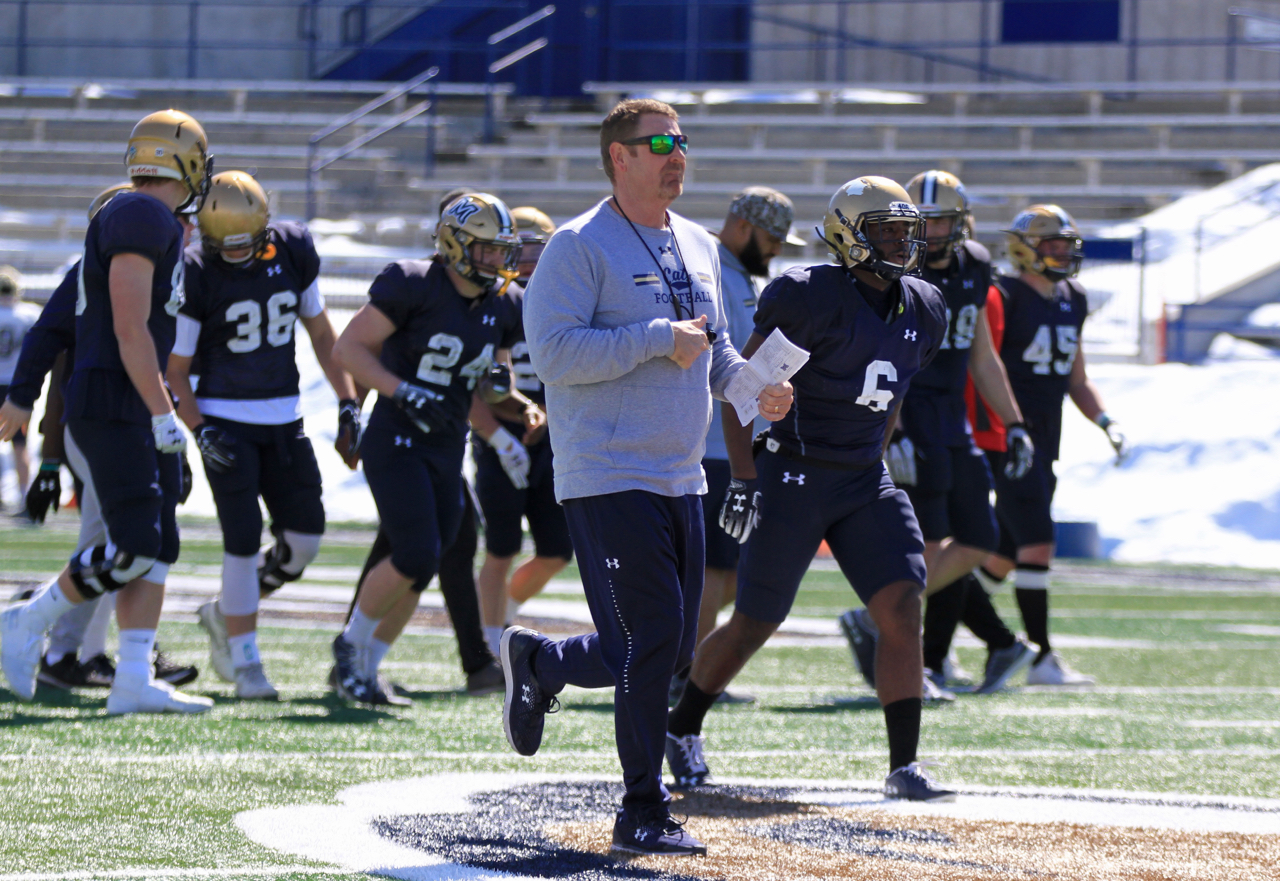
Editor’s note: With the exception of the quotes from Montana State head coach Jeff Choate, the other quotes used in this story were provided by Montana State sports information director Bill Lamberty. Montana State was scheduled to start spring football practices on March 30 before the Big Sky Conference cancelled all spring sports activities last month.
BOZEMAN, Montana — As Montana State battled the elements in Bozeman for most of last spring, Jeff Choate made sure to reinforce his stance that he by and large wished the structure of playing football in March and April wasn’t considered necessary.
This spring, for much more dangerous elements completely out of Choate or anyone else’s control, Montana State did not conduct spring football. The Big Sky Conference announced the cancellation of all spring sports championships and activities just a few days before MSU was slated to open spring practices on March 30.
During a one-on-one interview with Skyline Sports on March 23, Choate expressed concern for his players’ academic standings given the cancellation of classes on the Montana State campus. He acknowledged his team’s desire to connect with each other and workout together, two things that will not be allowed in big groups for the foreseeable future given the COVID-19 pandemic that is owning the day across the globe.
But Choate also did not complain or bemoan the fact that his team will not navigate the 15 allowed spring practices granted by the NCAA, even though many teams in the Big Sky Conference did get some spring ball in and two schools — Portland State and UC Davis — completed the session.
[restrict paid=”true”]
“It’s well documented what I think of spring ball,” Choate said. “Last year, we got a whopping eight practices in and one of them, we literally walked out on the field, it was so ice, we walked back in and we counted it as a practice. And we had a spring game so on paper, we had nine. But in reality, we were out on the field eight times and some of those were cut short, some of those were helmets only.

“I don’t know how much you retain, I really don’t. With our quarterback situation, it would’ve been nice to get a little bit of a pecking order going into the summer but we aren’t hung up on it. I’m not. You know who likes spring ball? Freshmen and sophomores. That’s who likes spring ball. Everybody else, I’m good.
“Nobody is really going to get that much so I don’t think that matters at all. What you do in March, I don’t really think that is going to show up and help you in December, I don’t think.”
In Choate’s fourth season, Montana State went on its best run in 35 years. The Bobcats capped a 9-3 regular-season with a 48-14 lambasting of rival Montana, a statement that also gave MSU its first four-game winning streak over the Griz in more than 40 years. That victory over the No. 3-ranked team in the FCS also helped Montana State earn a first-round bye in the FCS Playoffs.
The fifth-seeded Bobcats easily handled Albany in the second round and Austin Peay in the quarterfinals to advance to the semifinals for the first time since MSU’s 1984 national title season.
For the duration of Choate’s tenure, the Bobcats have improved their overall talent through recruiting and development. Last year’s MSU squad had one of the best offensive lines in the country, one of the most fearsome defenses in the nation, and a rushing offense that led the Big Sky in yards per game on the ground because of brute strength and diverse schematics.
Choate’s tenure has also been trademarked by Montana State’s revolving door at quarterback and a seemingly constant stream of offensive coordinators and quarterbacks coaches. In 2018, Troy Andersen willed MSU into the playoffs despite the fact that he was recruited to play and won Big Sky Freshman of the Year playing running back and linebacker.
In 2019, Casey Bauman won the starting quarterback job but held it for just three games. Tucker Rovig started for 12 games, turning a corner after MSU’s 16-12 loss at North Dakota to help the Bobcats to six straight wins.
During the recruiting season, Choate and his staff lost offensive coordinator Matt Miller, who took an assistant coaching job at Boise State, his alma mater. And the Bobcats added Matt McKay, a former 4-star recruit who started five games at North Carolina State two years ago before the Wolfpack got a new offensive coaching staff.

Andersen will certainly not be in the mix at quarterback next season — he earned first-team All-Big Sky honors at outside linebacker despite also playing offense sporadically — but the Bobcats do have an usual situation at quarterback. And MSU doesn’t get a spring ball to work out some kinks.
That means MSU will go into the summer with four players with Division I starting experience at quarterback, including three who will be in the mix for the starting job in fall camp if the global situation returns to normal.
“We will provide some structure for them,” Choate said when asked about player-run practices, a responsibility that usually falls to veteran quarterbacks. “You are always going to give them a framework to work with. Tucker and Casey too, they both have been through this and have both been the primary leaders in how the structure was going to go and keeping the time and keeping everyone on task so the practice flows with good rhythm.
“I think Matt is like that too. He’s a football junky. He started five games at N.C. State and I’m sure he was responsible for running those there. I don’t get hung up on that. I think if we give these kids the right structure and set the expectations the right way, they are all capable of leading.
“The good news is, if you would’ve asked me that question three years ago, I would’ve been terrified. But right now, I feel pretty good about our guys.”
Three years ago, MSU’s quarterback prospects were even murkier than they are now. Tyler Bruggman, a former transfer who made stops at Washington State, Louisville and Scottsdale Community College, had just left the program. Chris Murray, a transcendently athletic yet immature and sporadic leader, was entering his true sophomore season. And Rovig was coming off a redshirt season.

This spring, Justin Udy — a rising coach in the business who spent three years total with head coach Matt Wells as an analyst, the first two at Utah State and last season at Texas Tech — was hired as Choate’s five offensive play caller and fifth quarterbacks coach (not always one in the same) over the last five seasons. Udy has had to work with his quarterbacks via video conferencing web-based meetings.
“It’s been a challenge,” Udy said in an MSU press release. “I think there’s always an initial learning curve, but we’ve been able to get through that this first week back from spring break. We all have a better feel for what we need to do to be successful and productive.
“It’s been refreshing for me. The biggest disappointment is that we want to see those guys compete against each other and right now it’s in a different format, but it’s been great to see how those three guys have responded and the approach they’re taking with what’s going on right now.”
Despite MSU’s constant overturn at quarterback and on Choate’s offensive staff, the head coach and his assistants have created a culture where empowered leaders are featured in every position group. Aside from the quarterback spot, MSU’s spring ball was going to give Choate a chance to evaluate Udy’s scheme plus check out a variety of position battles — particularly at safety, wide receiver and defensive line — that will be crucial to observe leading up to the scheduled opening of the season.
MSU must find replacements for first-team all-league safety and captain Brayden Konkol, first-team all-conference middle linebacker Josh Hill, second-team all-league sack master Bryce Sterk, and second-team all-conference captain Derek Marks defensively.
MSU must also find replacements for wide receiver captains Kevin Kassis and Travis Johnson, along with 50-game starter and first-team All-American left tackle Mitch Brott. Although starting running back Isaiah Ifanse returns to lead a deep group in the backfield, slashing tailback Logan Jones will also be hard to replace.

Last season, Montana State went 11-4, equaling its best win total (tied with 2012) for the most wins by a Bobcat squad since its last national championship. Choate rattled off a list of players he was disappointed to not get to watch during spring ball, mostly younger Bobcats who play positions that will have intense battles come fall camp.
But as MSU enters the fifth season under his leadership, Choate continues to profess that culture and instilled leadership skills are more important to his program’s progress than any other factor.
For his first three seasons at the helm, Choate put forth his vision in great detail and, steadily, achieved each landmark. But last season, despite the memorable run to the FCS Final Four, MSU left several goals on the table. That’s what motivates Choate during these uncertain times.
“It’s pretty easy because Team 122, what they did last year, we get nothing for that,” Choate said. “We start with that: this is about Team 123. Let’s erase what happened a year ago and get what we need to accomplish now.
“The other thing that I tell them is we have our pyramid, our goals and one of our goals was undefeated at home. Well, we didn’t do that. Sac State beat us at home. One of them was Big Sky Conference champs. We didn’t do that. We dropped that game at North Dakota and that cost us a share of the league title.
“Our team didn’t accomplish the things we wanted. There are still things out there for us to do. And the standard will not go down. We are just going to keep raising the bar.”
[/restrict]
Photos by Brooks Nuanez. All Rights Reserved.

